ISHN logo
search
cart
facebook twitter linkedin youtube
  • Sign In
  • Create Account
  • Sign Out
  • My Account
ISHN logo
  • NEWS
    • Today's News
    • Global Safety News
    • Government Regulations
  • PRODUCTS
    • Product Innovations
    • Featured Products
  • TOPICS
    • Environmental Health and Safety
    • Facility Safety
    • Workplace Health
    • Occupational Safety
    • PPE
    • More Topics
  • CONSTRUCTION
  • TECHNOLOGY
  • COLUMNS
    • Best Practices
    • Dave Johnson: What’s going on
    • Editorial Comments
    • Leading Safety
  • MULTIMEDIA
    • ISHN Podcast
    • Videos
    • Cold Stress Education Quiz
    • Webinars
    • White Papers
  • MORE
    • Buyer's Guide
    • Newsletters
    • Convention Companion
    • Polls
    • Events
    • ISHN Store
    • Sponsor Insights
  • EMAGAZINE
    • eMagazine
    • Archived Issues
    • Contact
    • Advertise
  • JOIN TODAY!
PPE

Critical environments make demands on disposable gloves
By Dave Shutt
06107_F2_pic.jpg
June 1, 2017

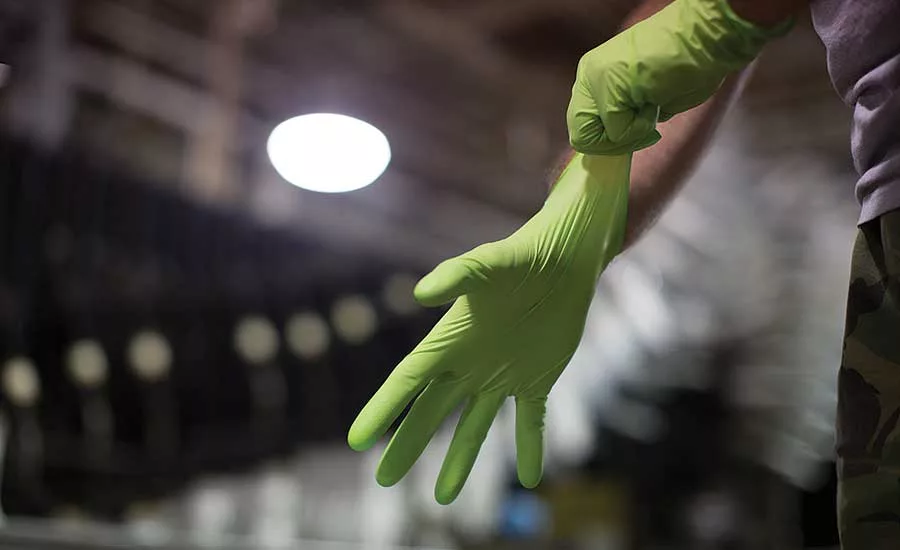
Industrial process environments where workers must wear PPE gloves are becoming increasingly controlled. While protecting the wearer from chemical exposure, gloves for cleanrooms must not introduce any contaminants into the space.

The evolving standard for these applications is powder-free, silicone-free, latex-free gloves such as single-use, disposable nitrile-based products that undergo a chlorination treatment, a deionized water wash and cleanroom drying and packing. The level of particles – most of which emanate from human skin, clothing and hair – and extractables must be kept to an absolute minimum.

Tasks and risks dictate design

Working with flammable liquids and gases, for example, calls for gloves that prevent electrostatic discharge (ESD) or buildup, which can damage electrical components and even ignite those flammable fluids. Laboratory workers, as well as those in the food and automotive industries, need thicker gloves – in the 8-mil range – to resist chemical penetration or permeation.

Multiple-length glove options have become necessary as well, given that handling hazardous chemicals (e.g., chemotherapy drugs) makes a longer-length glove better for covering more of the forearm – including overlapping the sleeve – and keeping it safe from exposure

The advantages of nitrile

Critical process environments also demand that people handle products with the greatest of care. Obviously, spills and drops can cause breakage or infiltration that can contaminate the environment or product. Disposable nitrile rubber gloves afford the gripping dexterity and fatigue-lessening comfort and feel that sharply reduce the risk of clumsiness and accidents.  (Finger movement flexibility is superior to latex, making these gloves a good fit for pharmaceutical applications such as vaccine and enzyme production.) Since they also offer better abrasion resistance than latex, they’re a safer bet for maintaining critical environments that must be free of RNA, which is more likely to degrade than DNA and is readily sloughed off human skin.

The industry continues to improve on groundbreaking material, such as technology to increase the tensile strength of nitrile cleanroom gloves so that they have enhanced barrier protection and puncture resistance. Nitrile gloves with minimal electrostatic current are relatively new options for preventing ESD harm to sensitive manufacturing tools and machines.

Importance of comfort

While its imperviousness to punctures and chemical, biological and radioactive substances make it a preferred disposable glove material for cleanrooms and other controlled environments, nitrile’s real benefit is comfort. Glove makers often apply vanguard nitrile-based manufacturing processes to hybridize the protection of nitrile with the touch sensitivity of rubber latex. 

Since cleanroom workers usually wear cumbersome garments, apparel manufacturers are looking for ways to make them less restrictive and permit easier, more nimble motions. Gloves that require less direct hand and forearm muscle exertion fit the bill.

Rigorous test and standards

The qualification of gloves for cleanroom usage in high-tech manufacturing environments involves rigorous testing to ensure that the gloves can protect products from contamination or ESD. A new industry report describes how dipped film gloves may be subjected to contact stain and near-contact stain tests. The test glove material is placed in a temperature/relative humidity chamber and held against or close to the product. The materials pass muster if they are free from stains, discoloration or corrosion and then undergo objective laboratory tests that measure for extractable particles, ions and organic elements.

Cleanrooms have different designations to mark their levels of cleanliness – e.g., Class 1, Class 10, Class 100 – and industry standards stipulating maximum allowable numbers of particulates per cubic foot for those designations. So, it’s important that the gloves chosen for cleanroom use have particle counts that aren’t greater than the maximum standard for that facility.

Acceptable Quality Levels (AQLs) are numerical product standards that health authorities stipulate for medical gloves. It’s one more way in which the bar has been raised for critical environment-safe gloves.

The norm used to be that a medical glove had to have a 1.5 AQL. Now, it’s likely down to .65 — effectively, more than cut in half — in most facilities. Whether it’s a medical device area, cleanroom or pharmaceutical lab, the demands have risen across the board.

Role of packaging

Glove packaging is no less important than glove materials and properties in ensuring the gloves’ acceptability for cleanrooms and other critical environments. Since uncoated chipboard dispenser boxes can throw off particles and contaminate gloves, dispenser-boxed gloves that protect the wearer are free of powder but not particles. They also may contain additives or fillers that reduce the surface resistivity to ESD and compromise glove cleanliness.

Gloves that are flat packaged, doubly-poly bagged and vacuum-sealed, with all cuffs at one end (to avoid contaminating bare hand contact with any glove part except the cuff), lessen the packaging risk to pristine maintenance of environments in which all atmospheric and material factors must be strictly controlled.

KEYWORDS: eco-friendly Hand Protection

Share This Story

Looking for a reprint of this article?
From high-res PDFs to custom plaques, order your copy today!

Dave Shutt coordinates Showa Best Glove’s new product development in general purpose, disposable and chemical-resistant glove lines among research and development, field sales and marketing teams, as well as distributor and end-user customers. A 20-plus-year veteran with industry players such as Reichhold, he most recently served as central region manager for Best Manufacturing, prior to the integration of Showa Japan and Best. He holds a degree in business administration from Malone College and is a Carnegie Graduate.

Recommended Content

JOIN TODAY
to unlock your recommendations.

Already have an account? Sign In

  • forklift safety

    Exploring the latest technologies in forklift safety

    With more staff and more stock in warehousing now more...
    Workplace Training Strategies
    By: Josh Cramer
  • welding

    All about welder’s flash or arc eye

    A flash burn is a painful inflammation of the cornea,...
    Environmental Health and Safety
  • dangerous jobs

    The 10 most dangerous jobs in the U.S.

    On-the-job deaths have been rising — hitting the highest...
    Government Safety Regulations
    By: Benita Mehta
Manage My Account
  • eMagazine Subscriptions
  • ISHN Newsletter & Other Newsletter Alerts
  • Online Registration
  • Manage My Preferences
  • Subscription Customer Service

More Videos

Sponsored Content

Sponsored Content is a special paid section where industry companies provide high quality, objective, non-commercial content around topics of interest to the ISHN audience. All Sponsored Content is supplied by the advertising company and any opinions expressed in this article are those of the author and not necessarily reflect the views of ISHN or its parent company, BNP Media. Interested in participating in our Sponsored Content section? Contact your local rep!

close
  • man wearing the the Sundström SR200 Full Face Mask Respirator
    Sponsored byOHD

    5 Fit Testing Mistakes That Could Cost You

  • This image shows Magid AcuSpex polarized blue mirrored safety glasses.
    Sponsored byMagid Glove and Safety

    Construction PPE Guide: What Crews Need for Each Task

  • lone worker in confined space
    Sponsored byAlphasense Ltd.

    GET THE LEAD OUT of your Safety Oxygen Sensors!

Popular Stories

chemical safety

It Was Just Sugar: Catastrophic Safety Failures in Louisville

Workers in high-visibility clothing descending stairs in an industrial facility.

Faster evacuations and lower operating costs with the SST Series Solution from WatchGas Detection

men working on a construction site in the summer heat

Heat Illness Prevention Begins Long Before Temperatures Rise

top 10 most dangerous jobs

Events

July 21, 2026

When Dust Becomes a Disaster

In this webinar, attendees will gain a foundational understanding of combustible dust hazards, including the conditions that lead to fires and explosions, common ignition sources, and high-risk processes found throughout industry.

View All Submit An Event

Poll

Seasonal Readiness

With the federal heat stress prevention rule on the horizon, which area of your safety program needs the most attention?
View Results Poll Archive

Products

Surviving an OSHA Audit A Management Guide, 2nd Edition

Surviving an OSHA Audit A Management Guide, 2nd Edition

See More Products

ISHN Podcasts

Related Articles

  • Disposable gloves

    See More
  • Avian flu impact on the price of disposable gloves

    See More
  • Raven nitrile glove

    Raven® Patriot nitrile exam grade disposable gloves

    See More

Related Products

See More Products
  • 1118645685.jpg

    Advanced Safety Management: Focusing on Z10 and Serious Injury Prevention, 2nd Edition

See More Products
×

Become a Leader in Safety Culture

Build your knowledge with ISHN, covering key safety, health and industrial hygiene news, products, and trends.

JOIN TODAY
  • RESOURCES
    • Advertise
    • Contact Us
    • Directories
    • Manufacturing Division
    • Store
    • Want More
  • SIGN UP TODAY
    • Create Account
    • eMagazine
    • Newsletters
    • Customer Service
    • Manage Preferences
  • SERVICES
    • Marketing Services
    • Reprints
    • Market Research
    • List Rental
    • Survey/Respondent Access
  • STAY CONNECTED
    • LinkedIn
    • Facebook
    • YouTube
    • X (Twitter)
  • PRIVACY
    • PRIVACY POLICY
    • TERMS & CONDITIONS
    • DO NOT SELL MY PERSONAL INFORMATION
    • PRIVACY REQUEST
    • ACCESSIBILITY

Copyright ©2026. All Rights Reserved BNP Media, Inc. and BNP Media II, LLC.

Design, CMS, Hosting & Web Development :: ePublishing