Does your bicycle helmet really provide protection?
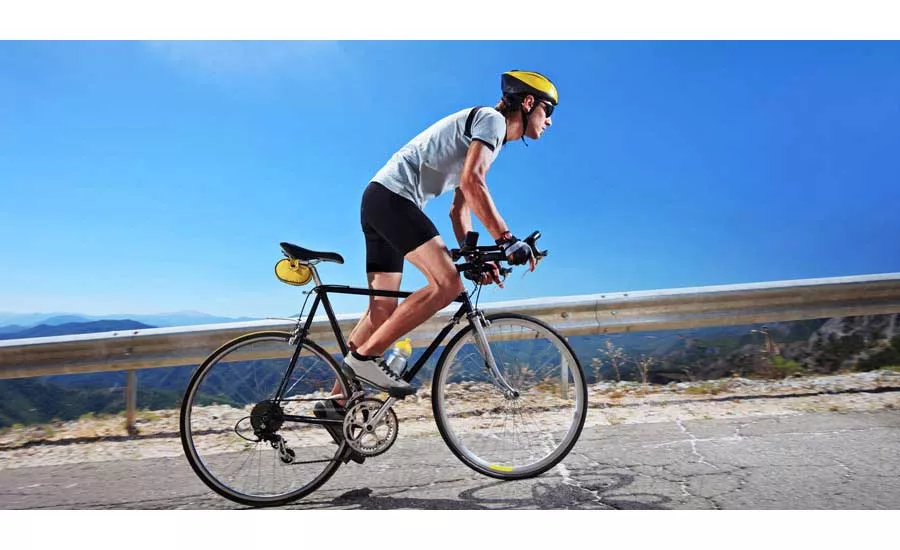
Bicycle helmets have been shown to reduce the risk of head injuries in cycling, but, until now, consumers who want to buy one that offers the best protection have had little information to go on. A new ratings program, based on collaborative research by Virginia Tech and the Insurance Institute for Highway Safety (IIHS), fixes that.
The first 30 helmets to be tested — all popular adult-size models — show a range of performance, with four earning the highest rating of 5 stars, two earning 2 stars, and the rest in the 3-4-star range. Cost wasn't a good predictor of performance. Both the $200 Bontrager Ballista MIPS and the $75 Specialized Chamonix MIPS earn 5 stars.
"Our goal with these ratings is to give cyclists an evidence-based tool for making informed decisions about how to reduce their risk of injury," says Steve Rowson, director of the Virginia Tech Helmet Lab and an associate professor of biomedical engineering and mechanics. "We also hope manufacturers will use the information to make improvements."
While the government requires that helmets pass a series of tests to be sold in the U.S., the new ratings rely on a more realistic evaluation based on joint Virginia Tech and IIHS research.
"As more people choose the bicycle as a mode of transportation, better helmet design is one of the tools that can be used to address the increasing number of cycling injuries," says David Zuby, chief research officer at IIHS and a frequent bike commuter.
A total of 835 bicyclists were killed in crashes with motor vehicles in 2016. That is the highest number of bicyclist deaths since 1991.
More than half of those killed in 2016 weren't wearing helmets. Helmet use has been estimated to reduce the odds of a head injury by 50 percent.
The bike helmet rating system developed by Rowson and his colleagues builds on their years of experience evaluating other types of sports head protection. The Virginia Tech Helmet Lab currently rates football and hockey helmets, as well as soccer headgear.
"In cycling, we saw an opportunity to reach a broad cross section of the public and bring a new level of safety to an activity with a wide range of other benefits," Rowson says.
Bike helmets in the U.S. are required by the Consumer Product Safety Commission (CPSC) to pass a series of tests in which helmets are struck against an anvil at a set speed. The only requirement is that the helmets prevent head impact accelerations over 300 g, a level associated with skull fracture or severe brain injury. There is no requirement for helmets to limit concussion-level forces, which are more common among bicyclists in crashes.
CPSC tests reveal a range of performance within the 300 g limit, and Consumer Reports takes that variation into account for its own helmet ratings. However, those tests don't reflect the circumstances of most real-world bike crashes.
One shortcoming of the CPSC testing is that it doesn't evaluate the entirety of the helmet. For instance, the helmet rim is excluded from CPSC testing, even though studies of bicycle crashes have found that a large number of cyclist head impacts are at the helmet rim, often at the sides or front of helmets. In addition, the CPSC testing requires helmets to be dropped perpendicular to the impact surface. In contrast, a bicyclist's head is more likely to strike the pavement at an angle during a crash. Finally, the speed at which the helmet hits the anvil in the CPSC testing represents an extremely severe impact that isn't typical of most bike crashes.
Before developing their test protocol, the Virginia Tech researchers conducted two studies with IIHS support. In the first one, they used the CPSC rig to test a group of helmets at two locations — one at the side of the helmet, within the CPSC test area, and one at the front rim, which isn't subject to the required testing. They found that on certain models, the rim location was more vulnerable.
The second study used a different test rig with a more realistic dummy head hitting a slanted anvil, covered with 80-grit sandpaper to approximate the roughness of asphalt. These tests were designed to replicate more accurately the angle at which a bicyclist's head is likely to strike the pavement in a crash.
The rig with the slanted anvil and more realistic head did a better job teasing out differences among helmets, the researchers found. A slightly modified version of that rig is being used for the ratings.
For the ratings, the lab tests each helmet at six commonly impacted locations, including two at the rim. Helmets are dropped on the anvil at two speeds taken from studies of real-world crashes — the median speed at which a rider's head is estimated to hit the ground and a higher speed equivalent to the 90th-percentile speed in the real-world crash studies.
Sensors embedded in the headform measure linear acceleration and rotational velocity, and the risk of concussion is estimated from those measurements. The number of stars assigned to each helmet represents how effectively that model reduces overall injury risk.
Of the four 5-star helmets in the initial test group, all are equipped with a Multi-Directional Impact Protection System (MIPS). This technology creates a low-friction layer inside the helmet.
"The idea behind MIPS is that, when the helmet hits the road and sticks initially due to the high friction, your head actually slides relative to the helmet," says Megan Bland, a Virginia Tech doctoral student who conducted much of the research for the new ratings. That slip plane reduces the rotational forces that jostle the brain, causing concussions and other injuries.
In addition to MIPS, helmet style also seems to play an important role in performance. So-called road helmets, which have an elongated, aerodynamic shape tended to perform better than "urban" helmets, which have a more rounded shape with fewer vents and thicker shells.
The lab is continuing to test more adult helmets of different styles, including mountain bike and skate/BMX helmets, and will update its website as new ratings are released. Evaluations of youth helmets also are planned.
The lab is continuing to test more adult helmets of different styles, including mountain bike and skate/BMX helmets, and will update its website as new ratings are released. Evaluations of youth helmets also are planned.
Virginia Tech bicycle helmet ratings
Helmets are listed from best to worst within rating categories.
Best Available
- Bontrager Ballista MIPS
- Garneau Raid MIPS
- Bell Stratus MIPS
- Specialized Chamonix MIPS
Very Good
- Scott ARX Plus MIPS
- Bontrager Quantum MIPS
- Specialized Prevail II
- Smith Overtake
- Giro Savant
- Bell Draft MIPS
- POC Octal
- Giro Foray MIPS
- Giro Synthe
- Giro Sutton MIPS
- Specialized Evade II
- Garneau Le Tour II
Good
- Triple 8 Dual Certified MIPS
- Bell Reflex
- Bontrager Solstice
- Bern Brentwood
- Bell Division
- Schwinn Thrasher
- Giro Revel
- Schwinn Flash
- Kali City
- Nutcase Street
- Specialized Centro
- Bontrager Electra
Adequate
- Lazer Genesis
- Bern Watts
Looking for a reprint of this article?
From high-res PDFs to custom plaques, order your copy today!


