A NIOSH flashback:
How to work safely with robots – circa 1984
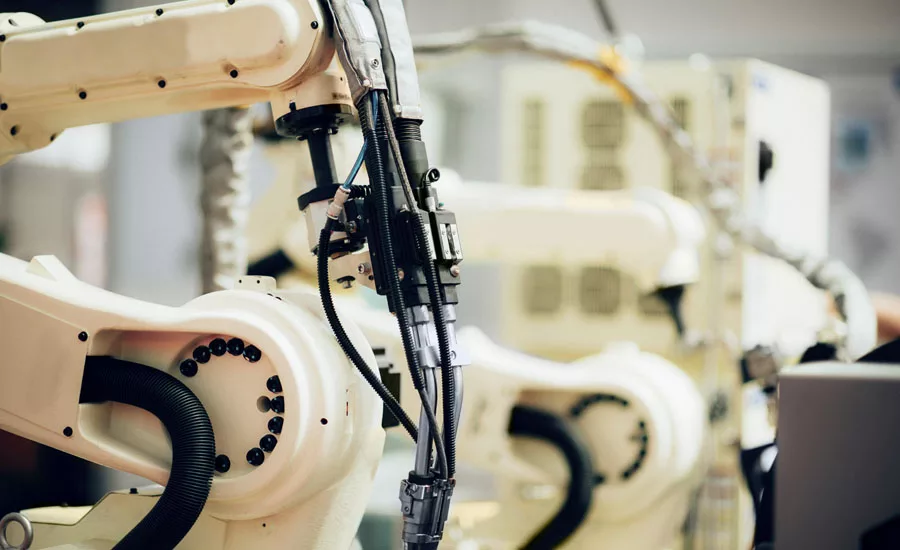
With the recent focus on robots and worker safety, it may be surprising to learn that the National Institute for Occupational Safety and Health (NIOSH) first addressed this issue 34 years ago. In 1984, the agency released safety recommendations for working with robots after an experienced operator of an automated die-cast system died when he became pinned between the back end of an industrial robot and a steel safety pole.
Here is that accident report and the recommendations that followed:
Background
On July 21, 1984, a thirty-four-year-old male operator of an automated die-cast system went into cardiorespiratory arrest and died after being pinned between the back end of an industrial robot and a steel safety pole. The hydraulic robot had been installed in an existing production line to remove die-cast parts from a die-cast machine and to transfer these parts to a trimmer. The victim had fifteen years’ experience in die-casting and had completed a one-week training course in robotics three weeks before the fatal incident.
The victim entered the working range of the operating robot presumably to clean up scrap metal that had accumulated on the floor. Despite training in the robotics course, instructions on the job, and warnings by fellow workers to avoid this dangerous practice, the victim apparently climbed over, through, or around a safety rail which surrounded two sides of the robot’s work envelope. The entry point in the safety rail was interlocked. No other presence-sensing devices were operative in the system.
This preventable fatality demonstrates a growing problem of the failure of workers to recognize all the hazards associated with robots. While workers may readily recognize hazards associated with the working zone of the robotic arm, they may not recognize dangers associated with the movement of other parts of the robotic assembly. In this case, the victim was trapped between a fixed object (a steel pole 4 inches in diameter) and the active back end of the robot which was outside the working zone of the robotic arm; the worker apparently presumed this area to be “safe.”
Recommendations by NIOSH
To minimize the risk of such incidents, NIOSH offers the following recommendations regarding the design of robotic systems, the training of workers, and their supervision.
A. The Design of Robotic System
Regarding both existing robotic equipment and new designs, NIOSH recommends that the robotic system:
- Include physical barriers that incorporate gates equipped with electrical interlocks so that operation of the robot stops when the gate is opened.
- Include, as a backup to electrical interlocks, motion sensors, light curtains, or floor sensors that stop the robot whenever a worker crosses the barrier.
- Provide barriers, as may be appropriate, between robotic equipment and any freestanding objects such as posts limiting robot arm movement so that workers cannot get between any part of the robot and the “pinch points.”
- Provide adequate clearance distances around all moving components of the robotic system. It is of particular importance that this be considered in plans for replacing a human worker with a robot; a robot often requires more operational space than does a human worker doing the same task.
- Include remote “diagnostic” instrumentation as much as possible so that the maximum amount of troubleshooting of the system can be done from areas outside the operating range of the robot. Whenever it is necessary for a worker to be within the operating range of a robot, additional special provisions for safety should be taken, including, at a minimum, the presence of another worker who can turn off the robot should an emergency develop (buddy system).
- Provide adequate illumination in the control and operational areas of the robotic system so that written instructions, as well as buttons, levers, etc., are clearly visible.
- Include on floors or working surfaces clearly visible marks that indicate the zones of movement of the robot.
B. Training of Workers
Training specific to the particular robot in question should be provided to workers who will be programming, operating, or maintaining robots. Moreover, refresher courses which re-emphasize safety and discuss new technological developments should be provided for experienced programmers, operators, and maintenance workers. This training should emphasize safe work practices and stress that:
- Workers must be familiar with all working aspects of the robot, including full range of motion, known hazards, how the robot is programmed, emergency stop buttons, and safety barriers, before operating or performing maintenance work at robotic work stations.
- Operators should never be in reach of the robot while it is operating.
- Programmers, operators, and maintenance workers should operate robots at reduced speeds consistent with adequate worker response to avoid hazards during programming and be aware of all conceivable pinch points, such as poles, walls, and other equipment, in the robots’ operational area.
C. Supervision of Workers
Supervisors should:
- Assure that no one is allowed to enter the operational area of a robot without first putting the robot on “hold,” in a “power down” condition, or at a reduced operating speed mode.
- Recognize that with the passage of time, experienced workers doing automated tasks may become complacent, overconfident, or unattentive to the hazards inherent in complex automated equipment. Close supervision of such operations is imperative to assure safety.
We are requesting that company managers, editors of appropriate trade journals, robot equipment designers, and safety and health inspectors institute these recommendations and bring them to the attention of the potential victims.
Looking for a reprint of this article?
From high-res PDFs to custom plaques, order your copy today!


