ISHN logo
search
cart
facebook twitter linkedin youtube
  • Sign In
  • Create Account
  • Sign Out
  • My Account
ISHN logo
  • NEWS
    • Today's News
    • Global Safety News
    • Government Regulations
  • PRODUCTS
    • Product Innovations
    • Featured Products
  • TOPICS
    • Environmental Health and Safety
    • Facility Safety
    • Workplace Health
    • Occupational Safety
    • PPE
    • More Topics
  • CONSTRUCTION
  • TECHNOLOGY
  • COLUMNS
    • Best Practices
    • Dave Johnson: What’s going on
    • Editorial Comments
    • Leading Safety
  • MULTIMEDIA
    • ISHN Podcast
    • Videos
    • Cold Stress Education Quiz
    • Webinars
    • White Papers
  • MORE
    • Buyer's Guide
    • Newsletters
    • Convention Companion
    • Polls
    • Events
    • ISHN Store
    • Sponsor Insights
  • EMAGAZINE
    • eMagazine
    • Archived Issues
    • Contact
    • Advertise
  • JOIN TODAY!
Workplace Health

Obesity-linked cancer rate varies widely from state to state
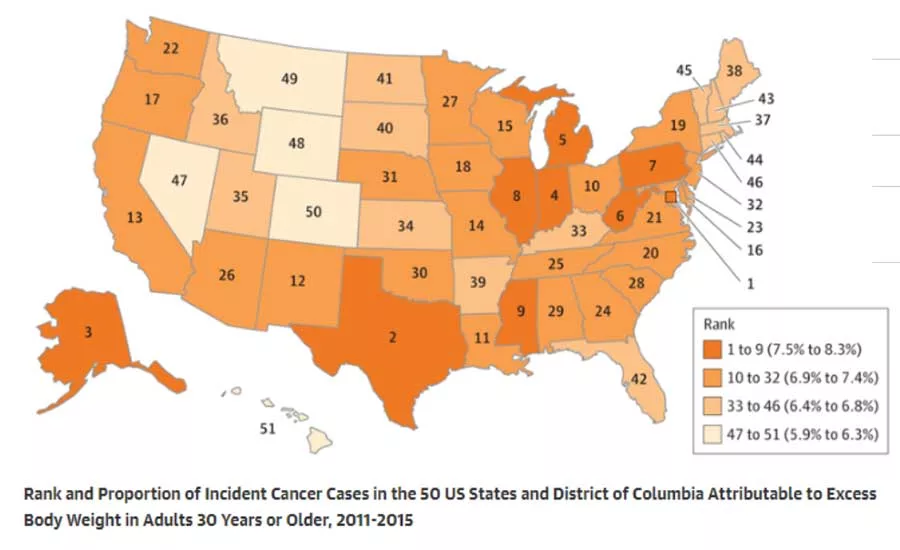
cancer obesity map
January 3, 2019

A new study looking at the share of cancers related to obesity finds an at least 1.5-fold difference between states with the highest and lowest proportions. The proportion of cancer cases that could be attributable to excess body weight ranged from a high of 8.3% in the District of Columbia to a low of 5.9% in Hawaii, reflecting variations in obesity rates in the states. The study appears in JAMA Oncology. (American Cancer Society map shown above.)

Excess body weight is an established cause of cancer, currently known to be linked to 13 cancers. While differences in excess body weight among states in the United States are well-known, there is little information on the burden of obesity-related cancers by state, information that would be useful for setting priorities for cancer control initiatives.

To learn more, American Cancer Society investigators led by Farhad Islami, M.D., Ph.D., Scientific Director, Surveillance Research, calculated the population attributable fraction (PAF) of incident cancer cases attributable to excess body weight among adults aged ≥30 years in 2011-2015 in all 50 states and the District of Columbia.

They found that in both men and women, there was at least a 1.5-fold difference between states with the highest and lowest proportions of cancers attributable to excess body weight. Among men, the population attributable fraction (PAF) ranged from 3.9% in Montana to 6.0% in Texas. Meanwhile, the PAF for women was approximately twice as high as for men, ranging from 7.1% in Hawaii to 11.4% in the District of Columbia. States with largest PAFs were mostly located in the South and Midwest, plus Alaska and the District of Columbia.

The proportion was far greater for some individual cancer types. For endometrial cancer, for example, the PAF ranged from 36.5% in Hawaii to 54.9% in Mississippi and was 50.0% or more in 19 states.

“The proportion of cancers attributable to [excess body weight] varies among states, but [excess body weight] accounts for at least 1 in 17 of all incident cancers in each state,” write the authors. “Broad implementation of known community- and individual-level interventions is needed to reduce access to and marketing of unhealthy foods (eg, through a tax on sugary drinks) and to promote and increase access to healthy foods and physical activity, as well as preventive care.”

Article: Proportion of cancer cases attributable to excess body weight by state in the United States, 2011-2015 JAMA Oncol 2018 DOI: 10.1001/jamaoncol.2018.5639

KEYWORDS: health and wellness public health

Share This Story

Looking for a reprint of this article?
From high-res PDFs to custom plaques, order your copy today!

Recommended Content

JOIN TODAY
to unlock your recommendations.

Already have an account? Sign In

  • forklift safety

    Exploring the latest technologies in forklift safety

    With more staff and more stock in warehousing now more...
    Facility Safety
    By: Josh Cramer
  • welding

    All about welder’s flash or arc eye

    A flash burn is a painful inflammation of the cornea,...
    Environmental Health and Safety
  • dangerous jobs

    The 10 most dangerous jobs in the U.S.

    On-the-job deaths have been rising — hitting the highest...
    Government Safety Regulations
    By: Benita Mehta
Manage My Account
  • eMagazine Subscriptions
  • ISHN Newsletter & Other Newsletter Alerts
  • Online Registration
  • Manage My Preferences
  • Subscription Customer Service

More Videos

Sponsored Content

Sponsored Content is a special paid section where industry companies provide high quality, objective, non-commercial content around topics of interest to the ISHN audience. All Sponsored Content is supplied by the advertising company and any opinions expressed in this article are those of the author and not necessarily reflect the views of ISHN or its parent company, BNP Media. Interested in participating in our Sponsored Content section? Contact your local rep!

close
  • man wearing the the Sundström SR200 Full Face Mask Respirator
    Sponsored byOHD

    5 Fit Testing Mistakes That Could Cost You

  • This image shows Magid AcuSpex polarized blue mirrored safety glasses.
    Sponsored byMagid Glove and Safety

    Construction PPE Guide: What Crews Need for Each Task

  • lone worker in confined space
    Sponsored byAlphasense Ltd.

    GET THE LEAD OUT of your Safety Oxygen Sensors!

Popular Stories

SpaceX 7 launch

OSHA Investigating Fatal Fall at SpaceX Starbase

Automated loading dock equipment

After March 2026 Rivian Death, Safety Managers Reassess Loading Dock Systems Under OSHA's Warehouse Emphasis Program

psychology in the workplace

Most Workplaces Measure Psychological Safety, Ignoring Psychosocial Risks

top 10 most dangerous jobs

Poll

Seasonal Readiness

With the federal heat stress prevention rule on the horizon, which area of your safety program needs the most attention?
View Results Poll Archive

Products

Surviving an OSHA Audit A Management Guide, 2nd Edition

Surviving an OSHA Audit A Management Guide, 2nd Edition

See More Products

ISHN Podcasts

Related Articles

  • NFPA report: Electrical safety varies widely from state to state

    See More
  • Pipeline fights move to state level

    See More
  • Michigan becomes first state to lower acceptable blood lead levels for workers

    See More

Related Products

See More Products
  • Optimizing Social Media from a B2B Perspective

See More Products
×

Become a Leader in Safety Culture

Build your knowledge with ISHN, covering key safety, health and industrial hygiene news, products, and trends.

JOIN TODAY
  • RESOURCES
    • Advertise
    • Contact Us
    • Directories
    • Manufacturing Division
    • Store
    • Want More
  • SIGN UP TODAY
    • Create Account
    • eMagazine
    • Newsletters
    • Customer Service
    • Manage Preferences
  • SERVICES
    • Marketing Services
    • Reprints
    • Market Research
    • List Rental
    • Survey/Respondent Access
  • STAY CONNECTED
    • LinkedIn
    • Facebook
    • YouTube
    • X (Twitter)
  • PRIVACY
    • PRIVACY POLICY
    • TERMS & CONDITIONS
    • DO NOT SELL MY PERSONAL INFORMATION
    • PRIVACY REQUEST
    • ACCESSIBILITY

Copyright ©2026. All Rights Reserved BNP Media, Inc. and BNP Media II, LLC.

Design, CMS, Hosting & Web Development :: ePublishing