Luck does not prevent slips, trips and falls

Credit: Getty Images
In 1943, American airman Alan Magee was flying over France in his B-17 bomber nicknamed Snap Crackle Pop. Suddenly, he was thrown from the aircraft.
Wearing a parachute that failed to open, he fell more than 22,000 feet — four miles — crashing into the glass roof of a train station below. Luckily, he survived and was given medical treatment by German soldiers, then occupying France. Held as a prisoner of war, he was released in 1946 and lived to the ripe old age of 84.
It’s a fantastic story, but don’t allow it to minimize how serious falls can be, especially when they occur in the workplace. According to a report by the Bureau of Labor Statistics (BLS) released in December of 2023, work-related fatalities due to falls, slips, and trips increased by nearly 2 percent in 2022, resulting in 865 deaths.*
But this report focuses only on the number of workers who lost their lives due to fall-related accidents. The number of people injured by falls, slips, and trips is estimated at 2,000 per year, according to data from the National Floor Safety Institute. These injuries can vary in seriousness, but all too often, many produce severe injuries, including fractured hips and broken bones.
One more point we should make: falls, slips and trips are costly. According to the Liberty Mutual Workplace Safety Index, slips, trips and falls regularly cost American businesses more than $11 billion annually.
With June being National Safety Month, it’s time for businesses in all industries to examine why these falls, slips, and trips occur and, even more important, what steps we can take to help minimize, if not eliminate, them.
Because so many of these accidents are related to floor care, many administrators are turning to independent distributors who market various floor care products for answers. And if they are members of a network of distributors, they can take advantage of training programs that will help them understand how slip, trip, and fall accidents occur and what can be done to prevent them.
Distinguishing the types of falls
Before we discuss floor care, managers of industrial facilities need to be aware of the four types or categories of falls that can occur in the workplace. They are the following:
1. Trip-and-fall. A common type of fall occurs when we unknowingly encounter a foreign or unexpected object on the floor, such as a power cord, a step, or a kitchen utensil that has fallen to the floor.
2. Stump-and-fall. Less common than a trip-and-fall, this often occurs when we walk on an uneven floor, bump into a rug or mat, or step onto a “tacky,” oily, or greasy floor area.
3. Step-and-fall. This happens when we encounter an unexpected height change in the floor: most frequently, this is when we walk from a higher floor surface to a lower floor surface.
4. Slip-and-fall. This is the most common type of floor-related accident and usually occurs when a floor is too slippery to be safely walked upon. For our purpose here, we will focus on the slip-and-fall accident.
Proper floor cleaning
Proper floor cleaning is a critical aspect of maintaining safety in any facility. However, surprisingly, it is traditional floor care cleaning using mops and buckets that can contribute to slip-and-fall accidents. As the mops are used, they collect and then spread soil and contaminants, making the floor slippery, which, as we mentioned, is the key cause of slip-and-fall accidents.
To mitigate this risk, it’s essential for cleaning professionals to use clean mops and to change them regularly. Additionally, the bucket cleaning solution should be refreshed as it becomes soiled to prevent the floor from becoming slippery. Your independent distributor can instruct cleaning workers on accomplishing this.
For larger industrial spaces, automatic scrubbers offer an efficient alternative. These machines can handle the cleaning process more effectively by scrubbing, rinsing, and drying the floor in a single operation. The size and type of the scrubber should be tailored to the facility’s specific needs.
To avoid costly mistakes, distributors can often provide expert advice on the best fit and best machine for your unique environment. These machines can significantly reduce the risk of slip-and-fall accidents and ensure a safer environment for workers.
Prevention
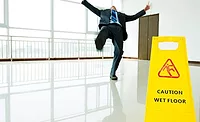
Especially in industrial locations, incidents can open the door to all four categories of falls. For instance, spills, grease, or oil may find their way to the floor; however, addressing the situation at the moment it happens may not be an option. In such cases, using and placing safety cones, otherwise known as warning cones, is imperative.
However, there’s more to safety cones than we may realize. For instance, according to ANSI and OSHA**, the words used on cones have the following meanings:
Danger: The most urgent message applies to extreme situations where there is a high probability of death or serious injury should someone walk or be in a specific area.
Warning: Somewhat less urgent, it is used when there is a possibility, but not a high probability, of injury or death in an area.
Caution: This message indicates that a hazardous situation may be present that could lead to an accident or injury.
Further, the color of these cones can vary. Danger signs are often red, warning signs are orange, and caution signs are yellow. These signs are not only placed when there are floor-care issues but also wherever there are hazards or potential hazards in a facility.
As to placement, install the signs as close to the problem area as possible and then around the perimeter. This can be several feet from the incident. The perimeter helps walkers identify where they can and can’t proceed in an area.
As we can see, the prevention of slips, trips, and falls is a complex issue but one that can be effectively managed with training, education, and guidance. By taking proactive steps and utilizing the expertise of knowledgeable distributors, organizations can create a safer work environment for everyone.
*It is believed many more falls, slips, and trips occur each year that are not reported.
**American National Standards Institute; Occupational Health and Safety Administration
Looking for a reprint of this article?
From high-res PDFs to custom plaques, order your copy today!