Risk management challenges: Safety is in the eye of the beholder
Some see danger where others are happy to take the risk
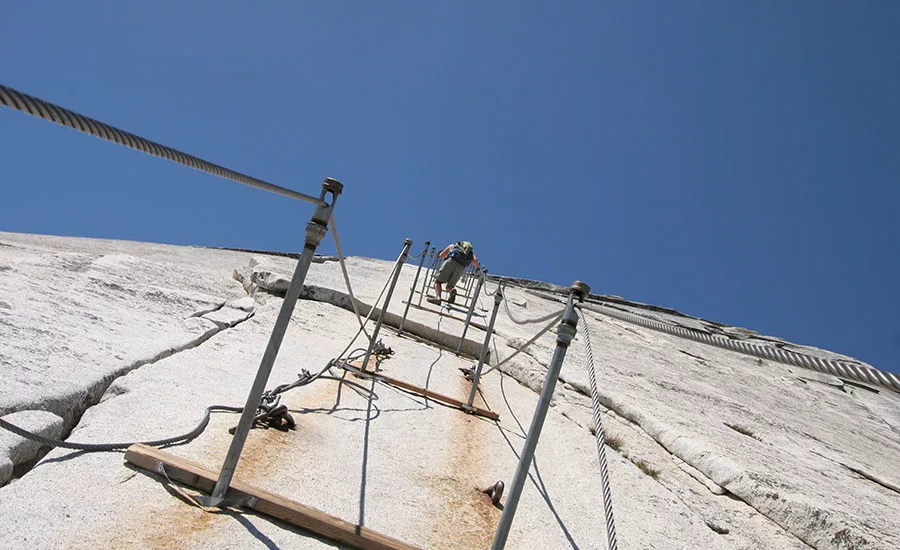
The steep, nearly vertical, trail with cables for climbers on Half Dome in Yosemite National Park.
Photo credit: Krilt / iStock / Getty Images Plus
This past July, a 20-year-old hiker and her father were descending the cables at Yosemite National Park’s Half Dome, a 5,000-foot-high unique rock formation, when she slipped in a sudden downpour. She fell about three-quarters of the way down the 400 feet of twin steel cables covering the most dangerous part of the climb, sustained a severe head fracture, and probably died during the fall. Father and daughter had hiked thousands of miles together.
About 100 injuries occur every year on the route up and down Half Dome. At least ten others have suffered fatal falls from losing their grip on the cables, usually when the rock is wet. Thousands of people summit Half Dome every season, with the park service limiting access to 225-300 people per day, using a permit system. About 35,000 people applied for Half Dome permits in 2023, according to the park service.
Wooden blocks are drilled into the rock about every ten feet between the cables to help navigate the steep, 45-degree angle climb and descent. The Sierra Club installed the cables, attached to a series of poles, in 1920. They have since been rebuilt and reinforced.
The climb using the cables is called terrifying by some, awe-inspiring to others.
All-too-familiar debate
The tragedy this summer has sparked a debate about the need for safety improvements on Yosemite’s Half Dome. It is similar to debates in the workplace over how much safety is needed to be safe. And the differences of opinion about the risks posed by Half Dome are reminiscent of different attitudes about safety and risks held by workers.
One more similarity between this national park tragedy and workplace serious injuries and fatalities — once again safety becomes an issue in reaction to something horrible happening.
This is not to say the National Park Service ignores the risks of climbing Half Dome. To pick up their permit, climbers must attend a safety briefing. There are signs at the beginning of the trailhead warning, in effect, that the task ahead is dangerous and possibly fatal. Permits, briefings, warning signs — all typical safety precautions in the workplace as well.
Some climbers believe existing Half Dome safety practices and safeguards are sufficient. “Half Dome is dangerous,” says one experienced climber. “National parks aren’t Disneyland.” The same can be said for many construction sites, mines, assembly lines, warehouses and other worksites. “Nature includes danger. Visitors can’t expect to be perfectly safe,” he says.
This comes close to the age-old industrial adage: accidents will happen. Work includes danger. Workers can’t expect to be perfectly safe.
Says another naturalist: “We shouldn’t… [try] to subdue Half Dome and national parks in general. Wild places, even semi-wild places, are good for the soul.”
One veteran climber adds: Recreating in the mountains is inherently risky. “You can never make the mountains completely safe.”
How close is this to claiming work is inherently risky and you can never make workplaces 100-percent safe?
Some workers carry that attitude and accept the risks, even take risks. Just as some experienced climbers prefer to walk on the outside of Half Dome’s cables, grabbing on to just one, because you can pass the long single file of people more easily.
The case for increasing safety
Then there is the other side of the debate. Why are the wooden planks so far apart, asked the father of the 20-year-old who fell to her death. He told the Los Angeles Times he guessed it would cost a few thousand dollars to double the number of rungs. That’s a sum he figured could easily be collected from the 50,000 people who pay for $10 permits to climb Half Dome each year. It leaves him wondering why nothing has been done to address the obvious risk. As I write this in early September, the National Park Service had refused to comment on the incident or the need for safety improvements and had not responded to the father.
The Los Angeles Times interviewed a dozen men and women from across the country, ranging in age from 18 to 54, at the cables. They all agreed: more secure footholds would be welcome. “I consider myself a strong 19-year-old guy,” said one. “I thought it would be a breeze to scamper up. I was scared my grip strength would go. It would have been a nightmare.”
A 39-year-old man from Dallas, still catching his breath at the top of the summit, was shocked at the upper-body strength needed to hang on to the cables. How many workers are surprised by the strength needed to do a job? Overexertion is the number one most frequent cause of injury, according to a survey of 1.2 million workers’ comp claims from 2017-2021. Number two: slips, trips and falls.
Doubling the number of wooden slats would be a great idea, said the exhausted climber.
The cables have been called ugly, crude and cumbersome, not unlike some workers’ attitude about personal protective equipment. Speaking of PPE, some climbers take the extra precaution of wearing a climbing harness with lines they attach to the cables. This system of connecting to the cable using a specialized carabiner is popular in Europe to protect adventurers from mountaintops with high exposures. But as with other safety practices, this clipping and unclipping to get past the vertical posts slows you down – a downside for climbers who want to move fast, or workers who face production pressures. And as with wearing PPE, people still must decide for themselves to clip in and use the safety system. Some will, some won’t.
Hard question to answer
How much safety is enough safety? It will always be difficult if not impossible to reach a consensus, whether it is climbing or working on a “high-consequence” exposure. People simply have different attitudes about safety and risks. On the road you see some motorcyclists wearing helmets, others do not. Eighteen states have laws mandating motorcycle helmets. Most obey the laws; some flout them.
The tragedy at Half Dome this summer raises another issue to debate: do safety investments and improvements give workers (and climbers) a false sense of security? Again, you’re unlikely to find consensus here. One letter writer responding to the LA Times article believed more safety would indeed create that false security. Any number of safety and health professionals in industry would vehemently disagree, believing you can’t have too much safety in a dangerous workplace.
Safety is in the eye of the beholder. It’s one of the challenges pros confront managing different attitudes toward safety and getting everyone on the same page. That’s why so many tactics are used by professionals – coaching, observations and feedback, enforcement, training, rules and policies, incentives, one-on-one conversations and the inventive and resourceful ideas of pros. These tactics are mostly all impossible to apply on Half Dome. Which is where off-the-job safety and on-the-job safety go their separate ways.
Looking for a reprint of this article?
From high-res PDFs to custom plaques, order your copy today!