You Only Know What You Know: The Critical Flaw in Workplace Safety Assumptions
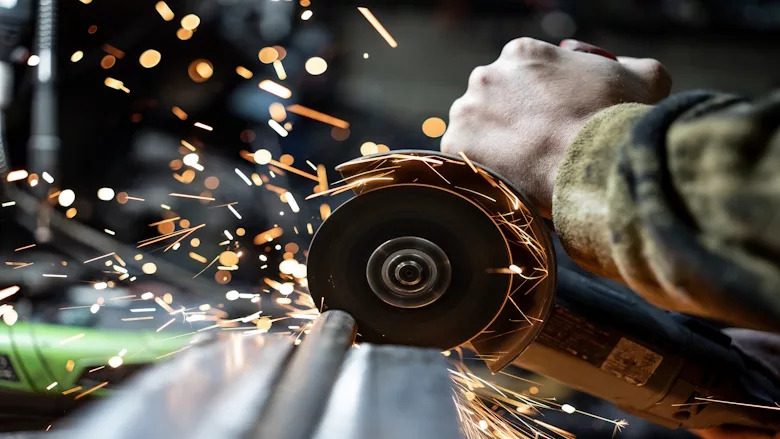
Credit: Nikola Milosevic / E+ / Getty Images Plus
I was writing an article about the hazards of a cutting disc on a grinder because the majority of users (and providers of the grinder) are not aware of a particular hazard associated with it. Which made me think that concept would be a good subject in itself. How could so many people not know of the hazard? You only know what you know. Unless you read the manual of the grinder to see its recommendation for using a cutting disc, you are not aware. Everything that seems so obvious to us now, at one time we did not know.
This is why training and reading the manuals of tools and equipment is crucial for safe work. I heard a good idea once that I incorporated by having employees read and sign the manual for a particular power tool in the tool room.
I remember years ago that an apprentice busted his tooth by pulling a hammer claw trying to remove a nail. Who would have thought you would need to train someone to use a hammer on a construction site? No one at that site did, but when you find out that he put himself in the line of fire and was not trained to step to the side, then you see the need. We only know what we know. Explaining things is paramount for a safe work performance.
Often overlooked angle grinder hazards
Angle Grinders are a useful tool for fabricating metal. Many companies have recognized that the use of an angle grinder can be hazardous due to the injuries from their use. Only trained individuals who have read the manual should use them.
Grinding wheel injuries
There are several types of accidents caused by angle grinders. One example is fire can be one from the sparks generated. Make sure one has a hot work permit and follows what it states before using a cutting disc.
Entanglement is another concern; I have been on a job that required employees to wear a high visibility reflective vest while working. A helper was grinding and the wheel sucked up the vest inside the guard. The company decided to allow workers to take the vest off while grinding in a low traffic area as a corrective action. Avoid other loose clothing as well.
Kickback is an unexpected force on the grinder that pushes it up and can be difficult to control since the user is not expecting it. This is why we always have to make sure there is a handle on the grinder and that both hands are being used. Often when I mention the need for a handle on the grinder part, I am hit by the scenario that the user cannot reach a spot in the web of an I-beam with the handle on. In this case, we can step back and assess the situation and decide whether a pencil grinder is appropriate for that task, but until then we need to keep the handle on.
The infamous "flying debris” that is listed on so many JSAs as a hazard when grinding is another potential injury. The wheel spinning can generate particles by scraping off metal when grinding small sparking fragments off to a desired shape. This is why employers want eye protection and a face shield to be used when grinding.
Contact with the disc is another big potential hazard. Angle grinders can cut through stone, concrete, metal and other strong materials, so they have no trouble cutting through one’s skin, finger, or arm easily. Due to the frequency and severity of these injuries, many companies have tried to use cutting wheels as a last resort. They would rather try to use a cutting torch, or band saw to use the metal than a cutting disc due to the risk. One refinery required journeyman level craftsmen only to use the angle grinder. They also implemented administrative control of a form with the foreman and safety signing off on the form.
One can reduce these hazards by effective inspection of the angle grinder.
Angle grinder inspection
Check the overall condition of the grinder. Remove from service if damaged or all requirements are not satisfied. The cord, battery and side handle must be attached and in good condition. The wheel specification label must be readable.
See if there is a checklist from the manufacturer of your model that has an item not listed here: https://www.osha.gov/sites/default/files/2018-12/fy15_sh-27664-sh5_Toolbox_Angle_Grinder.pdf
Now this is the part that most users do not know:
- Cutting wheels require Type 1 Guards. A Type 1 guard must be used with Type 1 wheels.
1910.215(c)(1)(i)(i) - Cutting-off wheels, Types 1 and 27A (see paragraphs (c)(1) (ii) and (iii) of this section).
1910.215(c)(1)(ii) - Type 1 cutting-off wheels are to be mounted between properly relieved flanges which have matching bearing surfaces. Such flanges shall be at least one-fourth the wheel diameter.
- The Guard must encapsulate the opposite side of the cutting wheel, 180 degrees across the perpendicular center line covering both sides. Type 27 grinding wheel guards which only cover one side of the wheel are not acceptable. In the event of a catastrophic wheel failure the shrapnel will be contained in the guard.
- This standard has greatly reduced injuries.
- Guard Type and Sizes Must match wheel specifications.
Type 1 guard and disc
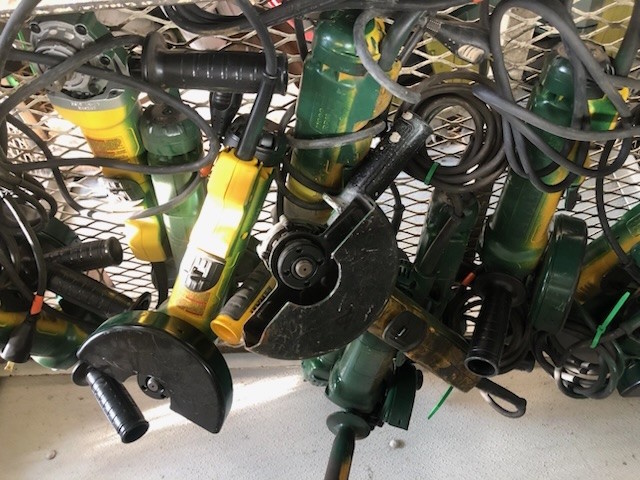
Photo credit: Chad C. French
Type 27 Guard and disc

Photo credit: Chad C. French
This grinder above is extremely dangerous — a cutting disc, no handle on it for control, no Type 1 guard.

Photo credit: Chad C. French
Type 1 cutting disc, but with an open face Type 27 guard that will NOT protect one from debris. If the cutting disc brakes, there is no handle in place (also not in use, but make sure it is when needed).
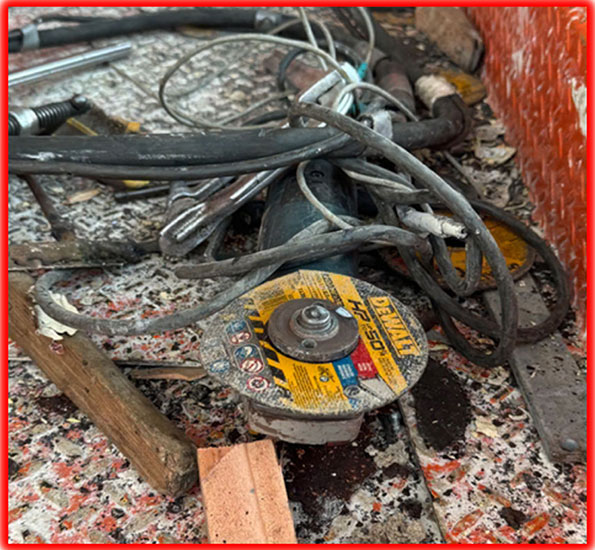
Photo credit: Chad C. French
I observed the grinder above in the same circumstance as described, but with a crack in the cutting disc that has no guard at all — very dangerous. All items shown were corrected. I advise reading how to store discs from the manufacturer.
A funny story
In saying you “only know what you know” I was reminded of another event that a person at work told a group of us. He said that when he was around 19 or 20 years old, his dad asked him to go to the hardware store to purchase some wood screws. He said he went there, looked around everywhere and they did not have any. So, he went home and told his dad the same. He then told us that his dad said, “What do you mean? They were completely out of wood screws?” He told his father “Yes, they were all metal.” He said his dad just stared at him for a long time and shook his head, and then he told us laughingly, “I didn’t know.” Some of the crowd rolled their eyes thinking he was a doofus, but I always found it quite funny, because I could have seen something like that happening to me and I appreciated his candidness for a good laugh. That story is a good example of how people only know what they know, and it is up to management to make sure employees have the information needed to perform their task.
In conclusion, cutting discs are a useful tool for the industry and can be very effective with the proper management and training. Now that you know a bit more about them, pass it on and work safe.
Sources
http://www.osha.gov/laws-regs/regulations/standardnumber/1910/1910.215
American National Standards Institute. Safety Code for the Use, Care, and Protection of Abrasive Wheels. ANSI B7.1. Approved: December 18, 1970.
Looking for a reprint of this article?
From high-res PDFs to custom plaques, order your copy today!