Hazard Communication Keeps Safety at the Forefront
Power-Pack Your Warehouse with Warning Signs
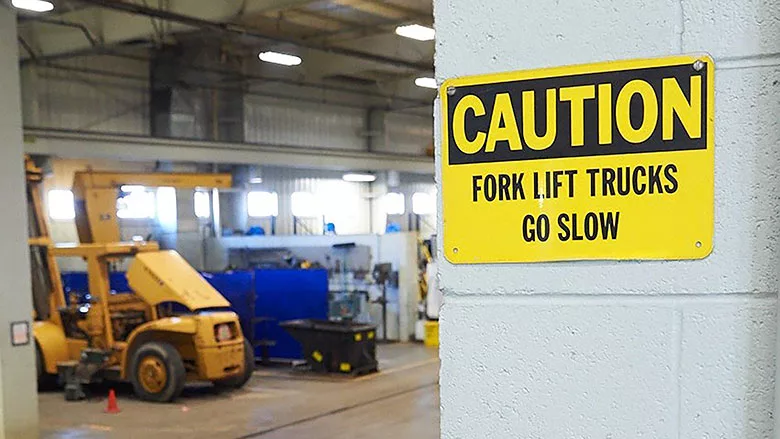
Take a look around your warehouse, and you might convince yourself that safety signs aren’t needed because the hazards are “obvious.” Yet, if you consider the perspective of your new, transferred, contract, temporary, or visiting workers, what appears visible to you may not be evident to them.
The reality is you cannot shadow these workers every minute to protect them. However, you can use the “power” of signs to alert, prohibit, instruct, warn, and inform workers about warehouse hazards! Even seasoned workers will benefit. Signs reinforce safety messages, remind them of the safer way to go, and reflect your safety culture.
Signs are a control method
Note that safety signs have limitations. They’re lower on the hierarchy of controls for a reason. Signs are classified as administrative controls, but they’re no match for other controls that remove a danger or substitute it with a lesser threat. Signs also cannot replace engineering controls, e.g., machine guards, lifting devices, guardrails, noise enclosures, and exhaust ventilation, which strive to keep the hazard from reaching the worker.
Still, when serious hazards cannot be eliminated, reduced, or isolated, signs are a means to help prevent death, injury, illness, and/or property damage at your warehouse. In fact, they can take an active role in your safety program.
Signs are OSHA-required at warehouses
Signs are not just a best practice. Whether you store anything from auto parts, electronics, and furniture to food, lumber, and chemicals, it’s likely your warehouse has some sign requirements. As OSHA targets warehouses for inspection under its National Emphasis Program on Warehousing and Distribution Center Operations, take steps now to meet your OSHA obligations.
The average initial penalty for a sign violation last fiscal year cost almost $4,150. This can multiply if you have more than one. Plus, it’s not unheard of for OSHA to find a sign violation and sock an employer with a fine over $40,000!
The average initial penalty for a sign violation last fiscal year cost almost $4,150. This can multiply if you have more than one.
Warehouses are general industry settings. That means to ensure sign compliance, you must review the applicable OSHA regulations at 29 CFR 1910. Sign requirements are found throughout. Examples that may relate to your warehouse include:
- Electrical — If you have an electrical room with exposed live parts, be sure to mark the entrance forbidding unqualified persons to enter, per 1910.303. Post signs where workers might contact live parts of services over 600 volts, nominal, in conformance with 1910.304. For any other hazards which could cause injury due to electric shock/burns or failure of electric equipment parts, 1910.335 requires signs, tags, or attendants to warn employees. Barricades may also be used, but only in conjunction with safety signs.
- Exits — Section 1910.37 is your source for exit sign requirements. Install EXIT signs using plainly legible letters and keep the line-of-sight to these signs clearly visible. If your workers cannot immediately see an exit door in their work areas, they should be able to see a sign(s) directing them to one. What’s more, if along an exit access someone could mistake a door or passageway for an exit, you need to mark it with a NO EXIT sign or equivalent or identify it with a sign describing its use, such as CLOSET.
- Fire protection — If you’re using portable fire extinguishers, identify them pursuant to 1910.157, so your workers can quickly spot them in a fire. Moreover, 1910.158 prescribes that fire hose reels and cabinets be “conspicuously identified.” Signs placed above eye level are popular methods of identification.
- Overhead cranes — Ensure a rated load marking is stationed on each side of an overhead crane. If the crane has more than one hoisting unit, each hoist has to have its rated load marked on it or its load block. If you cannot easily read the marking from the ground or floor, it’s not compliant with 1910.179. Finally, before you make crane adjustments/repairs, OSHA calls for “Warning” or “Out of Order” signs on the crane and either on the floor below or on the hook.
Search for the words “sign” or “mark” in the following regulations for some other typical warehouse sign requirements:
- Clearance limits — 1910.176
- Confined spaces — 1910.146
- Hazard communication — 1910.1200
- Nonpotable water — 1910.141
- No smoking — 1910.106 and 1910.125
- Toxic and hazardous substances — 29 CFR 1910 Subpart Z
- Welding and cutting — 1910.252 and 1910.253
Also, check your state/local codes and regulations to determine if they, too, require signs.
OSHA’s catch-all requirement
Section 1910.145 triggers signs or symbols (or other effective means, such as training) when failure to post signs or symbols may lead to accidental injury or property damage. It’s a sweeping requirement for posting signs near hazards. It could be applied for things like:
- Admittance
- Chemicals
- Ergonomics
- Fire prevention
- Machinery
- Slips, trips, and falls
- Personal protective equipment (PPE)
- Vehicle struck-bys
Take steps to find and meet your sign needs
Conduct an indoor/outdoor site assessment to find out what signs you have in place and which ones you’re lacking at your warehouse. While you do your survey, consider:
- Signage concerns, e.g., illegible, inaccurate, or obstructed signs; inconsistent sign formats; signs overloading the same location; or “signs” scribbled on a piece of paper.
- Areas that warrant a sign, e.g., unmarked hazards, hazardous areas, safety/emergency/fire equipment, exit pathways, clearances, traffic areas, and machinery; entrances to PPE-required areas; and maintenance areas.
- Changes at work and company policies that prompt a sign.
Then correct signage issues and meet your sign needs. Refer to 1910.145 for DANGER, CAUTION, and SAFETY INSTRUCTION sign formats and requirements for training workers in signs.
Final words
As a warehouse employer, you cannot always be present to warn workers of hazards. Signs don’t take the place of other control measures, but they’re a supportive element of an effective safety program.
Looking for a reprint of this article?
From high-res PDFs to custom plaques, order your copy today!