ISHN logo
search
cart
facebook twitter linkedin youtube
  • Sign In
  • Create Account
  • Sign Out
  • My Account
ISHN logo
  • NEWS
    • Today's News
    • Global Safety News
    • Government Regulations
  • PRODUCTS
    • Product Innovations
    • Featured Products
  • TOPICS
    • Environmental Health and Safety
    • Facility Safety
    • Workplace Health
    • Occupational Safety
    • PPE
    • More Topics
  • CONSTRUCTION
  • TECHNOLOGY
  • COLUMNS
    • Best Practices
    • Dave Johnson: What’s going on
    • Editorial Comments
    • Leading Safety
  • MULTIMEDIA
    • ISHN Podcast
    • Videos
    • Cold Stress Education Quiz
    • Webinars
    • White Papers
  • MORE
    • Buyer's Guide
    • Newsletters
    • Convention Companion
    • Polls
    • Events
    • ISHN Store
    • Sponsor Insights
  • EMAGAZINE
    • eMagazine
    • Archived Issues
    • Contact
    • Advertise
  • JOIN TODAY!
Columns

MANAGING BEST PRACTICES: The most basic of safety tools

By Dan Markiewicz MS, CIH, CSP, RMP
March 3, 2009


If you were to boil down safety management into concise and essential elements, what would they be? Here’s my take. The fundamental elements from which all occupational safety management programs evolve include: 1) Safety is the likelihood that no harm will result when hazards are controlled; 2) hazards are comprised of conditions and acts; 3) harm is an unwanted event such as an injury, illness, or property damage; and, 4) management is practices taken to achieve a desired result.
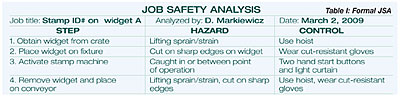
Job safety analysis

The foundation of all occupational safety management programs hinge on some form of safety assessment, such as a Job Safety Analysis (JSA). A JSA has three main parts: 1) job step; 2) hazard; and 3) control. JSAs may be informal or formal. Every job in a work organization should be assessed even before the actual work commences.

An informal JSA is a non-documented practice. A formal JSA is documented. An example of a formal JSA is shown in Table I below:

JSAs evolve from basic to advanced depending upon the complexity and of the work being performed and sophistication of the organization.
5 key definitions

  • Hazards: Hazards are anything that may cause harm including chemical, physical, ergonomic, electrical, biological, radiological, and psychological acts or conditions. Unsafe acts generally cause more harm than unsafe conditions. Hazards that cause injury are easier to recognize than hazards that cause illness.

    Hazards and exposure should be described with action verbs. Examples include: impact with falling object; fall from elevated surface; and, contact with electrical current.

  • Harm: Harm generally results from a sequence of events that have a root cause being either a condition or act, or both. Some people may be more prone to harm than other people. Management has control over all conditions in the workplace and influences all acts through rewards and punishments.

    Harm may be described in categories that include death, recordable injury, first-aid, and near-miss. Proportionally, there are very few deaths and many near-misses in occupational settings. To prevent death management must focus on controlling near-misses.

    An injury happens immediately. An illness takes time, sometimes years, to develop. If harm doesn't occur in a snap of the fingers, it is generally classified as an illness. Some researchers claim that significantly more workers die from workplace illness than through injuries, but this claim must be viewed in the longterm and big picture of all workplace exposures.

  • Controls: The hierarchies of controls, from most effective to least effective, are: Elimination; Substitution; Engineering Controls e.g. ventilation; Warnings e.g. signs; Administrative Controls e.g. training; and Personal Protective Equipment (PPE). PPE should only be used while other controls are being investigated or installed.

  • Risk: Risk (reciprocal of safety) is the likelihood that harm will result when hazards are uncontrolled. The acceptance of risk should be made jointly by management and employees. An acceptance of risk implies an awareness of the risk, which is generally accomplished through training.

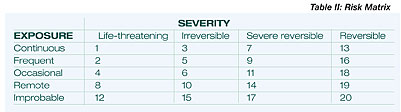
    Risk may be assessed formally by a matrix that considers frequency and severity. An example of a risk matrix is shown in Table II above.

    Risk matrices are supported by ranking schemes based on numbers; such as: High Risk (1-5); Serious Risk (6-9); Medium Risk (10-17); and, Low Risk (18-20). A desired result (management practice) may be to be proactive on all high/serious risks and be reactive to medium/low risk.

  • Measurements: Measurements keep management on track to reach a destination. Measurements come in many forms including inspections, audits, assessments, investigations, and records. The basic measurement for most workplaces is the OSHA 300 Form for recording and tracking employee injury and illness.

Share This Story

Looking for a reprint of this article?
From high-res PDFs to custom plaques, order your copy today!

Dan Markiewicz, MS, CIH, CSP, RMP, is an independent environmental health and safety consultant and a long-time columnist. He can be reached at (419) 356-3768 or by email at dan.markiewicz@gmail.com.

Recommended Content

JOIN TODAY
to unlock your recommendations.

Already have an account? Sign In

  • forklift safety

    Exploring the latest technologies in forklift safety

    With more staff and more stock in warehousing now more...
    Workplace Training Strategies
    By: Josh Cramer
  • welding

    All about welder’s flash or arc eye

    A flash burn is a painful inflammation of the cornea,...
    Environmental Health and Safety
  • dangerous jobs

    The 10 most dangerous jobs in the U.S.

    On-the-job deaths have been rising — hitting the highest...
    Government Safety Regulations
    By: Benita Mehta
Manage My Account
  • eMagazine Subscriptions
  • ISHN Newsletter & Other Newsletter Alerts
  • Online Registration
  • Manage My Preferences
  • Subscription Customer Service

More Videos

Sponsored Content

Sponsored Content is a special paid section where industry companies provide high quality, objective, non-commercial content around topics of interest to the ISHN audience. All Sponsored Content is supplied by the advertising company and any opinions expressed in this article are those of the author and not necessarily reflect the views of ISHN or its parent company, BNP Media. Interested in participating in our Sponsored Content section? Contact your local rep!

close
  • man wearing the the Sundström SR200 Full Face Mask Respirator
    Sponsored byOHD

    5 Fit Testing Mistakes That Could Cost You

  • This image shows Magid AcuSpex polarized blue mirrored safety glasses.
    Sponsored byMagid Glove and Safety

    Construction PPE Guide: What Crews Need for Each Task

  • lone worker in confined space
    Sponsored byAlphasense Ltd.

    GET THE LEAD OUT of your Safety Oxygen Sensors!

Popular Stories

SpaceX 7 launch

OSHA Investigating Fatal Fall at SpaceX Starbase

Worker Impairment

How to Tell When a Co-Worker is Impaired? A Safety Pro’s Challenge

psychology in the workplace

Most Workplaces Measure Psychological Safety, Ignoring Psychosocial Risks

top 10 most dangerous jobs

Poll

Seasonal Readiness

With the federal heat stress prevention rule on the horizon, which area of your safety program needs the most attention?
View Results Poll Archive

Products

Surviving an OSHA Audit A Management Guide, 2nd Edition

Surviving an OSHA Audit A Management Guide, 2nd Edition

See More Products

ISHN Podcasts

Related Articles

  • MANAGING BEST PRACTICES: The Faroes Statement:

    See More
  • MANAGING BEST PRACTICES: The corporate ethics eruption

    See More
  • MANAGING BEST PRACTICES: The fear factor: Deal with it

    See More

Related Directories

  • American Society of Safety Professionals (ASSP)

    The American Society of Safety Professionals (ASSP) is a global association of occupational safety and health professionals who are dedicated to workplace safety. We provide education, safety standards, advocacy and a professional community that supports our diverse members and the profession.
  • Alliance of Women’s Safety Apparel Manufacturers (AWSAM)

    The Alliance of Women's Safety Apparel Manufacturers is a collection of specialty manufacturers and distributors committed to providing properly designed and fitted PPE for women. Our foundational pillars are Awareness, Access and Advocacy. Our non-profit organization has 12 Founding Members and aligns the needs of women in the workforce and the companies they work for with specialty manufacturers dedicated to providing appropriate PPE for women. The Founding Members of the organization have made great strides in removing barriers to access that have existed for many years and kept women from being equally protected. Together, we create a platform that increases awareness of products made for women, encourages equal access to appropriately fitting PPE, and advocates for the safety of women in the workforce. In the spirit of co-opetition, we collaborate to envision what is next for women in industry as we work side by side to accomplish our mission, increase our impact, and share the journey with everyone seeking to elevate diversity and equality in their workplace.
  • Board of Certified Safety Professionals (BCSP)

    Since 1969, BCSP has been setting and certifying the technical competency criteria for safety, health, and environmental practitioners; ensuring safety through certification. In 2019, BCSP developed examCORE a comprehensive educational program for safety certification.
×

Become a Leader in Safety Culture

Build your knowledge with ISHN, covering key safety, health and industrial hygiene news, products, and trends.

JOIN TODAY
  • RESOURCES
    • Advertise
    • Contact Us
    • Directories
    • Manufacturing Division
    • Store
    • Want More
  • SIGN UP TODAY
    • Create Account
    • eMagazine
    • Newsletters
    • Customer Service
    • Manage Preferences
  • SERVICES
    • Marketing Services
    • Reprints
    • Market Research
    • List Rental
    • Survey/Respondent Access
  • STAY CONNECTED
    • LinkedIn
    • Facebook
    • YouTube
    • X (Twitter)
  • PRIVACY
    • PRIVACY POLICY
    • TERMS & CONDITIONS
    • DO NOT SELL MY PERSONAL INFORMATION
    • PRIVACY REQUEST
    • ACCESSIBILITY

Copyright ©2026. All Rights Reserved BNP Media, Inc. and BNP Media II, LLC.

Design, CMS, Hosting & Web Development :: ePublishing