As nations try to snuff out smoking, cigarette makers use trade treaties to fire up legal challenges

|
Posted with permission from FairWarning.org:
Andriy Skipalskyi was feeling proud, even triumphant, when he arrived last March at the World Conference on Tobacco or Health in Singapore.
Ukraine’s parliament had just voted to approve a public smoking ban, and its president had just signed a bill to outlaw tobacco advertising and promotion. These were revolutionary steps in chain-smoking Eastern Europe.
But Skipalskyi, a leading Ukrainian anti-smoking activist, heard little praise for his country from other delegates. As he told FairWarning: “Everyone was talking about Ukraine as the bad actor in the international arena in tobacco control.”
The reason was a bewildering move by Ukraine’s trade ministry. Within hours of the historic steps to curb smoking at home, the ministry, prodded by the tobacco industry, contested a tough anti-smoking law half a world away in Australia.
In a complaint to the World Trade Organization, Ukraine challenged the law, due to take effect December 1, that will ban distinctive logos and colors and require cigarettes to be sold in plain packs. Despite Ukraine having no tobacco exports to Australia—and therefore no clear economic interest—the trade ministry branded the law a violation of intellectual property rights under trade agreements Australia had signed.
Following Ukraine’s lead, Honduras and the Dominican Republic soon joined the attack on Australia, filing similar complaints with the WTO.
The case, which will be decided by an arbitration panel, signals an emerging pattern in the global tobacco wars. As top cigarette makers lose clout with national governments, countries around the world are adopting increasingly stringent rules to combat the public health burdens of smoking. To strike back, tobacco companies are increasingly invoking long-standing trade agreements to try to thwart some of the toughest laws.
The WTO case is only part of a three-pronged legal assault on Australia, aimed both at reversing the plain packaging law and warning other countries of what they might face if they follow its lead.
Public health advocates fear the legal attacks will deter other countries from passing strong anti-smoking measures. The “cost of defending this case, and the risk of being held liable, would intimidate all but the most wealthy, sophisticated countries into inaction,” said Matthew L. Myers, president of the Campaign for Tobacco-Free Kids in Washington D.C.
The dispute underlines broader concerns about trade provisions that enable foreign companies to challenge health, labor and environmental standards. Once a country ratifies a trade agreement, its terms supersede domestic laws. If a country’s regulations are found to impose unreasonable restrictions on trade, it must amend the rules or compensate the nation or foreign corporation that brought the complaint.
Advocates say countries should be free to decide how best to protect public health, without being second-guessed by unelected trade panels. Moreover, they argue, tobacco products, which kill when used as intended, should not be afforded the trade protections of other goods and services.
Worldwide, nearly 6 million people a year die of smoking-related causes, according to the World Health Organization, which says the toll could top 8 million by 2030. With fewer people lighting up in wealthy nations, nearly 80 percent of the world’s 1 billion smokers live in low-and middle-income countries.
Countries have been emboldened to pass more stringent measures by the Framework Convention on Tobacco Control. In effect since 2005, the treaty has committed about 175 nations to pursue such measures as higher cigarette taxes, public smoking bans, prohibitions on tobacco advertising, and graphic warning labels with grisly images such as diseased lungs and rotting teeth. (The U.S. has signed the treaty, but the Senate has not ratified it. The U.S. Food and Drug Administration has ordered graphic warnings for cigarette packs, but an industry court challenge on 1st Amendment grounds has stalled the rule.)
Line in the Sand
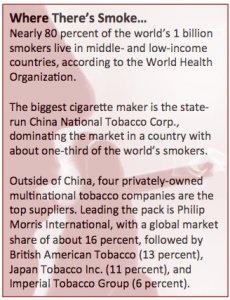 Cigarette makers say they acknowledge the hazards and the need for regulations. “We actually support the vast majority of them,” said Peter Nixon, vice president of communications for Philip Morris International, which has its headquarters in New York, its operations center in Switzerland, and is the biggest multinational cigarette maker with 16 percent of global sales.
But the industry has watched with growing concern as more than 35 countries have adopted total or near-total bans on cigarette advertising. Its big profits depend on consumer recognition of its leading brands. Yet in many countries, the once-ubiquitous logos and imagery are receding, leaving the cigarette pack as a last refuge against invisibility.
Now the pack, too, is under attack. Along with plain packaging laws such as Australia’s, countries are weighing retail display bans that keep cigarette packs out of view of consumers, and graphic health warnings so large that there is barely room for trademarks. Tobacco companies contend that countries enforcing such rules are effectively confiscating their intellectual property and must pay damages.
The industry also claims that measures like plain packaging are counterproductive. “We see no evidence—none at all—that this will be effective in reducing smoking,” Nixon of Philip Morris International said in an interview. In fact, he said, generic packaging likely will increase sales of cheap, untaxed counterfeit smokes, thus increasing consumption.
Louis C. Camilleri, chairman and CEO of Philip Morris International, drew a line in the sand in remarks to Wall Street analysts in November, 2010. The company would use “all necessary resources and…where necessary litigation, to actively challenge unreasonable regulatory proposals,’’ Camilleri said, specifically mentioning plain packaging and display bans.
Up to now, tobacco-related trade disputes have mostly involved quotas or tariffs meant to protect domestic producers from foreign competition. In the 1980s and ’90s, for example, the Office of the U.S. Trade Representative successfully challenged such barriers in Taiwan, Japan, South Korea and Thailand, boosting sales for U.S. cigarette makers R.J. Reynolds and Philip Morris.
The U.S. got a taste of its own medicine when a WTO panel in April upheld a ruling that the U.S. had discriminated against Indonesia by enforcing a ban on flavored cigarettes that exempted menthol but included Indonesian clove cigarettes. The U.S. has until next July to amend the law by treating all flavorings the same or to reach an agreement with Indonesia on compensation.
Ticking Time Bomb
The key issue now, though, isn’t traditional barriers but whether health regulations unduly restrict the movement of goods. In challenging anti-smoking rules, the industry has drawn on global treaties, such as the 1994 pact known as TRIPS (the Agreement on Trade Related Aspects of International Property Rights), that include broad protections for intellectual property and foreign investment.
|
“We will continue to use all necessary resources…and where necessary litigation, to actively challenge unreasonable regulatory proposals.” –Louis Camilleri, chairman and CEO of Philip Morris International. |
In the hands of aggressive corporations, such provisions have become “the ticking time bomb for this century as governments tackle problems like tobacco, the environment, obesity, access to essential medicines,” said Myers of the Campaign for Tobacco-Free Kids.
Events in the southern African nation of Namibia reflect the debate. In November, 2011, Namibian officials proposed to require graphic warnings on at least 60 percent of cigarette packs. The tobacco industry argued in written comments that such large warnings weren’t justified and, in the words of British American Tobacco, would “impose a very significant barrier to trade.” Namibia should pursue public health goals “in a manner that is respectful of its international obligations,” the company said.
The proposal is still pending, but Stanley Mungambwa, a senior health official in Namibia, sounded a defiant note in an email to FairWarning. “Namibia is a country that loves its people,” he said. “Money obtained from coffins is not what Namibia’s trade obligations is all about.”
Canada provided an early example of the possible chilling effects of industry threats. Though considered a leader in tobacco control, Canada in the mid-1990s withdrew a proposed plain packaging rule under legal pressure from the industry, which raised the issue of Canada’s trade obligations.
That happened even though internal documents produced later in tobacco litigation showed that industry officials, despite their public stance, feared their legal position was weak. As a 1994 memo from British American put it, “current conventions & treaties offer little protection” against plain packaging rules.
No Slam Dunks
Two recent legal decisions confirmed that such cases are no slam dunk for the industry. In September, a court in Oslo, Norway, rejected a lawsuit by Philip Morris Norway AS that challenged the country’s retail display ban. The company had claimed that in enforcing the ban, Norway had violated the European Economic Agreement by failing to use the least trade-restrictive measures to achieve its public health goals.
The court, siding with Norway’s government, found that other measures would not be as effective in insuring that “as few as possible youngsters begin to smoke, to prevent them from developing tobacco dependency.”
The second example was Australia’s victory in the first phase of its legal defense of plain packaging. Rejecting a lawsuit by the four top global companies–Japan Tobacco Inc. and Imperial Tobacco, along with British American and Philip Morris International—Australia’s High Court upheld the law as legal and constitutional.
The law requires that all cigarettes be sold in drab olive-brown packs, with pictorial warnings covering 75 percent of the front and 90 percent of the back.
The goal is to reduce “the attractiveness and appeal of tobacco products to consumers, particularly young people,” a spokeswoman for Australia’s Department of Health and Ageing said in an email to FairWarning.
But two major challenges remain.
In one, Philip Morris Asia has accused Australia of violating a 1993 bilateral trade pact between Hong Kong and Australia. Such agreements, known as investor-state treaties, allow a foreign investor by itself to bring damage claims against a country.
Lawyers for Australia contend the claim should be tossed out, citing a nimble asset-shuffling move by Philip Morris. To create grounds for the claim, they say, the company transferred its Australian operations to Hong Kong-based Philip Morris Asia after the plain packaging plan was announced.
The shares were transferred “for the very purpose of claiming a loss,” said Benn McGrady, an adjunct professor of law at Georgetown University and expert on global trade and health. This, he said, should be “virtually terminal in terms of the merits of their claim.”
Nixon of Philip Morris said the transfer should have no impact on the outcome. The case is before an arbitration panel of the United Nations Commission on International Trade Law.
Heavyweight Law Firms
And the WTO cases also remain alive. Cigarette makers are paying for heavyweight lawyers to represent Ukraine, Honduras and the Dominican Republic and press ahead with the challenges.
As company representatives have told FairWarning, Philip Morris International is paying the firm of Sidley Austin to represent the Dominican Republic, while British American is picking up legal expenses for Ukraine and Honduras.
“We are happy to support countries who, like us, feel plain packaging could adversely affect trade,” said British American spokesman Jem Maidment.
It’s not unusual in trade disputes for corporations to give legal assistance to governments with mutual interests. In this case, however, the three countries appear to have little direct stake in Australia’s tobacco control policies.
Tobacco exports from Ukraine to Australia are nonexistent, according to figures from Australia’s Department of Foreign Affairs and Trade. During the last three years, tobacco exports from Honduras and Dominican Republic have averaged $60,000 (U.S.) and $806,000, respectively.
Responding in April to an inquiry from Ukrainian journalists, the country’s Ministry of Economic Development and Trade said it had “a policy of supporting Ukrainian producers and protecting their interests in the internal and external markets.” In this case, the ministry said, it had “received concerns” about the plain packaging law from the Ukrainian Association of Tobacco Producers, made up of the top tobacco multinationals, and from the Union of Wholesalers and Producers of Alcohol and Tobacco Association.
Seeking to reverse Ukraine’s action, Andriy Skipalskyi, the 38-year old chairman of a Ukrainian public health group called the Regional Advocacy Center LIFE, collected hundreds of petition signatures at the Singapore conference asking his nation’s authorities to withdraw the challenge. The government ignored the request, and Honduras and Dominican Republic soon followed with complaints of their own.
Konstantin Krasovksy, a tobacco control official in Ukraine’s Ministry of Health, told FairWarning the countries had allowed themselves to be used. “Honduras, Dominican Republic and Ukraine agreed to be a prostitute,” he said.
Honduran officials, in an April press release, said Australia’s law “contravenes several WTO obligations on intellectual property rights.’’ It noted that the tobacco industry “employs several hundred thousand people directly and indirectly throughout the supply chain in Honduras.”
The Dominican Republic, a major cigar exporter, also said plain packaging “will have a significant impact on our economy.” In a written statement to FairWarning, Katrina Naut, director general for foreign trade with the country’s Ministry of Industry and Commerce, said that if other countries join Australia in adopting plain packaging, it will lead to falling prices for name-brand tobacco products and “an increase—rather than a decrease—in consumption and illicit trade.”
Battle in Uruguay
Among supporters of Australia, none is more vociferous than the government of Uruguay. It recently told the WTO’s Dispute Settlement Body that the global trading system “should not force its Members to allow that a product that kills its citizens in unacceptable and alarming proportions continues to be sold wrapped as candy to attract new victims.”
The stance reflects Uruguay’s own high-stakes battle with Philip Morris.
As of December 1, all cigarettes must be sold in plain packaging with graphic warnings covering 75 percent of the front and 90 percent of the back of the pack. (Canadian Cancer Society)
The company has challenged Uruguay’s requirement of graphic warnings on 80 percent of cigarette packs. Philip Morris is also fighting a rule that limits cigarette marketers to a single style per brand, making it illegal to sell Marlboro Gold and Green along with Marlboro Red.
The challenge by Swiss units of Philip Morris cites a 1991 bilateral treaty between Switzerland and Uruguay. Since filing the complaint in 2010, the tobacco company has also closed its only cigarette factory in Uruguay.
The regulations “are extreme, have not been proven to be effective, have seriously harmed the company’s investments in Uruguay,” according to a statement by Philip Morris International.
Uruguay, with a population of less than 3.5 million and an annual gross domestic product of about $50 billion, seems a poor match for the tobacco giant, which recorded $77 billion in sales in 2011.
Amid reports that government officials were seeking a face-saving settlement, Bloomberg Philanthropies announced in late 2010 that it would fund the legal defense of Uruguay’s anti-smoking laws. New York Mayor and businessman Michael R. Bloomberg, an ardent tobacco foe, affirmed the support of his namesake charity in a call to Uruguayan president Jose Mujica.
Advocates fear other countries may have a harder time standing their ground. “Bloomberg has been very generous, but his resources are not unlimited and he can’t pay to defend every tobacco regulation in every country,” said Chris Bostic, deputy director for policy for the group Action on Smoking and Health.
The Uruguay case could be pivotal, said Dr. Eduardo Bianco, president of the Tobacco Epidemic Research Centre in Uruguay. “If they [Philip Morris International] succeed with Uruguay they would send a clear message to the rest of the developing countries: ‘take care about us, you can be next.’”
About FairWarning
FairWarning (www.fairwarning.org) is a nonprofit, online news organization focused on issues of safety, health and government and business accountability.
Looking for a reprint of this article?
From high-res PDFs to custom plaques, order your copy today!
 Myron Levin founded FairWarning after more than 20 years as a staff writer for the Los Angeles Times, where he was a member of the California investigations desk. He has won numerous honors and awards for his detailed investigations of health and safety matters, including an Alicia Patterson Foundation fellowship and the National Press Club’s Consumer Journalism Award. He has reported on the tobacco industry, auto and tire safety, and a variety of product liability issues. He likes hiking and playing racquetball, and he owns a minuscule share of a professional minor league baseball team. Myron is a member of FairWarning’s board of directors.