Updates proposed for nutrition labels on food packages
"Added sugar" added, salt daily value lowered
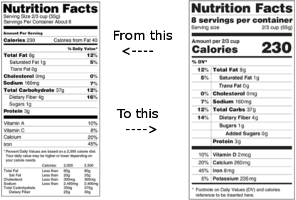 Would having the calories-per-serving in VERY LARGE numbers influence your decision to purchase – or not purchase – a food item?
You’ll get the chance to find out, if the FDA’s bid to revise the Nutrition Facts labels found on packaged foods is successful.
A fresh design
The agency said the proposed changes “reflect the latest scientific information, including the link between diet and chronic diseases such as obesity and heart disease. The proposed label also would replace out-of-date serving sizes to better align with how much people really eat, and it would feature a fresh design to highlight key parts of the label such as calories and serving sizes.”
FDA Commissioner Margaret A. Hamburg, M.D. said the labels have provided helpful information to consumers for 20 years, but needed to incorporate the latest in nutrition science in order to remain relevant, “as more has been learned about the connection between what we eat and the development of serious chronic diseases impacting millions of Americans.”
Last label change led to healthier ingredients
The label has not changed significantly since 2006 when information on trans fat had to be declared on the label, prompting manufacturers to reduce partially hydrogenated oils, the main source of trans fat, in many of their products.
“Our guiding principle here is very simple: that you as a parent and a consumer should be able to walk into your local grocery store, pick up an item off the shelf, and be able to tell whether it’s good for your family,” said First Lady Michelle Obama.
Some of the changes to the label the FDA proposed today would:
- Require information about the amount of “added sugars” in a food product. The 2010 Dietary Guidelines for Americans states that intake of added sugar is too high in the U.S. population and should be reduced. The FDA proposes to include “added sugars” on the label to help consumers know how much sugar has been added to the product.
- Update serving size requirements to reflect the amounts people currently eat. What and how much people eat and drink has changed since the serving sizes were first put in place in 1994. By law, serving sizes must be based on what people actually eat, not on what people “should” be eating. Present calorie and nutrition information for the whole package of certain food products that could be consumed in one sitting.
- Present “dual column” labels to indicate both “per serving” and “per package” calorie and nutrition information for larger packages that could be consumed in one sitting or multiple sittings.
- Require the declaration of potassium and vitamin D, nutrients that some in the U.S. population are not getting enough of, which puts them at higher risk for chronic disease. Vitamin D is important for its role in bone health. Potassium is beneficial in lowering blood pressure. Vitamins A and C would no longer be required on the label, though manufacturers could declare them voluntarily.
- Revise the Daily Values for a variety of nutrients such as sodium, dietary fiber and Vitamin D. Daily Values are used to calculate the Percent Daily Value on the label, which helps consumers understand the nutrition information in the context of a total daily diet.
- While continuing to require “Total Fat,” “Saturated Fat,” and “Trans Fat” on the label, “Calories from Fat” would be removed because research shows the type of fat is more important than the amount.
- Refresh the format to emphasize certain elements, such as calories, serving sizes and Percent Daily Value, which are important in addressing current public health problems like obesity and heart disease.
The science
The proposed updates reflect new dietary recommendations, consensus reports, and national survey data, such as the 2010 Dietary Guidelines for Americans, nutrient intake recommendations from the Institute of Medicine, and intake data from the National Health and Nutrition Examination Survey (NHANES). The FDA also considered extensive input and comments from a wide range of stakeholders.
The changes proposed today affect all packaged foods except certain meat, poultry and processed egg products, which are regulated by the U.S. Department of Agriculture’s Food Safety and Inspection Service.
Too much sugar and salt
“Americans have too much added sugar in their diets, and making them more aware of the total amounts of added sugars is a huge step forward,” said Nancy Brown, CEO of the American Heart Association (AHA), who added that changing the Reference Amounts Customarily Consumed (RACCs) in 17 food categories “will help people better understand how many calories they actually consume, especially if they plan to eat all the food in a container or package.”
The AHA also cheered the FDA’s decision to lower the Daily Value for Sodium to 2300 mg -- the amount recommended in the current Dietary Guidelines for Americans – but wants the amount even lower.
“There is strong scientific evidence that indicates lowering sodium can result in significant reductions in blood pressure. Consequently, the association will continue to recommend sodium intake to be limited to 1,500 milligrams a day. We intend to work with the FDA, during this 90-day comment period and beyond if need be, to highlight the increased benefits from further sodium reductions, and to advocate for stronger action.”
The FDA is accepting public comment on the proposed changes for 90 days.
For more information:
Looking for a reprint of this article?
From high-res PDFs to custom plaques, order your copy today!