If you are getting the impression that the flu season is worse than usual this year, you’re right. The CDC, which tracks the number of people who seek treatment for the flu, confirms that the numbers are higher than last year in all regions of the country.
If you have gone to the doctor recently with flu-like symptoms, your doctor may have advised you to stay home from work until you have recovered. But, do you know if your doctor and other health care workers also follow that advice?
You cannot get a cold by being cold and you can’t cure a cold with antibiotics. These are just two of the misconceptions about the common cold that persist, despite efforts from the health care community to dispel them.
The great interest in the illness is understandable. In the U.S. alone, adults average two to three colds per year and children get even more, according to the Centers for Disease Control and Prevention (CDC).
Under Food Code, to prevent spread of foodborne illness, yes
December 14, 2017
While health concerns are usually considered private matters, the Centers for Disease Control and Prevention (CDC) wants restaurant managers to talk to employees who are ill, to make sure they don’t spread foodborne illness to co-workers and customers.
It’s a significant problem. Nearly half of restaurant-related outbreaks are caused by sick food workers.
Managers may be hesitant to ask their employees about symptoms and diagnoses, especially since that conversation might lead to workers missing work and forgoing pay.
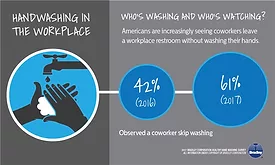
It may not be the first thing that comes to mind when one thinks of workplace conditions, but the state of restrooms – it turns out – is very important to American workers. In fact, the vast majority of workers – 89 percent - believe the condition of a workplace restroom is one indicator of how a company values its workforce.
In addition to protecting against inhalation of harmful airborne particles, sample units from four models of N95 filtering-facepiece respirators (FFRs) were found to be resistant to fluid penetration by synthetic blood in laboratory tests by the National Institute for Occupational Safety and Health (NIOSH) and an independent testing laboratory.
The flu is spread when a person who has the virus sneezes or coughs into the air or onto a surface. When someone breathes in or touches his or her eyes, nose or mouth after touching an item contaminated with the virus, he or she may contract the flu.
As we enter another influenza season, one question continues to vex medical and public health professionals: How do you stop people from catching the flu? The best way to prevent the flu is by getting an influenza vaccine every year. However, in the event of a large-scale influenza outbreak of a new virus strain or a pandemic, when influenza vaccine may not be promptly available, we will see tremendous demands on the health care system and its workers.
CDC recommends vaccination and antiviral treatment
January 11, 2013
Influenza activity continues to increase in the United States and most of the country is now experiencing high levels of influenza-like-illness (ILI), according to CDC’s latest FluView report. “Reports of influenza-like-illness (ILI) are nearing what have been peak levels during moderately severe seasons,” according to Dr. Joe Bresee.