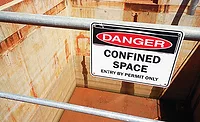
Confined space entry
In 2009, OSHA standard Confined Space
1910.146 was the 33rd most commonly cited
regulation, but it’s the eighth most costly, coming
in at just more than $3 million and more
than 1,000 citations. The average cost per citation
for confined space violations makes it the third most
costly regulation on OSHA’s list.
When companies look to comply with confined space 1910.146, they often go right to the regulation, read it over and then say, OK how do we comply with this to the letter of law? That’s the problem. The law doesn’t necessarily tell you which spaces are confined spaces and which are not. It leaves a large gray area open to interpretation for classifying confined spaces and even further classifying those spaces as permit or non-permit.
Let’s briefly review what OSHA expects to see for minimum compliance:
Confined Space Inventory Assessment – OSHA wants to see all your confined spaces listed in one place and classified as permit or non-permit spaces. Confined spaces should be labeled at the point of entry to help ensure full communication to possible entrants that they are about to enter a confined space.
Confined Space PPE – Air testing equipment specific to your industry and site needs should be available to your employees who will be entering the space. Equipment must be maintained and documented that the maintenance was done correctly (i.e. testing prior to use, sent off for calibration at device specific intervals, etc.).
Confined Space Policy, Procedures, and Training – Perhaps the most important element of a confined space program is to train the employees on the typical hazards that may be present in your confined spaces, your company policy on confined space, and the usage of your space-specific entry procedures. For permit required confined space, OSHA wants to see specific entry procedures that the entrant can follow to ensure the spaces is rendered safe to enter for their specific service.
The best way to create an inventory list is to decide what you are comfortable leaving off the list. Obviously if you leave something off and someone gets hurt because of it, you will not have done your job correctly. So work backwards from the intent: To keep people safe when entering spaces that are not designed for continuous occupancy. By checking each space with that logic, it becomes clearer what should and should not be on your list.
Once you have your inventory list created, classify which spaces are permit required and which are not. Permit required confined spaces (PRCS) are more hazardous and require specific procedures to be followed before entering to neutralize the hazards. Spaces that are less likely to cause harm to entrants are non-permit confined spaces.
Most readers of this article may not be authorized entrants, but may be in charge of training or influencing the training for the entrants. When designing a confined space procedure format for your company, it’s important to put some thought into how the program will be maintained. If there are discrepancies on the procedure, there should be a direct number they can call to let someone know that it needs correction. If they have questions, who can they call, etc.? All of this information, along with the specific entry and exit techniques, should go on the back of every procedure to ensure a basic coverage system-wide. The front side of the procedure is where the performance is gained and it’s where there is no rulebook of what it must contain or how it must be laid out.
a. Include reference to any Lockout-Tagout procedures that must be followed prior to entry.
2. Next show picture layout of the entry points with tag labels pointing to specific entry points.
3. Show PPE required for entering that space (some PPE may only be required at times which is why we recommend using a table with yes, no, and sometimes column).
4. Show hazards with pictures if possible. Take pictures of gas lines, moving parts, possible entrapment hazards, etc., so that the entrant can quickly see what to expect from this space.
5. Explain what the magnitude of each hazard is and how to neutralize and verify that it has been properly neutralized.
Audit your confined space procedures annually when you audit your machine-specific LOTO procedures. Since the two programs work together, it makes sense to maintain them together.
Utilizing a graphic confined space program will give your company and your authorized entrants the best chance at ensuring safety is achieved and maintained throughout each confined space entry.
When companies look to comply with confined space 1910.146, they often go right to the regulation, read it over and then say, OK how do we comply with this to the letter of law? That’s the problem. The law doesn’t necessarily tell you which spaces are confined spaces and which are not. It leaves a large gray area open to interpretation for classifying confined spaces and even further classifying those spaces as permit or non-permit.
Let’s briefly review what OSHA expects to see for minimum compliance:
Confined Space Inventory Assessment – OSHA wants to see all your confined spaces listed in one place and classified as permit or non-permit spaces. Confined spaces should be labeled at the point of entry to help ensure full communication to possible entrants that they are about to enter a confined space.
Confined Space PPE – Air testing equipment specific to your industry and site needs should be available to your employees who will be entering the space. Equipment must be maintained and documented that the maintenance was done correctly (i.e. testing prior to use, sent off for calibration at device specific intervals, etc.).
Confined Space Policy, Procedures, and Training – Perhaps the most important element of a confined space program is to train the employees on the typical hazards that may be present in your confined spaces, your company policy on confined space, and the usage of your space-specific entry procedures. For permit required confined space, OSHA wants to see specific entry procedures that the entrant can follow to ensure the spaces is rendered safe to enter for their specific service.
Create an inventory list
Start with the inventory assessment to know how many confined spaces you have. This is a difficult task because decisions need to be made about how much risk the company is willing to take on in the gray area. Some spaces, like closets, most will agree does not need to be on a confined space assessment. But how about fluid drains with grates overhead, large air handler units, elevator service rooms, etc.?The best way to create an inventory list is to decide what you are comfortable leaving off the list. Obviously if you leave something off and someone gets hurt because of it, you will not have done your job correctly. So work backwards from the intent: To keep people safe when entering spaces that are not designed for continuous occupancy. By checking each space with that logic, it becomes clearer what should and should not be on your list.
Once you have your inventory list created, classify which spaces are permit required and which are not. Permit required confined spaces (PRCS) are more hazardous and require specific procedures to be followed before entering to neutralize the hazards. Spaces that are less likely to cause harm to entrants are non-permit confined spaces.
Obtain PPE and equipment
Now that you have your list of permit required confined spaces, you must buy specific PPE for your facility. Identify the hazards that could be present in your spaces, then go with the meter that gives you all of these readings. It’s also important to know that the equipment isn’t just meter and respirators, but also sometimes ventilators, entrance guarding, emergency rescue equipment, etc. The PPE you select at this point will help you when you create specific procedures in the next step that can be followed by the authorized entrants to render the space safe for their specific service.Create procedures
This is where you can gain performance in your program by upgrading it to a graphical, intuitive approach. When authorized entrants are tasked with entering a space, it might be the third time they have entered that space that day, or it might be the first time they have entered it in months. They need a procedure that quickly gives them a visual list of the points of entry, hazards present, and PPE required.Most readers of this article may not be authorized entrants, but may be in charge of training or influencing the training for the entrants. When designing a confined space procedure format for your company, it’s important to put some thought into how the program will be maintained. If there are discrepancies on the procedure, there should be a direct number they can call to let someone know that it needs correction. If they have questions, who can they call, etc.? All of this information, along with the specific entry and exit techniques, should go on the back of every procedure to ensure a basic coverage system-wide. The front side of the procedure is where the performance is gained and it’s where there is no rulebook of what it must contain or how it must be laid out.
Procedure flow set-up from top to bottom:
1. Start with the header information at the top that identifies the space specific name, document number, creation date, audited date, etc.a. Include reference to any Lockout-Tagout procedures that must be followed prior to entry.
2. Next show picture layout of the entry points with tag labels pointing to specific entry points.
3. Show PPE required for entering that space (some PPE may only be required at times which is why we recommend using a table with yes, no, and sometimes column).
4. Show hazards with pictures if possible. Take pictures of gas lines, moving parts, possible entrapment hazards, etc., so that the entrant can quickly see what to expect from this space.
5. Explain what the magnitude of each hazard is and how to neutralize and verify that it has been properly neutralized.
Audit your confined space procedures annually when you audit your machine-specific LOTO procedures. Since the two programs work together, it makes sense to maintain them together.
Utilizing a graphic confined space program will give your company and your authorized entrants the best chance at ensuring safety is achieved and maintained throughout each confined space entry.
Looking for a reprint of this article?
From high-res PDFs to custom plaques, order your copy today!