Keep workers safe before, during & after confined space entry
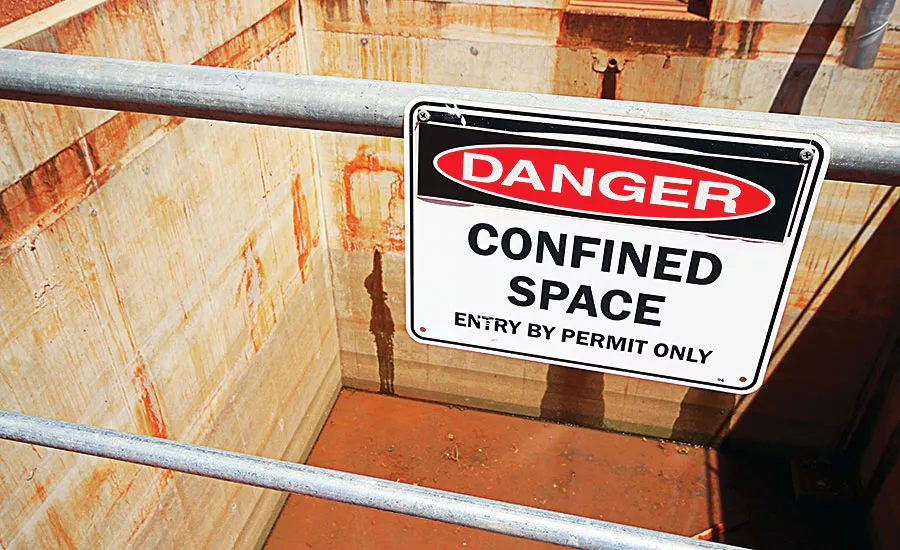
Working in confined spaces often presents unique challenges. These sites—characterized by their limited entry or exit paths and a size that makes them too small for continuous occupancy but large enough for worker activity—are vulnerable to a series of hazards, ranging from toxic gases to faulty structures.
Luckily, these dangers can be mitigated. With over one million workers entering confined spaces each year, it’s essential that safety managers invest in developing a confined space entry (CSE) plan of action, which can help identify and alleviate present risks. By detailing what workers can do before, during and after CSE, such plans give workers the agency necessary to protect themselves—and each other.
Step one: Assess potential hazards
As with all potentially dangerous situations on the worksite, it is crucial for workers to identify job and site-specific health and safety threats. For confined space scenarios, this comes by way of atmospheric testing prior to entering. This assessment has two distinct parts: evaluation testing and verification testing.
Evaluation testing can help identify dangerous airborne chemicals such as hydrogen sulfide (H2S), xylene and hexane, among others. For instance, H2S is particularly prevalent for those who work in confined spaces, since it weighs more than air, and is thus predisposed to accumulate in enclosed areas. In areas where H2S may be present—most commonly around crude petroleum and natural gas deposits or stagnant bodies of water, but also near manmade sites—workers must adhere to the proper protocol from a process and equipment perspective.
While the health hazards of the gas depend on its concentration and the duration of its presence, affects can include headaches (around 10-100 ppm), loss of smell after 2-15 minutes (around 100 ppm), a rapid loss of consciousness (around 700-1000 ppm) and almost instantaneous death (around 1000-2000 ppm). To establish H2S’s presence prior to CSE, workers can use portable gas detectors in conjunction with external pumps and hoses. Detectors with integrated rubber housing, shock-proof sensors and insensitivity to electromagnetic interference can provide superior test information, as they are largely impermeable to harsh environmental conditions.
In scenarios where confined spaces have either (1) potentially hazardous atmospheres (determined via evaluation testing); (2) designs that that can engulf workers; or (3) interiors that can cause asphyxiation, a permit and verification testing may be required.
Performed to ensure that any present chemicals exist at safe levels, verification testing assesses several different atmospheric qualities. Oxygen levels are tested first, since most gas meters fail to provide accurate readings in oxygen-deprived atmospheres. Next, the presence of combustible gases is established, followed by the presence of toxic gases, as the risks presented by the former are often more pressing than those presented by the latter.
Step two: Protect workers accordingly
Once a worksite’s hazards have been identified, it is important to arm workers with the proper safety gear. Respiratory protection, for instance, can help mitigate the effects of airborne threats. To return to the hydrogen sulfide scenario, for exposure levels below 100 ppm, full-face respirators with threefold sealing edges and wide straps can offer sufficient protection and comfort. If H2S levels are equal to or above 100 ppm, however, workers might require a self-contained breathing apparatus (SCBA) with a minimum lifespan of 30 minutes.
Like respiratory protection, portable gas detectors can help safeguard the air workers breathe. In addition to helping with initial atmospheric evaluations, personal detectors can help alert workers to fluctuations in gas concentrations while inside a confined space. Detectors that have sensors placed in multiple locations—at the top and front, for example—are particularly useful, as they can function well regardless of their placement on the workers’ person.
To ensure maximum worker safety, full-fledged monitoring systems can be used. These programs combine various protective measures that defend workers from an array of potential hazards. For example, programs that combine gas detection with video surveillance, access control and a two-way intercom can help defend workers from toxic gases and faulty structures, along with other threats.
Video systems that can monitor several points simultaneously and use infrared technology can be especially beneficial, as the former increases the breadth of surveillance and the latter allows for better vision in dark or dusty environments.
Simple access control systems—designated by a green light that signifies “access granted” and a red light that signifies “access denied,” for instance—can help make CSE processes easily comprehended and unaffected by language barriers.
A two-way intercom is yet another useful monitoring system feature, as it aids communication between interior workers and outside supervisors.
Step three: Exit and repeat
When finished using protective devices, workers should employ the appropriate cleaning and storage techniques. For example, workers might consider disinfecting used respirators, and then placing them in containers that are impervious to harm, contamination and extreme temperatures. By doing so, workers can help maintain device functionality and lifespan and ensure that the devices are ready for their next use.
Notably, workers should not remain in a permit space for longer than the maximum time allotted on the permit. Even if work is left unfinished, employees nearing the end of their allocated stay should exit the confined space and report back to the appropriate person. Upon re-entry, atmospheric testing should be repeated, unless continuous monitoring systems have been employed and are showing it is safe for the re-entry.
A confined space’s safety is never guaranteed, and environmental and structural changes can alter an atmosphere’s composition dramatically. As the saying goes, time is precious—especially when it comes to confined spaces. With the proper knowledge and protection, workers can stay safe on the job and come home uninjured, time and time again.
Information presented herein is for informational purposes only. Follow any applicable internal and external policies, procedures, rules, and regulations as it applies to your workplace environment.
Sources:
Looking for a reprint of this article?
From high-res PDFs to custom plaques, order your copy today!