IGA Helping Hand
Chemical contact: All about glove degradation, permeation & breakthrough time
(a) Appropriate hand protection must be worn when hands are exposed to hazards such as skin absorption of harmful substances, severe cuts, lacerations or abrasions, punctures, chemical or thermal burns and harmful temperature extremes.
(b) Employers must base the selection of appropriate hand protection on an evaluation of the performance characteristics of the hand protection relative to the task(s) to be performed, conditions present, duration of use and the hazards and potential hazards identified.
This rule makes it mandatory to match the right glove material with each application or task. This includes assessing the job for chemical exposures, and then selecting the appropriate chemical protective glove based on material, thickness, length and other traits.
Hazard assessment
A hazard assessment can be performed by an industrial hygienist or other safety professional familiar with the task. The hazard assessment begins with knowing what chemicals or combination of chemicals the task or job requires. The next step is to determine the chemicals’ toxic properties by reviewing the Material Safety Data Sheets (MSDS). Attention should be focused on potential local skin effects, as well as potential absorption through the skin and resultant systemic effects.
When reviewing the job requirements, the degree of dexterity required for each task must be taken into account. Tasks that require fine motor skills, such as laboratory work, may require a thinner glove material, while operations such as industrial parts cleaning may not.
Also, the length of exposure to the chemicals must be considered. Some tasks may require only splash protection or include intermittent contact, while others may involve complete immersion or continual contact with the chemicals.
Other factors to consider are chemical concentration and temperature. The higher the concentration and temperature of a chemical, the shorter the breakthrough time. The hazard assessment must also take into account additional hazards of the job, such as cut or abrasion hazards.
It’s important to remember that although the number of glove choices can be staggering, no one glove can possibly address all types of hand hazards. Gloves are never a substitute for safe work practices or proper engineering controls.
Choosing a glove material
Because different glove materials resist different chemicals, no one glove is suited for all chemical exposures. A glove that is well suited for one application may not be right for another. It is best to base glove material selection on the manufacturer’s chemical resistance guide. From the guide, choose a glove that is most resistant to the chemicals being used. Remember, the actual chemical compatibility of a given glove material can vary from manufacturer to manufacturer. Selections must be based on the particular manufacturer’s test data. To read a chemical resistance guide, it is important to become familiar with the terminology. (See Chemical Compatibility chart below.)
Another factor to consider is chemical combinations. Glove permeation guides generally list test data for pure chemicals only — not mixtures — because combining chemicals can change their physical properties and permeation rates.
In the non-mandatory Appendix B to the personal protective equipment rule, OSHA recommends the following:
(c) For mixtures and formulated products, (unless specific test data are available), a glove should be selected on the basis of the chemical component with the shortest breakthrough time, since it is possible for solvents to carry active ingredients through polymeric materials.
ANSI/ISEA 105-2011
ANSI/ISEA 105-2011, American National Standard for Hand Protection Selection Criteria, provides a consistent, numeric-scale method for manufacturers to rate their products against certain contaminants and exposures. With classifications based on this scale, users can make better-informed decisions about which gloves are best suited for their application.
Glove performance and pass/fail criteria are included for cut, puncture and abrasion resistance; chemical permeation and degradation; detection of holes; heat and flame resistance; and vibration reduction and dexterity.
The standard also includes a recommended hand protection selection procedure, and reference information on special considerations such as biological protection, extreme temperature applications, cleanroom applications, hazardous materials response applications, electrical protection and radiation hazards.
A section on human factors describes how fit, function and comfort are incorporated into glove selection.
Thickness and length
Other choices you must make in selecting chemical protective gloves include thickness and length. Thicker gauge gloves are heavier and have better chemical resistance than thinner gauge gloves. Thinner, lighter gloves offer better touch sensitivity and flexibility while chemical resistance is sacrificed. Glove manufacturers generally state that doubling the thickness of a glove quadruples the breakthrough time of the chemical.
Glove thickness is stated in either mils or gauge. A 10-gauge glove equals 10 mils, or 0.010 inches. When choosing your glove, look for the stated thickness on the manufacturer’s test data.
When assessing the job, also take into account the length of glove needed. Extra splash or immersion protection is provided by gloves longer than 14 inches. For deep tank cleaning or glove box applications, gloves can be as long as 31 inches. Generally longer gloves are made with thicker materials.
Finishes and linings
Gloves also have a variety of finishes and linings. Textured finishes are applied to gloves to give a better grip. Flock and knit linings are offered on many styles of gloves. Cotton flock linings are applied for basic perspiration absorption. Knit linings do this too, as well as offering a small amount of temperature protection.
Inspection and care
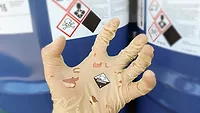
Even the best chemically resistant glove will break down after repeated chemical exposures. Before each use, gloves must be inspected for signs of chemical degradation such as swelling, cracking, shrinking or discoloration of the material. If detected, it means the glove material has undergone a physical change due to chemical contact and will no longer provide chemical protection. Also during inspection, look for any signs of holes or punctures and remove the gloves from service if any are found. For complete care and maintenance instructions, refer to the glove manufacturer’s information.
Commonly asked questions
Q. Can I get a thin surgical glove that offers chemical resistance?
A. Thinner glove materials sacrifice chemical resistance to offer the best touch sensitivity and dexterity. Because surgical gloves are so thin, the material is easily stretched over the hand, allowing better sensitivity. But this stretching also leaves bigger spaces in the glove material at a molecular level. These larger spaces allow a chemical to permeate through very quickly, limiting the amount of time it can be worn. Some surgical nitrile gloves offer limited splash protection from chemicals. These gloves are not intended for complete immersion in chemicals, and should only be used for a very limited time period.
Q. Can I decontaminate and reuse gloves?
A. Decontaminating gloves is possible, but generally not practical. The decontamination procedures would probably cost more than replacing the gloves, so glove manufacturers do not recommend it. Gloves are a limited-use item that requires replacement after time and chemical exposures.
Q. Is there a standardized test used to test the chemical compatibility of glove materials?
A. The manufacturer runs permeation and degradation tests in accordance with standards established by the American Society for Testing and Materials (ASTM F739).
Please Note:
The information contained in this publication is intended for general information purposes only. This publication is not a substitute for review of the applicable government regulations and standards, and should not be construed as legal advice or opinion. Readers with specific questions should refer to the cited regulation or consult with an attorney.
Reprinted with permission from Grainger, Quick Tips #191. Find more information you can use to help make informed decisions about regulatory issues you face in your workplace. View all Quick Tips Technical Resources at www.grainger.com/quicktips.
SIDEBAR
Chemical Compatibility
Glove Material: NITRILE
Challenge Chemical Degradation Breakthrough Time Permeation Rate
Isopropanol E >480 min. .001
Breakthrough Time: The elapsed time between initial contact of the chemical on the glove surface and the analytical detection on the inside of the glove. Typically expressed as a greater than symbol (>), the example shows the test was run for 480 minutes and then stopped. This may also be expressed as “ND” for none detected
Degradation: A change in one or more of the physical properties of a glove due to contact with a chemical. Can appear as a swelling, softening, shrinkage or cracking of the material. Rating example is “E” for excellent, meaning the glove has little or no signs of degradation when exposed to the challenge chemical. A good degradation rating does not guarantee an acceptable breakthrough time.
Permeation Rate: The rate at which a chemical passes through a glove material. This process involves absorption on the glove surface, the diffusion of the chemical through the material and desorption on the gloves inside surface. This is a complex measurement: µg/cm2/MIN (micrograms per square centimeter per minute). This measurement is also limited to the “LDL” or Lower Detection Limit of the equipment used. The example given is .001, but is sometimes expressed as “E” or “P” for excellent or poor.
Looking for a reprint of this article?
From high-res PDFs to custom plaques, order your copy today!