ISHN logo
search
cart
facebook twitter linkedin youtube
  • Sign In
  • Create Account
  • Sign Out
  • My Account
ISHN logo
  • NEWS
    • Today's News
    • Global Safety News
    • Government Regulations
  • PRODUCTS
    • Product Innovations
    • Featured Products
  • TOPICS
    • Environmental Health and Safety
    • Facility Safety
    • Workplace Health
    • Occupational Safety
    • PPE
    • More Topics
  • CONSTRUCTION
  • TECHNOLOGY
  • COLUMNS
    • Best Practices
    • Dave Johnson: What’s going on
    • Editorial Comments
    • Leading Safety
  • MULTIMEDIA
    • ISHN Podcast
    • Videos
    • Cold Stress Education Quiz
    • Webinars
    • White Papers
  • MORE
    • Buyer's Guide
    • Newsletters
    • Convention Companion
    • Polls
    • Events
    • ISHN Store
    • Sponsor Insights
  • EMAGAZINE
    • eMagazine
    • Archived Issues
    • Contact
    • Advertise
  • JOIN TODAY!
Today's Safety NewsPPE

Permeation, degradation, and breakthrough: How they affect your PPE

Do your gloves have chemical compatibility?
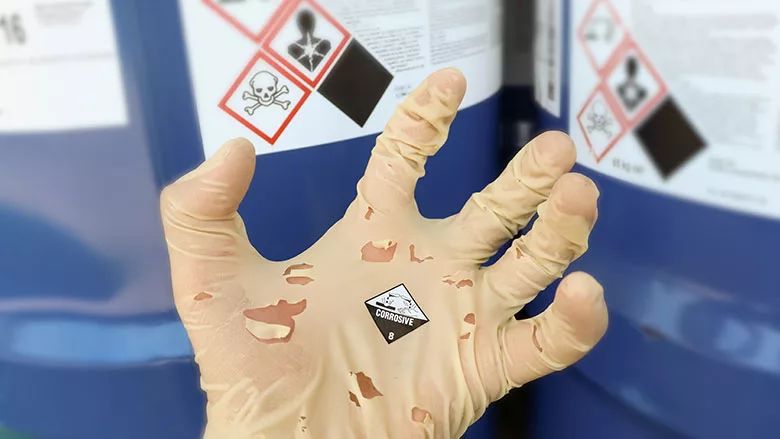
gloves damaged by chemicals
Photo: Kittisak Kaewchalun / iStock / Getty Images Plus via Getty Images

Photo: Kittisak Kaewchalun / iStock / Getty Images Plus via Getty Images

May 10, 2013

Often, employees who are exposed to chemical hazards need to use personal protective equipment (PPE) that includes gloves and, occasionally, chemical protective suits. Chemical protective suits and gloves come in a variety of materials, and no one material protects against all chemical hazards. When choosing PPE, it's important to understand how to properly select the material for the protective apparel your employees wear.

There are three basic criteria that determine chemical compatibility of chemical protective gloves and clothing: permeation rate, degradation, and breakthrough time.

Permeation rate:Permeation rate is a measurement of how quickly a chemical passes through a material at the molecular level. It can be thought of as a slow leak, similar to how air seeps through plastic soda bottles and makes your soda go flat (hence the expiration date on the bottles!). Thicker materials tend to have slower permeation rates. Permeation rates are reported differently by different manufacturers, but a higher number generally means a quicker penetration rate.

Degradation:Degradation is the physical changes to the material caused by the chemical, which can include swelling, stiffening, wrinkling, changes in color, and other physical deterioration. The slower the degradation occurs in the presence of a chemical, the more protective the material is for that specific chemical.

There are no standardized tests for degradation; each manufacturer generally has its own test.

Breakthrough time:Breakthrough time is how much time it takes from the initial contact of the chemical with the material until it is detected on the opposite side of the material (essentially, when it begins to soak through). Obviously, the greater the breakthrough time, the more protective the material is for that particular chemical.

Breakthrough is measured using a standardized test (ASTM F739).

Other considerations

In addition to permeation, degradation, and breakthrough, there are other considerations when buying chemical protective gloves and clothing:

· Just because a glove or chemical protective suit is made from the same material does not mean it is the same from one manufacturer to another. Manufacturers use different blends and manufacturing processes. For this reason, it is important to review the data from the specific glove and clothing manufacturer rather than a "generic" information source.

· Most chemical protective clothing and gloves are tested with single chemicals rather than mixtures. If you need to protect employees who use chemical mixtures, contact the manufacturer to discuss your specific situation.

· Chemical protective clothing is generally tested for specific concentrations of a chemical. Do not assume that because it was tested at a high concentration it will be sufficiently protective at a much lower concentration. If there is no test data for a chemical concentration that is similar to that which you are using, contact the manufacturer to determine if the material is compatible.

· Permeation, degradation, and breakthrough are measured under laboratory, rather than real-world, conditions.You need to examine whether your application has unique considerations that may make a particular material unsuitable for your use, for example, high temperature, low temperature, employee mobility needs, chemical mixtures, etc.

Because there is no one material that can protect against all chemicals, chemical protective gloves and clothing need to be selected on the specific application where it is needed. Understanding how the materials for this type of PPE are evaluated will help you make the appropriate choice for protecting your employees.

KEYWORDS: chemicals Hand Protection PPE protective apparel

Share This Story

Looking for a reprint of this article?
From high-res PDFs to custom plaques, order your copy today!

Recommended Content

JOIN TODAY
to unlock your recommendations.

Already have an account? Sign In

  • forklift safety

    Exploring the latest technologies in forklift safety

    With more staff and more stock in warehousing now more...
    Workplace Training Strategies
    By: Josh Cramer
  • welding

    All about welder’s flash or arc eye

    A flash burn is a painful inflammation of the cornea,...
    Environmental Health and Safety
  • dangerous jobs

    The 10 most dangerous jobs in the U.S.

    On-the-job deaths have been rising — hitting the highest...
    Transportation Safety
    By: Benita Mehta
Manage My Account
  • eMagazine Subscriptions
  • ISHN Newsletter & Other Newsletter Alerts
  • Online Registration
  • Manage My Preferences
  • Subscription Customer Service

More Videos

Sponsored Content

Sponsored Content is a special paid section where industry companies provide high quality, objective, non-commercial content around topics of interest to the ISHN audience. All Sponsored Content is supplied by the advertising company and any opinions expressed in this article are those of the author and not necessarily reflect the views of ISHN or its parent company, BNP Media. Interested in participating in our Sponsored Content section? Contact your local rep!

close
  • man wearing the the Sundström SR200 Full Face Mask Respirator
    Sponsored byOHD

    5 Fit Testing Mistakes That Could Cost You

  • This image shows Magid AcuSpex polarized blue mirrored safety glasses.
    Sponsored byMagid Glove and Safety

    Construction PPE Guide: What Crews Need for Each Task

  • lone worker in confined space
    Sponsored byAlphasense Ltd.

    GET THE LEAD OUT of your Safety Oxygen Sensors!

Popular Stories

SpaceX 7 launch

OSHA Investigating Fatal Fall at SpaceX Starbase

Automated loading dock equipment

After March 2026 Rivian Death, Safety Managers Reassess Loading Dock Systems Under OSHA's Warehouse Emphasis Program

psychology in the workplace

Most Workplaces Measure Psychological Safety, Ignoring Psychosocial Risks

top 10 most dangerous jobs

Poll

Seasonal Readiness

With the federal heat stress prevention rule on the horizon, which area of your safety program needs the most attention?
View Results Poll Archive

Products

Surviving an OSHA Audit A Management Guide, 2nd Edition

Surviving an OSHA Audit A Management Guide, 2nd Edition

See More Products

ISHN Podcasts

Related Articles

  • Chemical contact: All about glove degradation, permeation & breakthrough time

    See More
  • PPE in manufacturing

    How to make the most out of your PPE program

    See More
  • Do you want your PPE from a vending machine?

    See More

Related Products

See More Products
  • Top Ten Pitfalls in OSHA Recordkeeping and How to Avoid Them

See More Products

Related Directories

  • DQE Inc.

    Since our founding in 1990, DQE Inc. has remained a committed domestic manufacturer of portable decontamination shower systems and developer of preparedness support solutions. We champion a practical approach to product selection and development informed by our background in national healthcare emergency preparedness and on-scene emergency response. We bring our experience, passion, and knowledge to customers every day to address complex industry challenges. We continue to design novel products and solutions for a diverse mix of organizations across several industries. The DQE global distribution network and export experience allow us to efficiently support multi-national organizations as well. Visit us here to learn more about our legacy and how we continue to help organizations like yours be Ready Now for What’s Next! https://dqeready.com/about-dqe/
  • Grace Industries

    How Do You Protect Your Lone Workers? Working at Heights? Check out our new WorkForce product line - Fall Detection with Immediate Notification – Prevent Suspension Trauma. Fixed Facility – No Monthly Fees. Working in the field? Check out Grace Connected Safety – Cellular and Satellite Cloud Connect
×

Become a Leader in Safety Culture

Build your knowledge with ISHN, covering key safety, health and industrial hygiene news, products, and trends.

JOIN TODAY
  • RESOURCES
    • Advertise
    • Contact Us
    • Directories
    • Manufacturing Division
    • Store
    • Want More
  • SIGN UP TODAY
    • Create Account
    • eMagazine
    • Newsletters
    • Customer Service
    • Manage Preferences
  • SERVICES
    • Marketing Services
    • Reprints
    • Market Research
    • List Rental
    • Survey/Respondent Access
  • STAY CONNECTED
    • LinkedIn
    • Facebook
    • YouTube
    • X (Twitter)
  • PRIVACY
    • PRIVACY POLICY
    • TERMS & CONDITIONS
    • DO NOT SELL MY PERSONAL INFORMATION
    • PRIVACY REQUEST
    • ACCESSIBILITY

Copyright ©2026. All Rights Reserved BNP Media, Inc. and BNP Media II, LLC.

Design, CMS, Hosting & Web Development :: ePublishing