ISHN logo
search
cart
facebook twitter linkedin youtube
  • Sign In
  • Create Account
  • Sign Out
  • My Account
ISHN logo
  • NEWS
    • Today's News
    • Global Safety News
    • Government Regulations
  • PRODUCTS
    • Product Innovations
    • Featured Products
  • TOPICS
    • Environmental Health and Safety
    • Facility Safety
    • Workplace Health
    • Occupational Safety
    • PPE
    • More Topics
  • CONSTRUCTION
  • TECHNOLOGY
  • COLUMNS
    • Best Practices
    • Dave Johnson: What’s going on
    • Editorial Comments
    • Leading Safety
  • MULTIMEDIA
    • ISHN Podcast
    • Videos
    • Cold Stress Education Quiz
    • Webinars
    • White Papers
  • MORE
    • Buyer's Guide
    • Newsletters
    • Convention Companion
    • Polls
    • Events
    • ISHN Store
    • Sponsor Insights
  • EMAGAZINE
    • eMagazine
    • Archived Issues
    • Contact
    • Advertise
  • JOIN TODAY!

Showers and eyewashes

August 1, 2003
Imagine this: What was "never going to happen to me" has suddenly happened, and you need to get this hazardous material off you - now! It is all over your clothes, hands, face and getting into your eyes. It is starting to hurt - a lot.

You have walked past the emergency shower and eyewash every day and you just need to get there now. But where is it? How far away was it? Can you see it? How can you find it? Will it work when you get there? Can I get some help?

The answers to most of these questions should have been determined before the worker was exposed to that terribly nasty hazardous material.

Back to basics

So, in order to have those answers when you need them, let's go back to the basics. The ANSI Z358.1 standard for Emergency Shower and Eye Wash Equipment is an excellent reference to use as minimum selection criteria for emergency shower and eyewash equipment. The Z358.1 lists, details and describes the dimensions, flow rates and accessories that most North American manufacturers typically use as a compliance target for their product specifications.

Here are six elements of emergency equipment to consider when determining your shower and eyewash safety strategies.

1) Hands-free

Start with the assumption that in most areas where emergency equipment is installed there is potential for worker exposure to hazardous materials that are aggressive and potentially damaging to skin and eye tissue. It is important to understand that any foreign substance that enters the eye will likely cause it to "water" - nature's irrigation process. Even for a particulate, hazard eyewash stations are a necessity at the work site. Peoples' natural tendency is to close their eyes; in this situation they need to hold them open to irrigation, therefore hands-free operation of all equipment becomes necessary.

2) Equipment types

Let's consider the most basic of choices regarding emergency equipment installation. Recommend the use of either plumbed equipment or self-contained stations with sufficient flow per ANSI Z358.1:

  • Basic eyewash when the worker is handling materials that can easily enter the eyes, whether the irritant is aggressive to the eyes or not;

  • Eye/face wash when the material is aggressive and potentially damaging to the eyes and skin and exposure is limited to the facial area only;

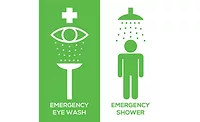
  • A combination shower and eye or eye/face wash where partial or full body exposure from the aggressive material is possible;

  • Adding a drench hose is an excellent component addition in situations when hard-to-reach exposure results in the need to treat upward sprays to areas such as the armpits, under the neck, or when you require localized body irrigation;

  • Personal wash stations in the form of hand-held sized containers. These do not offer sufficient flushing fluid to justify reference as an eyewash station per ANSI. These stations, when positioned directly beside a worker, act as a supplementary device allowing immediate use and the time to get to emergency equipment. A common error can be choosing the wash "bottle" by itself and thinking that you have satisfied the workers need for an eyewash station.

    3) In the right place

    The placement of emergency equipment can be the most crucial decision made when the treatment of workers exposed to hazardous materials is concerned. Carefully consider the distance and travel time between the identified hazard and the safety appliance.

    The first few seconds of exposure to detrimental material can be the most damaging to workers' eyes and skin. Thus, the equipment should be easily accessible but positioned to avoid further contact with the hazardous substance. If necessary, build a barrier between the hazard and the emergency appliance, or locate it away from any spray potential in a well-lit area with proper signage, bringing immediate awareness to the emergency equipment.

    Another important element is the space necessary to allow the user to receive assistance from a coworker if necessary. If disrobing was needed to get the substance away from the skin then modesty curtains are a recommended accessory. The installation of an alarm device is advisable to draw attention to the use of the equipment, especially if the user is working alone or in an isolated area. To be effective this device may need to provide local and remote annunciation indicating the use of the emergency equipment.

    4) Adequate water supply

    The equipment selection alone will not determine that the injured worker will get the results from the safety appliance as required. Most plumbed eyewash stations deliver more than two gallons of water a minute, and volumes become greater as the other appliances are considered. Eye/face wash stations require three or more gallons, emergency showers a minimum of 20 gallons and a drench hose option can add another three gallons per minute each. The potential simultaneous use of multiple stations will result in cumulative volumes of fluid required.

    Determine how many workers are at risk, as the facility utility design must be of a size to support the safety appliance requirements, and install the adequate numbers of emergency stations. Complete the plumbing calculations to determine pipe size for the volume and adequate pressures required to accommodate water flow and ensure that the fluid is available.

    5) Not too hot

    There is no known study published in a medical or industrial workplace journal or healthcare study to use as a testimonial to identify an acceptable target temperature. It is generally acknowledged that the water should be a "tepid" temperature, defined in the ANSI Z358.1 standard as "moderately warm, lukewarm."

    In the Appendix B of that same standard is a recommendation that the water temperature should not exceed 38 degrees C (100 degrees F) for eyewash stations. Many users of temperature-controlled equipment for shower and eyewash stations have specified 80 degrees F to 90 degrees F as the target temperature for years. Consider that the equipment has to be able to deliver water at a usable temperature for the duration of the use of the appliance.

    Whatever your choice of an irrigation temperature, you should take caution to ensure that over-heated water never reaches the emergency equipment user. This is especially important when tempered water systems are used in conjunction with eyewashes as the eye tissue is very sensitive to heat and irrigation of the eyes with flushing fluid at an elevated temperature is a high-risk recommendation. Also, make sure that the system has "failsafe" - a design that will prevent the emergency equipment from contributing to an unsafe and potentially harmful condition to the user.

    6) What's it made of?

    Materials of construction are often overlooked as price comparisons can overcome value frequently. Safety equipment must be constructed of a material suitable to the environment and the conditions in which it is to be installed.

    Most manufacturers provide materials that will not corrode when exposed to water. If the equipment is exposed to aggressive substances that may deteriorate the components, protective pipe coatings, stainless steel or PVC piped units are more suitable and should be considered. The expense of these materials may initially seem high, but consider your application as it may make long-term functional and financial sense.

    The selection of shower and eyewash stations should be carefully completed. While standards can be consulted for minimum requirements, worker needs have to be properly identified relative to the facility and the hazards involved. The safety station placement has to be effective for the worker. This emergency equipment is the last effort in safety and the first step in an injury treatment process.

  • Share This Story

    Looking for a reprint of this article?
    From high-res PDFs to custom plaques, order your copy today!

    Recommended Content

    JOIN TODAY
    to unlock your recommendations.

    Already have an account? Sign In

    • forklift safety

      Exploring the latest technologies in forklift safety

      With more staff and more stock in warehousing now more...
      Facility Safety
      By: Josh Cramer
    • welding

      All about welder’s flash or arc eye

      A flash burn is a painful inflammation of the cornea,...
      Environmental Health and Safety
    • dangerous jobs

      The 10 most dangerous jobs in the U.S.

      On-the-job deaths have been rising — hitting the highest...
      Transportation Safety
      By: Benita Mehta
    Manage My Account
    • eMagazine Subscriptions
    • ISHN Newsletter & Other Newsletter Alerts
    • Online Registration
    • Manage My Preferences
    • Subscription Customer Service

    More Videos

    Sponsored Content

    Sponsored Content is a special paid section where industry companies provide high quality, objective, non-commercial content around topics of interest to the ISHN audience. All Sponsored Content is supplied by the advertising company and any opinions expressed in this article are those of the author and not necessarily reflect the views of ISHN or its parent company, BNP Media. Interested in participating in our Sponsored Content section? Contact your local rep!

    close
    • man wearing the the Sundström SR200 Full Face Mask Respirator
      Sponsored byOHD

      5 Fit Testing Mistakes That Could Cost You

    • This image shows Magid AcuSpex polarized blue mirrored safety glasses.
      Sponsored byMagid Glove and Safety

      Construction PPE Guide: What Crews Need for Each Task

    • lone worker in confined space
      Sponsored byAlphasense Ltd.

      GET THE LEAD OUT of your Safety Oxygen Sensors!

    Popular Stories

    SpaceX 7 launch

    OSHA Investigating Fatal Fall at SpaceX Starbase

    Automated loading dock equipment

    After March 2026 Rivian Death, Safety Managers Reassess Loading Dock Systems Under OSHA's Warehouse Emphasis Program

    psychology in the workplace

    Most Workplaces Measure Psychological Safety, Ignoring Psychosocial Risks

    top 10 most dangerous jobs

    Poll

    Seasonal Readiness

    With the federal heat stress prevention rule on the horizon, which area of your safety program needs the most attention?
    View Results Poll Archive

    Products

    Surviving an OSHA Audit A Management Guide, 2nd Edition

    Surviving an OSHA Audit A Management Guide, 2nd Edition

    See More Products

    ISHN Podcasts

    Related Articles

    • Q&A - Emergency showers & eyewashes

      See More
    • Emergency showers & eyewashes

      See More
    • 15 tips for using showers & eyewashes

      15 tips for using showers & eyewashes

      See More

    Related Directories

    • Hughes Safety Showers

      Hughes design and manufacture emergency safety showers, eye/face wash units and decontamination equipment to provide you with a safer working environment, greater protection against serious injury and peace of mind that you’re compliant with crucial safety standards. From mains and tank fed safety showers to portable self-contained eye washes, we have solutions for every environment.
    ×

    Become a Leader in Safety Culture

    Build your knowledge with ISHN, covering key safety, health and industrial hygiene news, products, and trends.

    JOIN TODAY
    • RESOURCES
      • Advertise
      • Contact Us
      • Directories
      • Manufacturing Division
      • Store
      • Want More
    • SIGN UP TODAY
      • Create Account
      • eMagazine
      • Newsletters
      • Customer Service
      • Manage Preferences
    • SERVICES
      • Marketing Services
      • Reprints
      • Market Research
      • List Rental
      • Survey/Respondent Access
    • STAY CONNECTED
      • LinkedIn
      • Facebook
      • YouTube
      • X (Twitter)
    • PRIVACY
      • PRIVACY POLICY
      • TERMS & CONDITIONS
      • DO NOT SELL MY PERSONAL INFORMATION
      • PRIVACY REQUEST
      • ACCESSIBILITY

    Copyright ©2026. All Rights Reserved BNP Media, Inc. and BNP Media II, LLC.

    Design, CMS, Hosting & Web Development :: ePublishing