Studying the causes of slips, trips and falls
Eyes wide shut
In behavioral safety, the term “eyes on path” describes the behavior of watching where you’re going. Many times, uneven or slippery surfaces can be avoided by simply watching where you are walking.Sounds like a matter of common sense, but of course it’s not always done. We read papers as we walk down the hall, look at someone else, or simply don’t watch the path ahead or look down to see tripping hazards.
Footwear's role
The shoes we wear can play a big part in preventing falls. The slickness of the soles and the type of heels worn need to be evaluated if slips, trips, and falls are to be prevented. Whenever a fall-related injury is investigated, the footwear needs to be evaluated to see if it contributed to the incident.Slippery and uneven surfaces
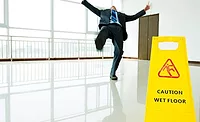
People cause most slippery surfaces — spilled coffee on the floor, oil leaks that haven’t been cleaned up, or highly waxed floors, to name a few. Conditions such as rain and ice are out of our hands, though we do have some control over whether we salt down walkways, use awnings at entryways, and in general deal with the elements. Slippery surfaces are usually a matter of housekeeping.An uneven surface is an injury waiting to occur. Behaviorally, we can usually avoid the problems posed by uneven surfaces by simply recognizing that they are a hazard and acting accordingly.
Tripping hazards
Hoses and cords strung across walkways in production areas are a continual hazard. Cords are also a problem in offices and conference rooms.Most tripping hazards are housekeeping items. Simply using cord protectors and running hoses overhead can reduce these dangers dramatically.
Elevated work areas
OSHA regulations require the use of fall protection devices when working six feet above the ground. This equipment is effective when employees are stationary, but getting to and from the elevated area, as well as tasks that cause continual movement above ground level, can lead to other problems. Employees must be trained in the use of fall arrest equipment — and it has to be used in order to prevent falls.Ladders and stairs
Unsafe behaviors are often involved when we are using ladders and stairs. Some of those at-risk behaviors are:- Not using the handrail;
- Rushing up or down and taking more than one step at a time;
- Failure to secure the ladder or have someone hold it;
- Using a chair or other piece of furniture in place of a ladder; and
- Leaving tripping hazards on the stairs.
Sidebar: Four ways to prevent slips & falls
Simply walking should not be a hazardous activity, yet many companies find that a large portion of their injuries start with a slip, trip, or same-level fall. Slips many times result in head injuries, back injuries, lacerations, fractures, pulled muscles, and deep contusions.The disabling effect of these types of incidents increases as the average worker gets older. A slip or fall that might only embarrass a 20-year-old can cause significant injury to a 40-year-old.
Prevention strategies start with identifying industry-wide causes of slips and trips. Next, modify your work areas to control any hazardous exposures. Modify work practices, too.
Finally, complete your prevention program with employee awareness training.
Controlling slip and trip hazards takes involvement by everyone. Management must commit to actions that implement engineering and work practice controls; supervisors need to conduct inspections and monitor work practices; and employees must use their training to avoid hazardous conditions.
1. Identifying hazards
Poor walking surfaces are the number one contributor to workplace slips and trips.Walking surfaces with worn tiles, curled mats, cracks, missing drain covers, ankle-biters and knee-knockers are a guaranteed environment for slips and falls.
Other factors include material in walkways, improper footwear, inadequate lighting, narrow aisles, horseplay, and blocked vision.
2. Controlling hazards
Start by considering the basic surface of the floor.Areas that routinely experience liquid spills require a good anti-slip coating. The surface should be rough enough to prevent liquid hydroplaning between floor and footwear.
Proper lighting will ensure that employees can see hazards and will provide the illumination needed for employees with poor eyesight.
All aisles should be at least 22 inches wide to eliminate the need to turn sideways when navigating the area.
Place high-visibility guards around ankle-biters and knee-knockers to prevent falls.
All floor mats should have beveled edges to prevent catching.
Use colored strapping material for packing — clear strapping material is very difficult to see on the floor.
Redirect fluid drains to prevent drainage onto walkways. Floor dams around equipment will prevent leakage from becoming a slipping hazard. Placing liquid-absorbing mats at building entrances and wet process areas will prevent the tracking of liquid.
3. Modifying work practices
Look at the processes that create liquid spills, material accumulation in walkways, and damage to floors.Place waste containers where they can be easily accessed.
Materials for cleanup must be easily accessible near potential sources of spills.
Examine the rate of accumulation of production scrap and then institute controls that prevent hazards.
Conduct pre-shift inspections of all work areas to ensure all slip and trip hazards are controlled.
Replace burnt light bulbs as soon as they are identified.
Don’t allow any material to be placed on stairs, crossovers, or between ladders and walls.
Provide a means of material movement that eliminates the blocking of vision.
4. Making employees aware
Bringing employees into the hazard control process is essential in developing an effective injury prevention program.Train employees in the hazards that create potential slips and trips.
Explain the need for low-heel, non-skid footwear. Pant legs and other clothing should not extend to within less than an inch of the floor.
Train employees to walk slowly on slick surfaces. Explain the immediate cleanup policy for spilled liquids. Require instant cleanup after all maintenance.
Encourage reporting of slip and fall hazards. Prohibit running and horseplay at work.
-By Marc Neuffer
Marc Neuffer, a retired nuclear propulsion naval officer, is currently director of www.SafetyInfo.com — a Web site that provides free safety information and tools to business and industry.
Looking for a reprint of this article?
From high-res PDFs to custom plaques, order your copy today!