Footwear standards define performance criteria
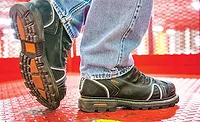
Hazards exist in every workplace in many different forms. Employees face many possible foot injuries from falling/rolling objects, crushing or penetrating materials, hot substances, corrosive or poisonous materials and electrical hazards to name a few. With such a wide array of potential foot hazards, the task of matching the correct footwear to the hazard(s) is the critical first step. To aid in the selection process, footwear is tested to meet certain performance criteria and marked to identify what hazards they are appropriate for.
Injury statistics
According to the Bureau of Labor Statistics (BLS), in 2013, approximately five5 percent of all nonfatal occupational injuries that resulted in days away from work were foot related, and they resulted in nine median days away from work. The best way to protect employees and to avoid costly foot-related injuries is to eliminate the hazards by using engineering and/or administrative controls. However, if these are not feasible or do not provide sufficient protection, protective footwear must be used.
OSHA standard requirements
Protective footwear requirements are referenced in Title 29 of the Code of Federal Regulations (CFR). These references are in 1910.132 Personal Protective Equipment (PPE) General Requirements and 1910.136 Foot Protection.
According to 29 CFR 1910.132, PPE must be used whenever an employer’s workplace hazard assessment determines that hazards that require PPE are present, or are likely to be present. What’s more, 29 CFR 1910.136 states each affected employee must wear protective footwear when working in areas where there is a danger of foot injuries and refers to the (ASTM F2412-05) Standard Test Methods for Foot Protection, F2413-05 Standard Specification for Performance Requirements for Protective Footwear and the American National Standards Institute (ANSI) American National Standard for Personal Protection—Protective Footwear (ANSI Z41-1999 and Z41-1991) for performance criteria.
On March 1, 2005, the ANSI Z41 reference was withdrawn and replaced by the ASTM Standards. On Sept. 9, 2009, OSHA issued an update to its PPE standards. The final rule went into effect in October 2009. The revision updated the references in these regulations to recognize the more recent editions of the applicable national consensus standards. It allows employers to use PPE constructed in accordance with any of three national consensus standards; the ASTM standards which were updated in 2011 and the ANSI Z41-1999 standard.
Requirements of ANSI Z41
Although OSHA allows footwear that meets performance requirements of Z41 (1991 or 1999), manufacturers no longer make footwear that meets these requirements due to the fact it was retired 10 years ago and replaced by ASTM F2412 and F2413. For purposes of this article a detailed description of the ASTM F2413 (2011) performance requirements will be provided.
Requirements of ASTM F2413-11(2011)
Footwear certified as meeting ASTM F2413-11 Standard Specification for Performance Requirements for Protective (Safety) Top Cap Footwear must first meet the requirements of Section 5.1 Impact Resistant Footwear and Section 5.2 Compression Resistant Footwear. Then the requirements of additional sections such as metatarsal protection, conductive protection, electric shock protection, static dissipative protection and protection against punctures can be met.
All footwear manufactured to this ASTM specification must be marked with the specific portion of the standard with which it complies. One shoe of each pair must be clearly and legibly marked (stitched in, stamped, pressure sensitive label, or a combination of these methods) on the inside or outside surface of the tongue, gusset, shaft or quarter lining. The marking must be enclosed in a rectangular border and a four line format is suggested. Line four is to be used when more than three sections of the standard applies to the footwear.
Each protective toe cap must be marked with the manufacturer’s name, trademark or logo. The cap number or identification, toe cap size and R (right)/ L (left) must be permanently stamped or marked in a conspicuous location.
Each metatarsal and puncture resistant device must be marked with the manufacturer’s name, trademark or logo and device number or identification in a conspicuous location.
Any changes to the original components of safety toe footwear such as replacing or adding aftermarket footbeds/inserts could cause failure to any or all parts of this Standard and the ASTM marking would be invalid. The footwear must be certified by an independent third party.
Add-on devices
An important point to remember is that the ASTM standard does not allow the use of add-on type devices—strap-on foot, toe or metatarsal guards—as a substitute for protective footwear, but OSHA does.
According to the ASTM standard, any protective toe caps or metatarsal guards must be designed, constructed and manufactured into the protective footwear during the manufacturing process and tested as an integral part of the footwear. OSHA says if an employer can provide documentation, such as testing data proving that the add-on devices provide protection equivalent to the ASTM performance standard, then the add-on devices are acceptable (29 CFR 1910.136(b)(2)). Most manufacturers of add-on devices have submitted their products to independent laboratories for testing. This data and its results can be obtained upon request.
Who pays for footwear
In February of 2008, OSHA clarified who must pay for PPE. Employers must pay for the minimum level of PPE that is required for the job. OSHA did exempt a few categories that included footwear. All non-specialty safety-toed protective footwear that is allowed to be worn off the worksite is exempt from this rule meaning employers are not required to pay for the footwear. However, if the footwear is not allowed off the worksite, has additional protection or is more specialized, such as shoes with non-slip soles, or steel-toed rubber boots, then it is subject to the employer payment requirement.
An employer is not required to pay for shoes with integrated metatarsal protection as long as the employer provides and pays for metatarsal guards that attach to the protective footwear.
Conclusion
Not all safety footwear is made the same and just because it has a protective toe doesn’t mean it is the correct footwear for the job. Having a firm understanding of the performance criteria and the markings utilized for safety footwear is vital to match the correct safety footwear to the hazard(s) identified for the job.
Looking for a reprint of this article?
From high-res PDFs to custom plaques, order your copy today!