Expect workers in their 60s & 70s ill with chronic diseases
Technology and ingenuity have advanced today where reasonable accommodations may allow almost any worker to be productive and safe while performing almost any job. Reasonable accommodation is any modification or adjustment to a job or the work environment that can be made without undue hardship upon the employer, and that will enable workers with limitations to perform essential job functions.
The Americans with Disabilities Act (ADA) of 1990 requires employers to provide reasonable accommodations for workers with qualified disabilities. The ADA Amendments Act (ADAAA) that took effect in 2009, with interpretative guidance from Equal Employment Opportunity Commission in 2011, broadened the definition of “disability” to make it easier for workers to qualify for ADA protections. Recent court decisions have expanded ADA protections to include impairments that are temporary and severe e.g. fractured leg.
Rise of accommodations
By 2020, 25 percent of the U.S. workforce will be over age 55. According to Bankrate, 75 percent of workers plan to work as long as they can.1 You should expect to see many workers in their 60s, 70s, and even older in coming years. Approximately 92 percent of older adults have at least once chronic disease, and 77 percent have at least two, according to the National Council on Aging.2 Many chronic diseases that are the most common diseases of aging -- heart disease, cancer, stroke, and diabetes -- qualify as disabilities under the ADA.
If employers must expand reasonable accommodations to a broadened population of disabled workers, including the growing population of older workers and workers with impairments or physical limitations such as pregnant workers, why shouldn’t employers expand this program to all other workers with impairments or limitations? The lazy decision to place workers on made-up light-duty work, or send them home for lack of work, or deny them work, when essential functions of a job are only prescribed by manual effort, is not the modern way to do things.
EHS pro involvement
The ADA has mostly been a human resource function. Unless there was a “direct threat to health and safety” (a provision within ADA) EHS pros have had limited involvement with ADA. With the anticipated increase in demand for employers to provide reasonable accommodations, within and outside the ADA, EHS pros should stake their claim to be leaders in this area because most reasonable accommodations are safety and health based.
Ask JAN
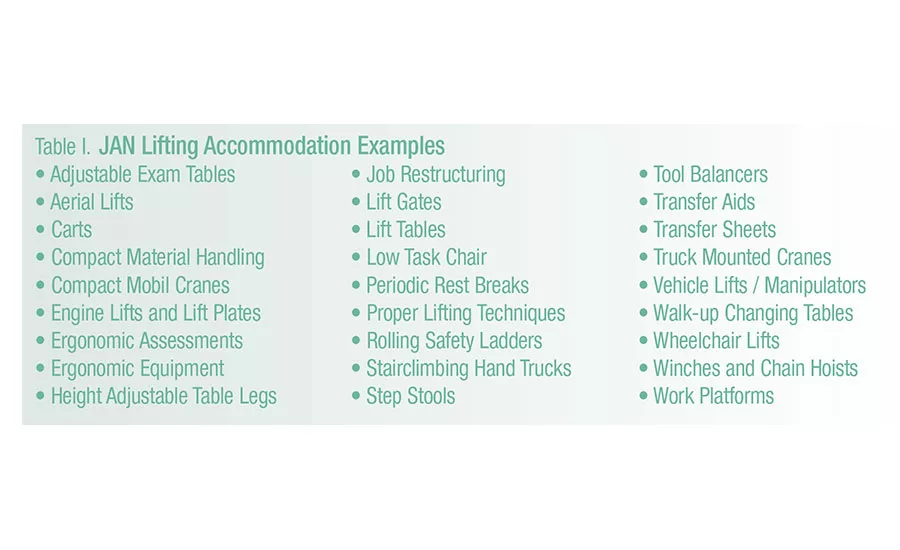
The Job Accommodation Network (JAN)3, a free service of the U.S. Department of Labor’s Office of Disability Employment Policy, helps employers comply with ADA reasonable accommodation requirements. JAN’s recommendations and resources should be very familiar to almost every EHS pro. For example, Table I are JAN examples for accommodations during lifting.
With the possible exception of job restructuring and periodic rest breaks, each example fits strongly into an EHS pro’s skill-set. JAN provides dozens of accommodation examples classed by activity e.g. lifting; classed by occupation or industry; and, classed by disability.
Address knowledge weakness
EHS pros’ most glaring weakness may be that they’re not fully aware of disabilities that have ADA coverage and how these disabilities may be accommodated in the workplace. Disabilities such as hearing loss and respiratory disorders should be readily understood because these fit under OSHA programs, and EHS pros should become more familiar with the common diseases of aging and learn about other disabilities such as bladder impairments, liver diseases, migraine headaches, sleep disorders, to name just a few. Review JAN’s full list disabilities.
Understand “undue hardship”
Employers are not required to make reasonable accommodations under ADA and other laws such as state and local laws for pregnant workers if doing so would create an “undue hardship” upon the employer. Undue hardship is a “significant expense or difficulty.”
While EHS pros may easily obtain costs for engineering controls e.g. lift tables and hoists, pros should have an appreciation of their employer’s financial resources and business operations e.g. function of workforce. To determine if accommodations are reasonable will often require a team effort. The more the EHS pro can demonstrate financial and business awareness, however, the more valuable they will be to their employer.
But undue hardship can cut both ways. The objective for reasonable accommodation is to keep the worker productive and safe when the worker has a disability, impairment or limitation. Without a reasonable accommodation the worker may suffer hardship.
Ingenuity
Technology and ingenuity have advanced today where reasonable accommodations may allow almost any worker to be productive and safe while performing almost any job. While EHS pros may seek out technology, they must develop their own ingenuity. Ingenuity goes beyond compliance with OSHA or ADA and related regulations and seeks out conformance with best practices to meet business and personal objectives.
Reasonable accommodations are the future of work. Unprecedented workforce demographics and expanded and new laws demand attention for reasonable accommodations. EHS pros must boost their skill set for this topic.
References:
1. http://www.bankrate.com/finance/financial-literacy/americans-plan-to-work-through-retirement-1.aspx
2. https://www.ncoa.org/healthy-aging/chronic-disease/
3. https://askjan.org/
Looking for a reprint of this article?
From high-res PDFs to custom plaques, order your copy today!