Make your confined space training healthy & robust
Demonstrate classroom learning in the field
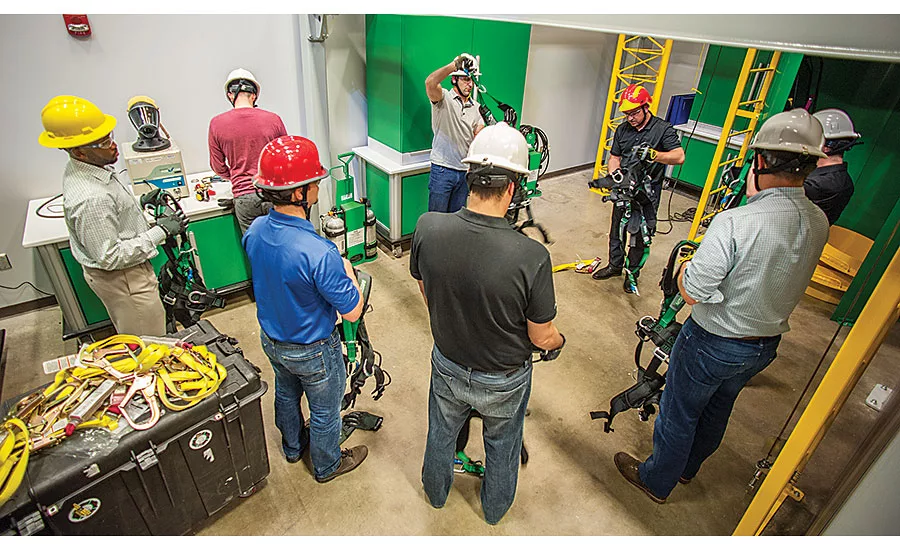
When it comes to confined space training, most workers who participate in entry teams have likely been through a class where they have been taught their specific roles and responsibilities under the General Industry 1910.146 or Construction 1926.1200 regulations. And in the respective training sections of each confined space standard, there are certainly clear-cut topics that are to be discussed with entry supervisors, entrants, and attendants. But teaching workers these roles and responsibilities is just a small part of what should be considered to be part of a healthy and robust training for them.
Laying the foundation
Surely enough, confined space entry training should begin in the classroom where students are taught such things as why these types of areas are hazardous, what types of safeguards are put into place to protect against such hazards, and the procedures as well as equipment that will be used as forms of control (or elimination) against identified dangers. But, after a step-by-step approach of introducing the concepts of hazard identification, evaluation, and control, the foundation has only been laid for where the real learning is to take place.
Most adult learners learn best by doing the activities that will be expected of them. This is something that even OSHA recognizes in the non-mandatory Appendix F to its 1910.146 regulation where it discusses what needs to take place for selection of confined space rescuers. Here, it spells out two types of evaluation:
- “Initial Evaluation” – This can be thought of as the employer being required to ask itself whether or not, in theory, a rescue team should be able to meet the demands of an actual rescue. Questions that are asked include how quickly the team can respond, whether there will be limits to its availability if called upon, if it has the right equipment to carry out the task, including entry, packaging, and retrieval, and if it has the necessary skills for medical evaluation of the victim(s). This should be looked at as a screening evaluation.
- “Performance Evaluation” – OSHA then directs employers to take potential rescuers that have passed the initial screening and to put them, on at least an annual basis, through a practice session in a space similar to the type from which they will be asked to perform rescues in order to critique deficiencies in “procedures, equipment, training, or number of personnel,” amongst other areas. This, in essence, lets the employer know whether the team is actually able to perform the types of rescues that will be required, learning and making corrections where deficiencies are found.
Demonstrating training retention
This theory of initial and performance evaluation should be transferred over also to evaluations of team capabilities for regular entries not involving rescues. Once roles have been discussed, equipment use has been demonstrated, and maybe even an exam has been given on how to determine whether or not a space is, indeed, a permit-required confined space, the time should come to hit the simulator (or an actual space if safety can be ensured) to demonstrate how much knowledge has been retained and whether or not the team can follow a step-by-step entry procedure on their own when given an entry task.
The best way for students to learn, and the best way to evaluate skills not coincidentally, is to have them demonstrate their knowledge and abilities while the instructor watches on in a controlled setting, having given the team a pre-determined script to follow. Students can be told, for example, that they are maintenance workers and have been asked to make a routine entry into a space to perform extraction of debris from it. Given this information, the instructor can step back and ask the students to identify step-by-step the proper procedures to take from the initial bump testing of portable air instruments, sampling of air within the space in the proper locations and for the necessary lengths of time, and setup of the entry / rescue system, to watching the team fill out the permit, agree that “acceptable entry conditions” have been met per employer policy when it comes to atmospheric conditions, workers safely attach to the entry system and communicate during the entry and, then, close out the “operation” properly.
Stand back and observe
By standing back and watching, the trainer can see areas where the students have firmly grasped the concepts, take note of steps that may be missed, and give small pieces of guidance to help bridge the gap between a deficient performance and one that will meet company code. If this is looked at purely as a training opportunity, students should not feel pressure of making mistakes and, instead, can be reinforced in areas where development potential is identified during a debriefing following the mock entry.
As anyone who has gone out into the workforce knows, the real learning takes place once out in the field. While theory-based training lays the foundation upon which skills and abilities will be built, adult learners must be given the opportunity to put the pieces of the puzzle together in a lifelike situation that mirrors what they will be actually be asked to do in the real world. The best way to do this is to slowly progress down the road from theory-based instruction to an interactive, hands-on approach that allows them to go through the motions of practicing with the procedures and equipment given to them for confined space entries during their routine, normal job.
Looking for a reprint of this article?
From high-res PDFs to custom plaques, order your copy today!


