Is your emergency response plan in place?
Your safety-at-heights program is in place. Your facility is well set up through identification and control of potential hazards and your workers are fully trained in use of their fall arrest PPE. You’ve made admirable efforts to avoid falls from heights altogether, but should one occur. Are you fully prepared for rescue post-fall arrest? An emergency response plan to retrieve a fallen worker is the vital next step in saving that worker from trauma, severe injury and death.
Orthostatic intolerance or suspension trauma due to sustained immobility can occur within a few minutes following a fall arrest, especially if the fallen worker has lost consciousness. Symptoms of this serious health risk include dizziness, weakness, sweating, fainting, and venous pooling (blood accumulation in the veins) that can reduce blood flow to the heart and oxygen to the brain.
Requirements & recommendations
OSHA (29 CFR 1926.502(d)(20) requires prompt rescue (in time to prevent serious injury to the worker) in the event of a fall, also ensuring that employees are able to rescue themselves. ANSI Z359.2-2007 Fall Protection Code recommends contact with a fallen worker within six minutes after a fall event. Well thought-out and executed emergency response plans for fall events are essential to minimizing the time that a fallen worker remains suspended.
While OSHA’s rescue requirements are brief, the Washington Industrial Safety & Health Division (WISHA) of the U.S. Department of Labor recommends these response plan basic elements and considerations.1
- Emergency-response procedures: Do your workers know immediate actions to rescue the victim, administer medical aid and then report and evaluate the incident?
- Chain of command: Do employees understand the rescue hierarchy? Are backup personnel on-site and quickly available?
- Critical resources: Are on-site first responders and medical supplies easily accessible? Is rescue equipment, including extension ladders and mobile lifts, in close proximity?
- Emergency-response training: Are your personnel trained to operate on-site rescue equipment and have access to communication to contact off-site first responders?
Your facility, job site and available personnel of course, factor into the appropriate rescue type(s).2
Worker self-rescue is ideal if the fallen worker is conscious and able. Personal rescue devices include small personal fall limiters, allowing a fallen worker to climb back to the surface due to the limited fall distance.
- Assisted rescue is a situation wherein minimal assistance brings the fallen but conscious worker to safety, such as use of a rescue ladder or rescue winch by another worker.
- Mechanically-aided rescue uses an aerial lift to retrieve a fallen worker who is unable to self-rescue. An extension ladder may also be useful for this rescue type.
- Pick-off rescue involves assistance from an individual or team to bring an incapacitated or unconscious worker to safety. Rescuers must be able to reach the worker, facilitate the descent and provide medical attention.
Rescue personnel
ANSI Z359.2-2007 Minimum Requirements for Comprehensive Managed Fall Protection Program suggests specific employer responsibilities, such as ensuring the presence and training of competent and authorized rescuers.3
Competent rescuers should possess experience, training and knowledge of rescue regulations and fall arrest systems equipment. These individuals must be able to verify the proficiency of authorized rescuers, identify hazards to rescuers, assess rescue resources, evaluate rescue procedures, and supervise authorized rescuers.
Authorized rescuers are personnel who will perform emergency rescue and are trained and experienced in rescue gear selection, inspection, operation and care.
Integrated self-rescue & preventive tools
Rapid self-rescue is preferred if at all possible; your post-fall arrest plans can provide fallen but conscious workers with means of self-help or integrated self-rescue to delay or even prevent onset of suspension trauma. These methods can include either simple prevention devices that workers carry as part of personal fall arrest systems, or a more advanced means of integrated self-rescue.
Suspension trauma relief steps are designed to increase circulation and blood flow, relieving pressure caused by harness leg straps. Footholds allow for standing and flexing of leg muscles while still suspended in the harness. These easily-deployed devices are carried by workers in fall arrest harness pouches. Please note that this economical option is meant only to delay or prevent suspension trauma for the time necessary for others to retrieve the fallen worker.
A rescue pulley system is designed for raising and lowering personnel or equipment in rescue and industrial work access and ideal for confined space applications. A rescue pulley system may allow for self or remote operation and be rated for a two-person load. A rescuer is needed for overhead setup, lowering and attachment of the haul carabiner to the victim. The fallen worker is lifted high enough to disconnect from the fall arrest system and then lowered to the ground.
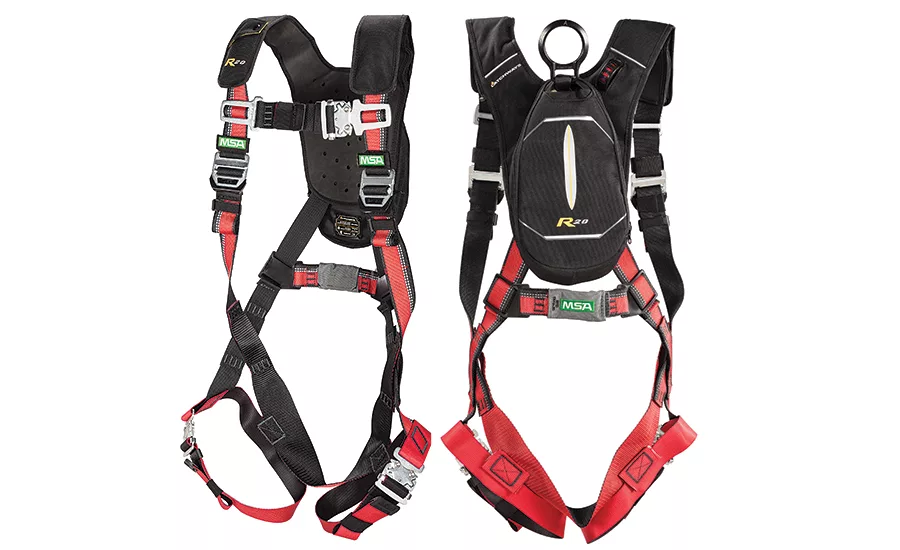
An integrated self-rescue harness system is designed to lower a worker to the ground via controlled descent after a fall. An integrated self-rescue system, likely contained within a backpack or pouch, attaches to a full-body harness and is used as part of a fall protection system or anchor point. In the event of a fall, the harness with integrated self-rescue suspend the worker; then allows for self-descent through a braking mechanism. This system type may also offer activation by a rescuer via a rescue pole, if the fallen worker is unable to do so.
New fall protection rescue products are there for the asking. You’ve done your best to create an environment to eliminate or minimize potential hazards. Emergency response plans and training are just as critical for those situations that can occur after the fall. Be sure that you’re prepared.
References
1 www.lni.wa.gov/safety/topics/atoz/fallprotect/FallProtectionEmergencies.pdf
2 MSA Competent Person for Safety at Heights Training
3 ANSI Z359.2-2007 Fall Protection Code
Looking for a reprint of this article?
From high-res PDFs to custom plaques, order your copy today!