Assess job sites for unexpected confined spaces
Deceptive spaces
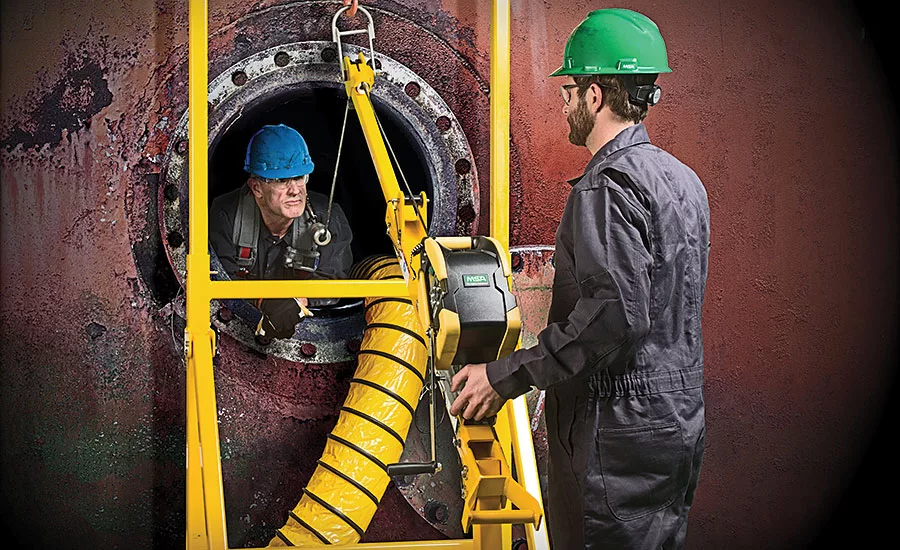
A work environment may not seem like a confined space at first glance, but the surprising truth is that confined spaces exist in many forms. They are found in nearly every industry, including food, chemical and petroleum processing, utility and communications installations, construction sites, and many others. Without a doubt, confined spaces expose workers to very real dangers.
So the question becomes, are you or your employees at risk? Should you take special precautions even if you are unsure whether or not your location could be considered a confined space? The obvious answer is yes — it’s best to treat an unknown area and its interior environment as if confined space exists and take all necessary safety measures.
Hazard alert
What are the specific hazards of confined space entry? Confined space entry ports and shafts are often small and narrow, accessed via ladder or rope. Without the proper PPE and preparation, workers can be trapped inside and become subject to toxic gases, explosions, oxygen deficiency, particulates, and other hazards.
Below is the technical definition of a confined space.
A confined space:
- is an area large enough for an employee to bodily enter and perform work
- has limited or restricted means of entry or exit
- is not designed for continuous human occupancy.
A permit-required confined space has one or more of the following characteristics:
- it contains, or has a known potential to contain, a hazardous atmosphere
- it contains material with engulfment potential
- it is configured such that entrants could be trapped or asphyxiated by inwardly converging walls or floors which slope and taper to a smaller cross section
- it contains any other recognized serious safety or health hazard.
Bearing these definitions in mind, conscientious employers carefully assess their job sites, develop written safety procedures, and provide training for their workforce. They also cooperate with OSHA regarding confined space atmospheric testing and use of respiratory, fall protection, head, eye, and face, hazmat, and gas detection gear. Conversely, failing to prepare may result in tragedy — injuries and fatalities do occur where no confined space procedures are in place or when workers ignore documented hazards, procedures, and company-provided PPE.
Deceptive spaces
It’s important to remember that confined spaces are sometimes deceptive in appearance. For example, the interior of an open-topped water tower is defined as a confined space, even though the top is open to the outdoor environment. The following are just a few examples of confined spaces, many of which are on record as sources of injuries and fatalities.
Open-topped water tanks such as those used to supply municipalities with fresh water require maintenance involving priming, painting, refinishing, and sandblasting. Work is sometimes performed via catwalks located above or risers placed within tanks. As these processes require use of potentially hazardous materials, unprotected workers within such tanks may be subject to concentrated hazardous vapors plus lack of oxygen despite the tank’s open top.
Control valve pits for water fountain displays pose potential asphyxiation hazards, as workers must crawl inside these pits to perform valve adjustments and maintenance. Workers can be subject to carbon monoxide buildup due to sewer trap gases found within, or oxygen deficiency/displacement due to mechanical corrosion or vegetation decomposition.
Grain silos present several confined space entry challenges. One such scenario involves bridging, a condition where grain that is stored wet crusts at the silo’s surface, slowing grain flow. Workers sometimes walk on this surface to break up crust. Workers attempting to break up crusted grain in this fashion have fallen through and died from engulfment.
Flowing grain emptying through a silo’s bottom creates a surprising degree of force and presents another hazard. A worker who has slipped into the grain flow just waist deep is at considerable risk of suffocation even when clutching a safety rope.
Grain spoilage presents yet another worker confined space hazard, as decomposition produces carbon dioxide, displacing oxygen within the silo. Workers within have been known to suffocate from lack of oxygen at the grain surface.
Cleaning, repair, and refurbishment of railroad tank cars can put workers at risk of asphyxiation or engulfment, as this line of work often involves interior sweeping, welding, cutting, scraping, buffing, and abrasive blasting. Workers may be subjected to hazardous tank residue of transported toxic chemicals, airborne insulation, and dust. Cover gas such as nitrogen may be used to inert interiors, preventing spoilage of food-related shipments but displacing the remaining oxygen within. Polyisocyanate foam used to insulate chlorine-carrying tank cars is a source of potential ignition, the smoke from which may expose workers to toxic substances.
Workers generally enter empty tank car confined spaces via top hatches. It is essential that railroad tank cars and other transport tanks are properly marked using warning signage and tags. Tank car interior confined spaces should be adequately ventilated as well as sampled and monitored for toxic gases, particulates, and oxygen deficiency.
Conclusion
As the examples above demonstrate, confined spaces can be found in expected—and unexpected—environments, but each and every occurrence represents potentially major health and safety risks for many workers. The ability to recognize and plan appropriately for confined space work can mean the difference between a job well done and disaster.
In light of all this, how can you respond?
As an employer, make sure you take advantage of the many resources available to help protect your employees from the hazards inherent in confined spaces. In particular, full compliance with the OSHA standard governing confined spaces, 29 CFR 1910.146, requires the expertise of safety and health professionals such as industrial hygienists. With their assistance, you can evaluate your work site with its unique challenges, create a written safety plan, and make sure your workers understand everything they need to know to minimize their risk of injury or death.
As an employee, know your environment, master your safety procedures, and be intimately familiar with your equipment. In this way, you’ll be better prepared to face the unexpected when you enter and work in confined spaces.
Sources:
- https://www.osha.gov/Publications/osha3138.pdf
- NIOSH Fatality Assessment and Control Evaluation (FACE) Program: www.cdc.gov/niosh/face/
- OSHA Safety and Health Topics; Confined Space: www.osha.gov/SLTC/confinedspaces/index.html
Looking for a reprint of this article?
From high-res PDFs to custom plaques, order your copy today!