Hazards in food & beverage manufacturing are found in many workplaces
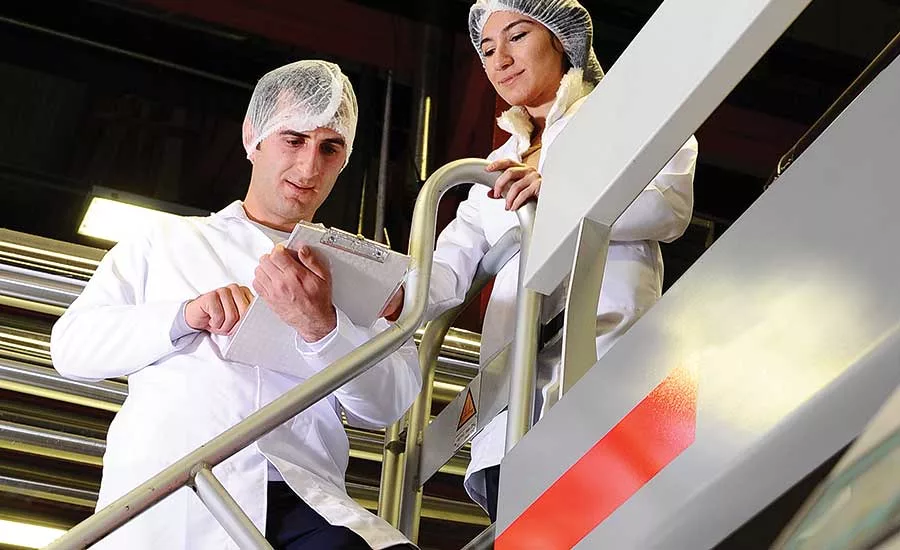
Addressing safety and health issues in the workplace saves employers money and adds value to their businesses. According to the National Safety Council’s Injury Facts 2017 Edition, estimates place the total costs associated with work-related deaths and injuries at $142.5 billion in 2015. These are expenditures that come straight out of company profits. When employees stay safe and healthy, employers realize substantial direct and indirect cost savings, and increased productivity and profitability. Employees and their families benefit because their family lives are not hindered by injury or illness, their stress is not increased and their incomes are protected. The safety and well-being of employees do not have to be sacrificed to drive business performance.
Injury Facts 2017 Edition also reports that the education and health services, manufacturing and retail trade industry sectors had the highest number of nonfatal occupational injuries and illnesses involving days away from work.
According to the Bureau of Labor Statistics (BLS) May 2015 National Industry-Specific Occupational Employment Estimates, more than 12 million people are employed in the North American Industry Classification System (NAICS) manufacturing sectors (31, 32 and 33) with slightly more than 1.7 million in the food and beverage manufacturing industry.
A company’s productivity and profitability goes hand-in-hand with a safe and healthy workplace. To enhance workers performance while maintaining a safe and healthy workplace, employers must strive to reduce work-related injuries and illnesses by creating a structure and framework for identifying potential risks and then problem-solving. Within the food and beverage manufacturing industry, key risks include manual handling and repetitive motion tasks; slips, trips and falls on the same level; machinery related hazards; confined space entry; and powered industrial truck related hazards.
Manual handling & repetitive motion tasks
Manual handling is any activity that requires the use of force to lift, lower, push, pull, carry, or otherwise move or hold an object or load. Repetitive motion is any movement that is repeated with little or no variation every few seconds.
Typically, manual handling injuries result from overexertion and repetitive motion injuries are influenced by how often a movement is repeated, the speed of the movement, the muscles involved and the force required. Overexertion due to lifting / lowering or repetitive motions accounts for 34 percent of workplace injuries that result in lost work days (Source: Injury Facts 2017 Edition). Injuries to the back, neck, hands, wrists, arms and shoulders due to manual handling and repetitive motion are common.
Manual handling and repetitive motion injuries can be prevented by:
- Reducing the physical exertion of the hands, arms and shoulders whenever possible – use power tools, reduce the movement, and rotate job tasks so that different movements and muscle groups are used.
- Reducing the need for excessive gripping strength or force – use fixtures to hold products, parts or tools; grip with the whole hand; minimize gripping with just the fingertips; and use two hands to equalize the weight handled in each.
Slips, trips & falls on the same level
Many materials used in the manufacturing of food and beverages are inherently slippery – water, oil/grease, grains, animal parts, etc. Keys to preventing slips, trips, and falls on the same level include:
- Ensuring that the walking/working surface provides sufficient friction – review the different types of flooring that can be used to increase the amount of friction while maintaining the ability to be sanitized.
- Encouraging the use of slip-resistant footwear in conjunction with proper housekeeping and walking/working surfaces – the slip hazard still exists if relying on slip-resistant footwear only.
Machinery-related hazards
Most machines used in the food and beverage manufacturing industry have moving parts that can cause injuries such as crushed fingers or hands, amputations, burns or even blindness. Safeguards are essential for protecting workers from these preventable injuries. These hazards must be eliminated (best option) or controlled.
The dangerous moving parts that need safeguarding fall into three fundamental areas – the point of operation, the power transmission and the moving parts. To protect workers from machinery-related hazards, safeguards must prevent contact between the worker and the machine, and minimize the possibility of workers placing any body parts into the moving machine parts. Safeguards must be designed to be secure and not easily tampered with or removed. They must also ensure that no objects can fall into the machines. Safeguards should allow for safe lubrication without removing the guard and not create an unacceptable impediment for workers.
Confined space entry
Silos, tanks, mixing vats, hoppers and storage bins are all typical confined spaces found in the food and beverage manufacturing industry. Fatalities in confined spaces are a recurring tragedy and many occur during rescue attempts.
The first step to prevent confined space fatalities is to determine if a confined space hazard exists. Many workplaces have areas that are considered “confined spaces,” because even though they are not necessarily designed for people, they are large enough for workers to enter to perform required tasks. A confined space also has limited or restricted means for entry or exit and is not meant for continuous occupancy.
Employers must take measures to prevent workers from entering confined spaces, label all confined spaces, and train workers to recognize what constitutes a confined space and the hazards that may be encountered.
Powered industrial trucks
Powered industrial trucks, sometimes referred to as forklifts or lift trucks, are widely used in the food and beverage manufacturing industry to receive and transport raw materials, transfer products to different locations and to load trucks.
Incorrectly operated and maintained forklifts pose a serious hazard to both the operator and to other workers in the facility. Hazards associated with forklifts include overturns, workers on foot being struck and workers falling off forklifts. The potential for carbon monoxide poisoning from exhaust emissions is another hazard associated with forklifts.
Employers must ensure that forklift operators are properly trained on each type of truck on general guidelines, tips for driving safely, and load issues to consider.
Conclusion
Every year workplace illnesses, injuries and deaths cost our nation billions of dollars. Investing in a good safety and health program can save businesses $4 to $6 dollars for every $1 invested (Source: www.osha.gov $afety Pays).
Sources:
- National Safety Council Injury Facts® 2016 Edition
- Occupational Safety and Health Administration $afety Pays
- U. S. Bureau of Labor Statistics National Industry-Specific Occupational Employment Estimates May 2015
Looking for a reprint of this article?
From high-res PDFs to custom plaques, order your copy today!