ISHN logo
search
cart
facebook twitter linkedin youtube
  • Sign In
  • Create Account
  • Sign Out
  • My Account
ISHN logo
  • NEWS
    • Today's News
    • Global Safety News
    • Government Regulations
  • PRODUCTS
    • Product Innovations
    • Featured Products
  • TOPICS
    • Environmental Health and Safety
    • Facility Safety
    • Workplace Health
    • Occupational Safety
    • PPE
    • More Topics
  • CONSTRUCTION
  • TECHNOLOGY
  • COLUMNS
    • Best Practices
    • Dave Johnson: What’s going on
    • Editorial Comments
    • Leading Safety
  • MULTIMEDIA
    • ISHN Podcast
    • Videos
    • Cold Stress Education Quiz
    • Webinars
    • White Papers
  • MORE
    • Buyer's Guide
    • Newsletters
    • Convention Companion
    • Polls
    • Events
    • ISHN Store
    • Sponsor Insights
  • EMAGAZINE
    • eMagazine
    • Archived Issues
    • Contact
    • Advertise
  • JOIN TODAY!
Today's Safety NewsPPEGlobal Safety News

Japanese utilities get a lesson in fall protection from IBEW
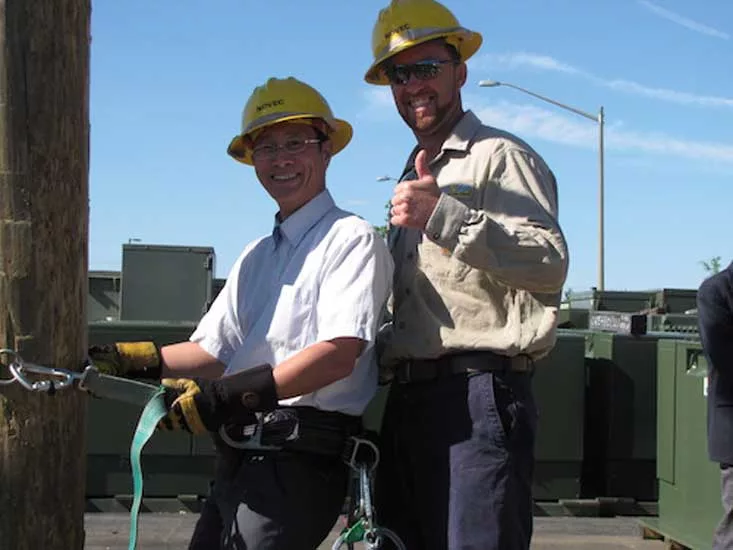
IBEW photo
July 11, 2017

Injuries and deaths from falls are a problem in the utility industry in Japan and regulations are changing to keep workers safer when working on power poles and transmission towers.

The U.S. utility industry worked through its own regulation shift three years ago, when OSHA required an upgrade to the traditional body or safety belt that linemen had been using for decades.

The Japanese executives wanted to learn how American workers and companies adapted to the new rules. (In EBEW photo above, After a little practice, a Japanese visitor and made his way up the pole - all the more impressive as they don’t use wood to make power poles in Japan.) 

“They could have approached anyone to talk about the safety improvements the U.S. has made. I think it is a great credit to the International Brotherhood of Electrical Workers (IBEW) that they came to us,” said IBEW Safety Department Director Dave Mullen. “We were founded on safety and that reputation has clearly spread around the world.”

Before the regulation change in the U.S., required fall protection for utility workers was similar in Japan and the U.S. In fact, it would have been familiar to linemen from the earliest days of the Brotherhood: the body belt. The body, or safety, belt is made up of two loops, joined together: one goes around the lineman’s waist, the other goes around the pole they are climbing.

But there has always been a problem with the body belt as fall protection, Mullen said.

“It just doesn’t do a great job. It works fine to position a lineman for work, but protecting someone from falling or from getting hurt by a fall? It has problems,” Mullen said.

Body belts can slip down a pole. Then, when the stop comes, it is all at once, a sudden jolt to a very vulnerable place: the lower back. The torso above the belt and the legs below continue accelerating after the belt stops moving. The deceleration can hyperextend or even break the spine. Even when workers have stopped climbing and are working, there is nothing to stop a lineman from losing balance to the side and rotating around the pole into a fall.

Since 2014, body belts have been banned by OSHA as a fall arrest system for electrical generation and distribution, and rules require both different harnesses -- rock-climbing style ones that go around the waist and legs or full body harnesses that incorporate the torso as well—and more secure ways of attaching those harnesses so workers either can’t fall or can’t fall far.

Mullen spent the day with two executives from an industry group representing the country’s utilities and a researcher for a Japanese manufacturer of industrial electrical equipment including Mitsubishi Research Institute’s Smart Energy Group Manager Hironori Iwasaki, so they could see how the equipment, workers and utilities have adapted.

They requested a field trip to see the gear in use. Mullen, with the help of Fourth District International Vice President Brian G. Malloy, arranged for a visit to Northern Virginia Electric Cooperative’s technical center in Gainesville, Virginia.

They were met by Manassas, Va., Local 1737 Business Manager Eric Stewart and members Justin Bettis and Emmanuel “Manny” Marfo, who are both part of Novec’s lineman rodeo team.

Bettis showed the executives how efficiently linemen use the more robust fall arrest systems while working on distribution poles.

Bettis even strapped one of them into a harness and sent him up a (short) pole of his own.

They also demonstrated the use of the full body harnesses, which Novec workers use primarily when working out of buckets.

The executives also requested a question-and-answer session with Mullen, who also brought in an OSHA representative and safety executives from Pepco Holdings, a subsidiary of Exelon, one of the largest utilities in the U.S.

The two-hour hour discussion covered everything from how workers and utilities collaborated with manufacturers to improve products to how utilities can empower workers to offer feedback to how American safety regulations are written and amended.

“Everyone is looking for a silver bullet, but what I wanted them to understand is that safety is never just one thing, especially not the equipment,” Mullen said. “We are safest and our companies most successful when there is collaboration between companies, workers, regulators and the manufacturers. I hope they saw a model of how we do it here that helps them back in Japan.”

Source: IBEW

KEYWORDS: accident prevention Fall Protection injuries

Share This Story

Looking for a reprint of this article?
From high-res PDFs to custom plaques, order your copy today!

Recommended Content

JOIN TODAY
to unlock your recommendations.

Already have an account? Sign In

  • forklift safety

    Exploring the latest technologies in forklift safety

    With more staff and more stock in warehousing now more...
    Facility Safety
    By: Josh Cramer
  • welding

    All about welder’s flash or arc eye

    A flash burn is a painful inflammation of the cornea,...
    Environmental Health and Safety
  • dangerous jobs

    The 10 most dangerous jobs in the U.S.

    On-the-job deaths have been rising — hitting the highest...
    Construction Industry Safety and Health
    By: Benita Mehta
Manage My Account
  • eMagazine Subscriptions
  • ISHN Newsletter & Other Newsletter Alerts
  • Online Registration
  • Manage My Preferences
  • Subscription Customer Service

More Videos

Sponsored Content

Sponsored Content is a special paid section where industry companies provide high quality, objective, non-commercial content around topics of interest to the ISHN audience. All Sponsored Content is supplied by the advertising company and any opinions expressed in this article are those of the author and not necessarily reflect the views of ISHN or its parent company, BNP Media. Interested in participating in our Sponsored Content section? Contact your local rep!

close
  • man wearing the the Sundström SR200 Full Face Mask Respirator
    Sponsored byOHD

    5 Fit Testing Mistakes That Could Cost You

  • This image shows Magid AcuSpex polarized blue mirrored safety glasses.
    Sponsored byMagid Glove and Safety

    Construction PPE Guide: What Crews Need for Each Task

  • lone worker in confined space
    Sponsored byAlphasense Ltd.

    GET THE LEAD OUT of your Safety Oxygen Sensors!

Popular Stories

SpaceX 7 launch

OSHA Investigating Fatal Fall at SpaceX Starbase

Automated loading dock equipment

After March 2026 Rivian Death, Safety Managers Reassess Loading Dock Systems Under OSHA's Warehouse Emphasis Program

chemical safety

It Was Just Sugar: Catastrophic Safety Failures in Louisville

top 10 most dangerous jobs

Poll

Seasonal Readiness

With the federal heat stress prevention rule on the horizon, which area of your safety program needs the most attention?
View Results Poll Archive

Products

Surviving an OSHA Audit A Management Guide, 2nd Edition

Surviving an OSHA Audit A Management Guide, 2nd Edition

See More Products

ISHN Podcasts

Related Articles

  • two men installing a permanent fall protection system

    Careers in Fall Protection: Building a Team That Protects America’s Workforce

    See More
  • MSA

    Major advancement in fall protection: MSA V-EDGE™ Self Retracting Lifelines (SRLs)

    See More
  • Rope Access Power Washing Building

    Next-Generation Rope Access: Innovations in Fall Protection Systems

    See More
×

Become a Leader in Safety Culture

Build your knowledge with ISHN, covering key safety, health and industrial hygiene news, products, and trends.

JOIN TODAY
  • RESOURCES
    • Advertise
    • Contact Us
    • Directories
    • Manufacturing Division
    • Store
    • Want More
  • SIGN UP TODAY
    • Create Account
    • eMagazine
    • Newsletters
    • Customer Service
    • Manage Preferences
  • SERVICES
    • Marketing Services
    • Reprints
    • Market Research
    • List Rental
    • Survey/Respondent Access
  • STAY CONNECTED
    • LinkedIn
    • Facebook
    • YouTube
    • X (Twitter)
  • PRIVACY
    • PRIVACY POLICY
    • TERMS & CONDITIONS
    • DO NOT SELL MY PERSONAL INFORMATION
    • PRIVACY REQUEST
    • ACCESSIBILITY

Copyright ©2026. All Rights Reserved BNP Media, Inc. and BNP Media II, LLC.

Design, CMS, Hosting & Web Development :: ePublishing