ANSI/ASHRAE Standard 199 improves industrial dust collection
Assess & compare PERFORMANCE
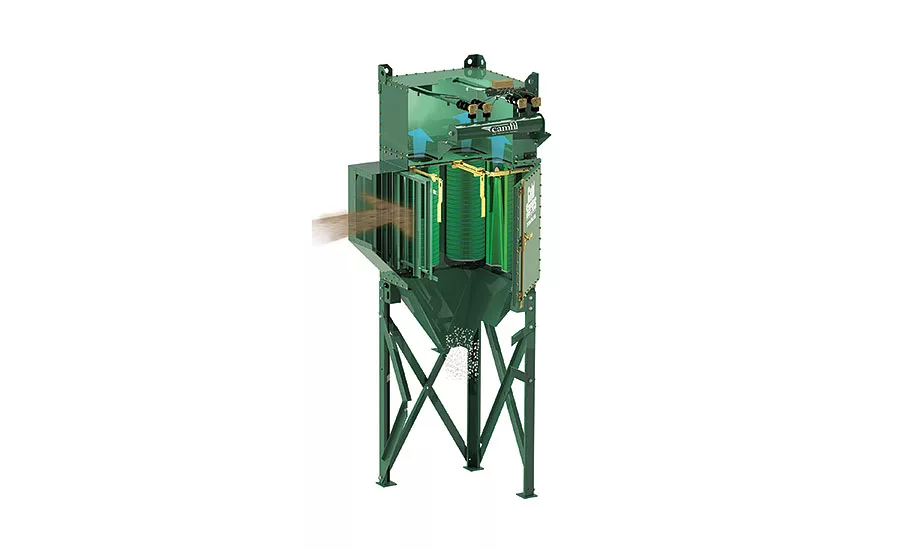
To help manufacturers evaluate industrial dust collection equipment with much greater accuracy, the American National Standards Institute (ANSI) and American Society of Heating, Refrigerating and Air-Conditioning Engineers (ASHRAE) developed Standard 199-2016. Titled “Method of Testing the Performance of Industrial Pulse Cleaned Dust Collectors,” the standard provides a way to accurately assess and compare self-cleaning dust collection systems. These are systems that use compressed air to discharge the dust cake from the filter without taking the air filter off line.
Purpose of Standard 199
Before Standard 199, there wasn’t an accurate test to measure the effectiveness of self-cleaning dust collectors and filters. Manufacturers could not get the data required to compare performance results based on true operating conditions, such as how different collector designs and filter options affect factors like emissions and energy consumption.
Previously, the only available standards were air filter tests like those from ASHRAE that measure filter efficiency in HVAC system environments. A widely used standard for comparing filters is ANSI/ASHRAE 52.2, which uses the Minimum Efficiency Reporting Value (MERV) system to measure air filter efficiency. However, ASHRAE 52.2 was developed for the HVAC filter market and does not address the way a dust collector operates – by pulse-cleaning filters periodically when a dust cake builds up. In addition, ASHRAE 52.2 doesn't consider the type of dust being collected or the equipment design.
Self-cleaning dust collectors
The standard applies to “bag, cartridge, or envelope industrial dust collectors that recondition the filter media by using a pulse of compressed air to discharge the dust cake from the filter media while the air cleaning device remains on line.” It provides a standardized method of testing performance of these collectors from inlet to outlet, accurately portraying the dynamics of this equipment in multiple filter arrangements versus single-filter initial efficiency methodologies like MERV.
Testing stages
Testing under Standard 199 includes a total of six stages that replicate a real-life dust collector application. The test takes into account that filters will load with dust and then be periodically cleaned using different modes of pulse-cleaning. All tests are performed with an inlet loading of 1 gr/ft3 using calcium carbonate as the test dust and specify particle size, bulk density, and moisture content. No more than 25 percent of the media in the dust collector is pulsed at one time.
- Stage 1: Dust is fed to the collector at a specified rate, without pulse cleaning, until a specified differential pressure is reached.
- Stage 2: On-demand pulse cleaning begins while the airflow and dust feed continue. The cleaning interval is determined by high and low differential pressure set points provided by the manufacturer of the dust collector.
- Stage 3: Continuous pulse cleaning of filters is performed at specified intervals, while maintaining the airflow and dust feed, for 24 hours or until the specified maximum differential pressure is reached.
- Stage 4: Final dust loading with on-demand cleaning is tested by maintaining the airflow and dust feed. The frequency of cleaning is triggered by high and low differential pressure set points and will vary depending on the pressure buildup of the system.
- Stage 5: The dust feed is maintained while suspending pulse cleaning to mimic how the dust collector would perform in an upset condition.
- Stage 6: A process commonly known as “downtime cleaning” is replicated to simulate a post-upset scenario.
Performance parameters measured
Standard 199 measures four key performance parameters:
- Emissions: The test measures initial emissions and emissions through the life of the test. This is important because the compressed air shock will allow dust to pass through the media. Emissions will be measured in milligrams per cubic meters of air (mg/m³).
- Pressure drop: A filter with a high dust-holding capacity and good dust release characteristics will require less frequent cleaning and maintain low pressure drop throughout the life of the filters.
- Compressed air usage: The better the cleaning abilities of the filters, the less compressed air will be needed, resulting in energy savings.
- Emission reading: This reading includes penetration through the whole system and measures particulate mass less than 1 μm, less than 2.5 μm and less than 10 μm as determined by photometric measurement in accordance with US EPA 40 CFR Part 50.
Voluntary compliance
Standard 199 is voluntary, so it is up to individual dust collector and filter manufacturers to develop an internal plan for compliance. Some manufacturers of dust collection equipment may opt to install a lab in-house where they can design, build and test collectors to meet the standard. However, for third-party verification, units should be sent to independent laboratories to confirm in-house results. It may take some suppliers several years to provide Standard 199 testing due to limited test facilities and the cost involved in commissioning independent testing.
Questions for your dust collector supplier
Because participation is voluntary, ask your supplier if their equipment been tested under Standard 199. If they plan to participate in the standard, ask where they are in the process. You will also want to know if the supplier operates an in-house test lab for Standard 199 testing and if they also commission independent testing to verify results. It is also important to ask if the supplier specified the same filters for your application that were tested under Standard 199.
Other important dust collection measures
Standard 199 does not measure all aspects of dust collection design and performance. Here are some additional rules that are important for manufacturers:
- NFPA 652: Standard on the Fundamentals of Combustible Dust introduces the concept of Dust Hazard Analysis (DHA), a methodology targeted toward factories involved in more basic processes involving simple dust collection systems.
- The EPA's National Emission Standard for Hazardous Air Pollutants (NESHAP) Rule 6x encompasses all manufacturing processes using materials that contain 0.1% by weight cadmium, chromium, lead, or nickel – or 1.0% by weight manganese, which is virtually a universal component of welding wire.
- OSHA's silica rule features a lower limit for worker exposure to harmful respirable crystalline silica dust as well as more stringent measures to monitor compliance.
Standard 199 and total cost of ownership
Standard 199 provides a useful tool for reviewing comparative results on emissions, pressure drop, compressed air consumption and energy among different dust collectors and filters. This information helps evaluate total cost of ownership (TCO) of a new dust collector over time by calculating the three areas of cost associated with this equipment — energy, consumables and maintenance & disposal.
Looking for a reprint of this article?
From high-res PDFs to custom plaques, order your copy today!


