ISHN logo
search
cart
facebook twitter linkedin youtube
  • Sign In
  • Create Account
  • Sign Out
  • My Account
ISHN logo
  • NEWS
    • Today's News
    • Global Safety News
    • Government Regulations
  • PRODUCTS
    • Product Innovations
    • Featured Products
  • TOPICS
    • Environmental Health and Safety
    • Facility Safety
    • Workplace Health
    • Occupational Safety
    • PPE
    • More Topics
  • CONSTRUCTION
  • TECHNOLOGY
  • COLUMNS
    • Best Practices
    • Dave Johnson: What’s going on
    • Editorial Comments
    • Leading Safety
  • MULTIMEDIA
    • ISHN Podcast
    • Videos
    • Cold Stress Education Quiz
    • Webinars
    • White Papers
  • MORE
    • Buyer's Guide
    • Newsletters
    • Convention Companion
    • Polls
    • Events
    • ISHN Store
    • Sponsor Insights
  • EMAGAZINE
    • eMagazine
    • Archived Issues
    • Contact
    • Advertise
  • JOIN TODAY!
Today's Safety NewsEnvironmental Health and Safety

A NIOSH Science Blog post

Coming soon to a workplace near you: Field-based respirable crystalline silica monitoring
By Emanuele Cauda PhD, Lauren Chubb DrPH, Valerie Coughanour MA, MFA
NIOSH
February 22, 2018

The NIOSH Mining Program aims to eliminate mining fatalities, injuries, and illnesses through relevant research and impactful solutions. More than 65 engineers work in the NIOSH Mining Program representing many disciplines including chemical, electrical, mechanical, industrial, mining, software, and general engineering. It is through the various lenses of these disciplines that NIOSH tackles a host of challenges in the mining industry. One such example is exposure to silica.

Worker exposure to respirable crystalline silica (RCS)—which can cause severe lung diseases—remains a major health concern in mining as well as in construction, oil & gas, and general industry. Having a quick, effective way to monitor RCS concentrations is crucial to combatting the potential negative effects of RCS exposure. Current RCS monitoring requires samples to be sent to an external laboratory for analysis, and it can take days or weeks for results to be available.

This time lag can mean workers who unknowingly worked in conditions with high RCS concentrations could continue to work subsequent shifts in similar conditions before getting sample results back and realizing they’ve been overexposed to RCS.

Researchers and engineers in the NIOSH Mining Program are addressing this problem by developing a novel, field-based monitoring approach that enables dust samples to be analyzed for RCS right at the mine site in only a few minutes. With this sort of on-the-spot analysis available, mines can assess the efficacy of engineering controls and work practices, and make necessary changes to optimize these controls.

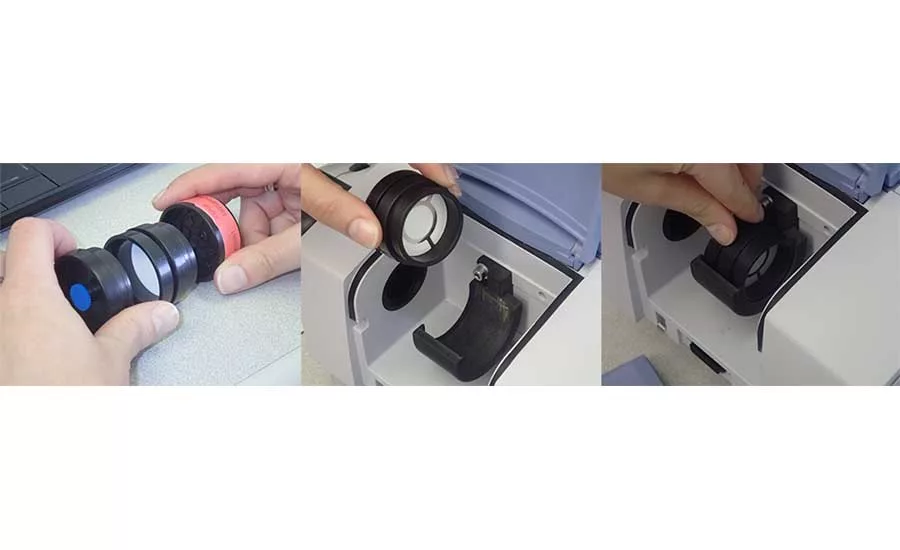
This field-based monitoring approach for RCS is designed around the use of commercially available portable Fourier-transform infrared (FTIR) instruments. A transmission direct-on-filter (DOF) analysis was selected because it is readily compatible with the respirable samplers already used by health and safety professionals. DOF analysis also does not require any pre-treatment of samples, and it can be done without removing the dust sample from the cassette in which it was collected. A complete analysis takes only one to two minutes per sample, then that same sample can be sent to an outside laboratory if confirmation is desired.

Shown above: A dust sample is first collected using traditional samplers. The sampling cassette is removed and placed in a portable Fourier-transform infrared (FTIR) instrument in the field. The FTIR instrument examines the dust sample and offers a complete analysis in one to two minutes.

Engineers and physical scientists in the NIOSH Mining Program are currently working to refine and optimize the monitoring approach. The goal is to create an approach that will provide useful information to the health and safety professional, while keeping implementation as simple and user-friendly as possible.

The accuracy of the RCS analysis takes first priority. Research has identified confounding minerals present in the dust of mining environments that could affect accuracy. NIOSH is focused on designing specific quantification models to account for the presence of these minerals. An optimized 37-mm sampling cassette is currently under development through a cooperative research and development agreement between NIOSH and a sampling equipment manufacturer. The cassette is similar to the standard three-piece design used by most health and safety professionals, with a few key modifications that enable the DOF analysis while limiting the possibility that the sample could be damaged during analysis. Additionally, NIOSH is exploring combining the DOF technique with commercially available real-time respirable dust monitors to enhance the monitoring capability.

Finally, NIOSH is developing tutorials and a dedicated software application to support users in the implementation of this new approach. When finalized, the tutorials will guide users about how to select and set up equipment, analyze respirable dust samples, and interpret the resultant data using the NIOSH software.

This ongoing research has been supported and advanced by beta testers in the mining industry, who have used this method and provided feedback to NIOSH to improve both accuracy and usability. While this approach was developed specifically with the mining industry in mind, the tools and technologies are easily transferrable to other non-mining environments where exposure to RCS is a concern.

This is one example of how NIOSH engineers are working to protect U.S. workers. Please click here to go to the NIOSH Science Blog web page and share in the comments examples of workplace safety and health problems that engineers in your organization have helped solve.

KEYWORDS: mining industry occupational diseases occupational exposure

Share This Story

Looking for a reprint of this article?
From high-res PDFs to custom plaques, order your copy today!

Emanuele Cauda, PhD, is a Senior Service Fellow in the NIOSH Pittsburgh Mining Research Division. He is also the Deputy Director of the NIOSH Center for Direct Reading and Sensor Technologies.
Lauren Chubb, DrPH, is a Physical Scientist in the NIOSH Pittsburgh Mining Research Division.
Valerie Coughanour, MA, MFA, is a Health Communication Specialist in the NIOSH Mining Program.

Recommended Content

JOIN TODAY
to unlock your recommendations.

Already have an account? Sign In

  • forklift safety

    Exploring the latest technologies in forklift safety

    With more staff and more stock in warehousing now more...
    Workplace Training Strategies
    By: Josh Cramer
  • welding

    All about welder’s flash or arc eye

    A flash burn is a painful inflammation of the cornea,...
    Environmental Health and Safety
  • dangerous jobs

    The 10 most dangerous jobs in the U.S.

    On-the-job deaths have been rising — hitting the highest...
    Transportation Safety
    By: Benita Mehta
Manage My Account
  • eMagazine Subscriptions
  • ISHN Newsletter & Other Newsletter Alerts
  • Online Registration
  • Manage My Preferences
  • Subscription Customer Service

More Videos

Sponsored Content

Sponsored Content is a special paid section where industry companies provide high quality, objective, non-commercial content around topics of interest to the ISHN audience. All Sponsored Content is supplied by the advertising company and any opinions expressed in this article are those of the author and not necessarily reflect the views of ISHN or its parent company, BNP Media. Interested in participating in our Sponsored Content section? Contact your local rep!

close
  • man wearing the the Sundström SR200 Full Face Mask Respirator
    Sponsored byOHD

    5 Fit Testing Mistakes That Could Cost You

  • This image shows Magid AcuSpex polarized blue mirrored safety glasses.
    Sponsored byMagid Glove and Safety

    Construction PPE Guide: What Crews Need for Each Task

  • lone worker in confined space
    Sponsored byAlphasense Ltd.

    GET THE LEAD OUT of your Safety Oxygen Sensors!

Popular Stories

SpaceX 7 launch

OSHA Investigating Fatal Fall at SpaceX Starbase

dust explosion

Tennessee OSHA Issues Record $3.1M Fine After Deadly Explosion at Munitions Plant

Worker Impairment

How to Tell When a Co-Worker is Impaired? A Safety Pro’s Challenge

top 10 most dangerous jobs

Poll

Seasonal Readiness

With the federal heat stress prevention rule on the horizon, which area of your safety program needs the most attention?
View Results Poll Archive

Products

Surviving an OSHA Audit A Management Guide, 2nd Edition

Surviving an OSHA Audit A Management Guide, 2nd Edition

See More Products

ISHN Podcasts

Related Articles

  • Coming soon to a theatre near you: Deepwater Horizon (the film)

    See More
  • ClickSafety launches training to help construction leaders and workers meet new OSHA respirable crystalline silica standards, maintain safer work environments

    See More
  • Oil and gas extraction workers exposed to respirable crystalline silica

    See More

Related Products

See More Products
  • 0470387408.jpg

    Preparing for OSHA s Voluntary Protection Programs: A Guide to Success

  • A Basic Guide to RCRA—Understanding Solid and Hazardous Waste Management, Second Edition

  • 111885960X.jpg

    Professional Rope Access: A Guide To Working Safely at Height

See More Products
×

Become a Leader in Safety Culture

Build your knowledge with ISHN, covering key safety, health and industrial hygiene news, products, and trends.

JOIN TODAY
  • RESOURCES
    • Advertise
    • Contact Us
    • Directories
    • Manufacturing Division
    • Store
    • Want More
  • SIGN UP TODAY
    • Create Account
    • eMagazine
    • Newsletters
    • Customer Service
    • Manage Preferences
  • SERVICES
    • Marketing Services
    • Reprints
    • Market Research
    • List Rental
    • Survey/Respondent Access
  • STAY CONNECTED
    • LinkedIn
    • Facebook
    • YouTube
    • X (Twitter)
  • PRIVACY
    • PRIVACY POLICY
    • TERMS & CONDITIONS
    • DO NOT SELL MY PERSONAL INFORMATION
    • PRIVACY REQUEST
    • ACCESSIBILITY

Copyright ©2026. All Rights Reserved BNP Media, Inc. and BNP Media II, LLC.

Design, CMS, Hosting & Web Development :: ePublishing