ISHN logo
search
cart
facebook twitter linkedin youtube
  • Sign In
  • Create Account
  • Sign Out
  • My Account
ISHN logo
  • NEWS
    • Today's News
    • Global Safety News
    • Government Regulations
  • PRODUCTS
    • Product Innovations
    • Featured Products
  • TOPICS
    • Environmental Health and Safety
    • Facility Safety
    • Workplace Health
    • Occupational Safety
    • PPE
    • More Topics
  • CONSTRUCTION
  • TECHNOLOGY
  • COLUMNS
    • Best Practices
    • Dave Johnson: What’s going on
    • Editorial Comments
    • Leading Safety
  • MULTIMEDIA
    • ISHN Podcast
    • Videos
    • Cold Stress Education Quiz
    • Webinars
    • White Papers
  • MORE
    • Buyer's Guide
    • Newsletters
    • Convention Companion
    • Polls
    • Events
    • ISHN Store
    • Sponsor Insights
  • EMAGAZINE
    • eMagazine
    • Archived Issues
    • Contact
    • Advertise
  • JOIN TODAY!
Occupational Safety

A NIOSH Science Blog post

Using worker health charts to learn about your workplace

By Amy Mobley MEn, Rebecca Tsai PhD
March 9, 2018

Jim manages a manufacturing plant that makes office furniture using plywood and other engineered wood products. Their worksite takes worker safety seriously, and is interested to know if the rate of severe injuries they are experiencing is high compared to injuries occurring at other office furniture manufacturing plants. This kind of information may be tricky to find, but in a search, he stumbles across the Worker Health Charts (WHC), a data visualization tool created by the National Institute for Occupational Safety and Health (NIOSH) that pulls from workplace safety and health data sets. Using Worker Health Charts, Jim is able to create graphic charts to visually show rates, distribution, and trends of work-related injuries, illnesses, and deaths.

Jim starts by selecting from a list of data sources or topics, including:

  • Exposure
  • Health and safety behaviors
  • Health status
  • Illnesses and conditions
  • Injuries
  • Working conditions and employment benefits
  • Workforce characteristics

Jim clicks on “severe non-fatal injuries and illnesses” by “industry” and makes selections from the dropdown options and clicks “Apply Options.”

Jim finds the data interesting, but it isn’t giving him the information he was hoping for. In reading through the chart, he rolls his cursor over the bars within the chart, which highlight red and pop out specific details about the incidence rate for that industry. He clicks on the “manufacturing” bar, and a new chart is produced, which shows the different types of manufacturing.

He clicks on “furniture and related product manufacturing” to further narrow the information displayed, and then clicks on “office furniture (including fixtures) manufacturing” to find the rate of severe injuries and illnesses among “wood office furniture manufacturers” based on data from the Bureau of Labor Statistics.

Jim feels this information is helpful, but he’d really like to know what kind of injuries are occurring most often. He notices an “Advanced” button and clicks on it. A box opens that allows him to further look at the data using a “filter” or “group.”
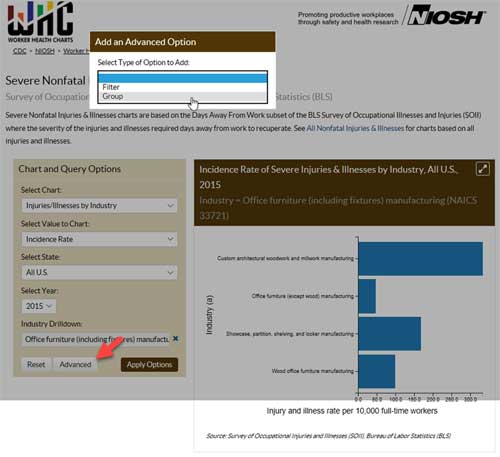
chart

  • “Filter” is used to restrict data to one specific category, for example: you can examine severe injuries and illnesses by age among office furniture manufacturing workers.
  • “Group” allows you to select up to five different categories for comparison.   For example, you can examine severe injuries and illnesses among office furniture manufacturing workers by exposure, time of day, part of body affected, among other options.

Jim clicks on “Advanced” and selects by “Group.” From the options provided, he chooses to chart “Part of Body Affected,” selecting:

  • Upper extremities
  • Lower extremities
  • Trunk

From the chart he produces, he is able to see that in 2015, injuries to the trunk were the most commonly occurring among wood office furniture manufacturing workers at an incident rate of 54.2 per 10,000 Full-Time Employees.

In looking through his injury logs, Jim notices most of his employee injuries occurred to the lower extremities, not the trunk like the Bureau of Labor Statistics data indicate. Jim begins to feel increasing concern. He decides to contact an occupational safety and health consultant to help him determine why his plant is experiencing high rates of lower extremities injuries.

This scenario is one way we hope that Worker Health Charts can be used by employers, workers, public health agencies and the general public to learn more about workplace injuries, illnesses, and deaths. And to identify where intervention and prevention efforts could be helpful.

Do you think this tool could be useful to you? If so, how would you use it? If not, what would you do to improve it? Click here to go to this NIOSH Science Blog post on the NIOSH website and leave your comments.

KEYWORDS: injuries injury and illness recordkeeping

Share This Story

Looking for a reprint of this article?
From high-res PDFs to custom plaques, order your copy today!

Amy Mobley, MEn, is a Health Communications Specialist in NIOSH’s Surveillance Branch in the Division of Surveillance, Hazard Evaluations & Field Studies.

Rebecca Tsai, PhD, is an Epidemiologist in NIOSH’s Surveillance Branch in the Division of Surveillance, Hazard Evaluations & Field Studies.

Recommended Content

JOIN TODAY
to unlock your recommendations.

Already have an account? Sign In

  • forklift safety

    Exploring the latest technologies in forklift safety

    With more staff and more stock in warehousing now more...
    Facility Safety
    By: Josh Cramer
  • welding

    All about welder’s flash or arc eye

    A flash burn is a painful inflammation of the cornea,...
    Environmental Health and Safety
  • dangerous jobs

    The 10 most dangerous jobs in the U.S.

    On-the-job deaths have been rising — hitting the highest...
    Government Safety Regulations
    By: Benita Mehta
Manage My Account
  • eMagazine Subscriptions
  • ISHN Newsletter & Other Newsletter Alerts
  • Online Registration
  • Manage My Preferences
  • Subscription Customer Service

More Videos

Sponsored Content

Sponsored Content is a special paid section where industry companies provide high quality, objective, non-commercial content around topics of interest to the ISHN audience. All Sponsored Content is supplied by the advertising company and any opinions expressed in this article are those of the author and not necessarily reflect the views of ISHN or its parent company, BNP Media. Interested in participating in our Sponsored Content section? Contact your local rep!

close
  • man wearing the the Sundström SR200 Full Face Mask Respirator
    Sponsored byOHD

    5 Fit Testing Mistakes That Could Cost You

  • This image shows Magid AcuSpex polarized blue mirrored safety glasses.
    Sponsored byMagid Glove and Safety

    Construction PPE Guide: What Crews Need for Each Task

  • lone worker in confined space
    Sponsored byAlphasense Ltd.

    GET THE LEAD OUT of your Safety Oxygen Sensors!

Popular Stories

SpaceX 7 launch

OSHA Investigating Fatal Fall at SpaceX Starbase

Automated loading dock equipment

After March 2026 Rivian Death, Safety Managers Reassess Loading Dock Systems Under OSHA's Warehouse Emphasis Program

psychology in the workplace

Most Workplaces Measure Psychological Safety, Ignoring Psychosocial Risks

top 10 most dangerous jobs

Poll

Seasonal Readiness

With the federal heat stress prevention rule on the horizon, which area of your safety program needs the most attention?
View Results Poll Archive

Products

Surviving an OSHA Audit A Management Guide, 2nd Edition

Surviving an OSHA Audit A Management Guide, 2nd Edition

See More Products

ISHN Podcasts

Related Articles

  • Researchers scramble to learn more about Zika virus

    See More
  • ishn0821-Stern-mainpic.jpg

    Safety pros can learn about how to maintain a civil workplace from anti-bullying policies at big universities

    See More
  • Highway work is dangerous– nearly 800 fatalities per year

    What we can learn about workplace safety from organized labor

    See More

Related Products

See More Products
  • industrial hy.jpg

    Industrial Hygiene: Improving Worker Health through an Operational Risk Approach

  • 9781138749573.jpg

    Occupational Health and Safety Management: A Practical Approach, Third Edition

  • occup safety.jpg

    Occupational Safety and Health: Fundamental Principles and Philosophies

See More Products

Related Directories

  • SafetyLine Lone Worker

    SafetyLine Lone Worker helps companies monitor the status of workers who are remote, alone, or working in hazardous situations. We are an automated check-in monitoring and emergency notification service. SafetyLine uses its communications infrastructure to ensure that workers have comprehensive monitoring, 24/7, without the need for costly monitoring centers.
×

Become a Leader in Safety Culture

Build your knowledge with ISHN, covering key safety, health and industrial hygiene news, products, and trends.

JOIN TODAY
  • RESOURCES
    • Advertise
    • Contact Us
    • Directories
    • Manufacturing Division
    • Store
    • Want More
  • SIGN UP TODAY
    • Create Account
    • eMagazine
    • Newsletters
    • Customer Service
    • Manage Preferences
  • SERVICES
    • Marketing Services
    • Reprints
    • Market Research
    • List Rental
    • Survey/Respondent Access
  • STAY CONNECTED
    • LinkedIn
    • Facebook
    • YouTube
    • X (Twitter)
  • PRIVACY
    • PRIVACY POLICY
    • TERMS & CONDITIONS
    • DO NOT SELL MY PERSONAL INFORMATION
    • PRIVACY REQUEST
    • ACCESSIBILITY

Copyright ©2026. All Rights Reserved BNP Media, Inc. and BNP Media II, LLC.

Design, CMS, Hosting & Web Development :: ePublishing