Personality tendencies impact performance
Are you a “doer,” “thinker,” “socializer” or “relator”?

It wasn’t until recently that we started understanding that people with different personalities tend to naturally pay more attention to safety attributes like work environment, people, equipment, processes, etc. based on their personality tendencies. Here are some simple definitions to get you thinking about personalities in a little different way:1
- Personality: Our comfort zone, how we react instinctively, our needs-driven behavior and what typically dictates our tendencies. Some of the more popular personality elements are called Doer, Thinker, Socializer and Relator. Our personality tendencies have a large and predictable impact on how we see, manage and mitigate risk and shape how we react to the safety attributes. Our personality style and tendencies tend to stay consistent over our lifetime.
-
Character: Our ethics, morals, commitments, values, background, beliefs, training, previous reflective experiences, awareness, and ability to self-manage things that may limit our capabilities to see and react to risk. Character is what typically allows us to respond to the safety elements, and our character may change some over time as we gain life and work experiences.
Personality style and tendencies are more closely linked to physiological elements, or how we are wired, and character elements are gained more from life and work experiences, training and things that happen to us along the way. Character is what separates each of us from another within the same personality type. - Tendencies: Our default or natural reaction to a stimulus. The reaction is an instinctual but predictable thought, action or behavior that typically happens without thinking, as opposed to thoughtful consideration driving a response.
-
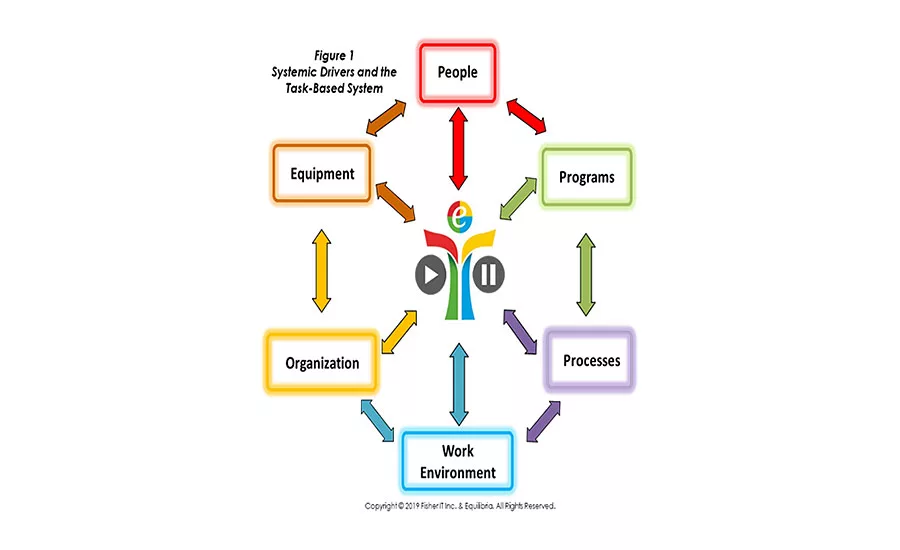
Systemic Drivers: (See Figure 1) Task-related elements that “drive” people to react without much thought based on their personality tendencies. Each person on any given task at any given time (the person in the middle of the system) is surrounded by the task-related elements of other people, programs, processes, work environment, organization (local to the task) and equipment, otherwise known as “systemic drivers.” This system exists on any task at work, at home and at play.
Data indicates that people with different personality tendencies react differently to these changes in systemic drivers. Since people do what they do, at the time that they do it, for reasons that make sense to them at the time, you can look to the systemic drivers to discover what the reasoning was/is for what they did and why it made sense to them at the time.2
Working in systems
How people interact with systemic drivers is called the “task-based system” and is useful to help us understand where risk may come from. An example may be if you were going to turn over mowing your lawn to your teenager. You could use the task-based system to better help them understand where the risk may actually come from, instead of where their personality may THINK it will come from. A socializer will probably not see the neighbors as a distraction risk, because they are people-oriented. A doer just may be ready to go because they have watched you mow for years and they think they are ready to operate the equipment.
Studies show when the risk comes from a systemic driver that your personality immediately pays attention to, you will probably see it and manage it effectively. But if the risk comes from a systemic driver that you do not tend to pay attention to naturally, you may be blinded to that risk and mismanage it. This is the essence of different people with different personalities seeing and managing risk differently.
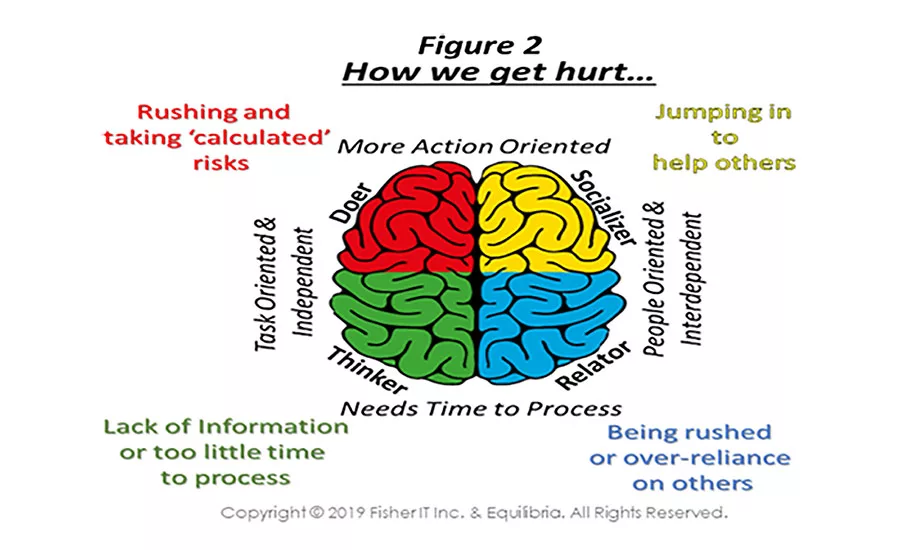
Most of the personality typing mechanisms are good at predicting how we prefer to communicate. Doers like to know “what;” Thinkers like to know “how;” Socializers like to know “who;” and Relators like to know “why.” Equilibria, LLC describes the personality tendencies in a simple format called E-Colors©. Doer (Red), Thinker (Green), Socializer (Yellow) and Relator, (Blue) (Figure 2). Equilibria datum of over 500,0000 inputs from around the globe shows that through understanding our personality types and tendencies we can predict with great certainty elements related to safety, quality, effectiveness, efficiency and productivity including:
- How and why people get hurt (Figure 2);
- What makes it difficult to follow written guidance;
- What makes it difficult for people to stop work and seek out help;
- Which systemic drivers we pay most attention to; and
- How human error traps like stress, high workload, time-pressure or overconfidence impact us and others.
Every individual has parts of all the different personalities within us, and no personality type is “better” than another. In addition, no one personality type is “riskier” than another; we each have different ways that we manage risk naturally. Being aware of and learning to manage these tendencies is the best way to mitigate the risk.
Taking the lessons learned from deploying in organizations around the world, and by understanding the predictable personality tendencies, organizations and individuals can be better prepared to minimize the probability someone will make an error, or when they do make an error, help reduce the consequence.
By providing individuals at all levels of the organization with personality tendency awareness and management tools, you improve overall risk awareness, workforce engagement, communication and safety culture, while driving incidents down.
Sources
1 – Barakat, E., Barber, J. & Wood, J., 2010, Achieving Sustainable Incident-Free Operations through Managing the Human Factor: A Success Story of Applying E-Colors, SPE Annual Technical Conference and Exhibition held in Florence, Italy, 19–22 September 2010 - SPE 135004
2 – Dekker, S., 2006, The Field Guide to Understanding Human Error, Ashgate Press, Surrey: England
Looking for a reprint of this article?
From high-res PDFs to custom plaques, order your copy today!