ISHN logo
search
cart
facebook twitter linkedin youtube
  • Sign In
  • Create Account
  • Sign Out
  • My Account
ISHN logo
  • NEWS
    • Today's News
    • Global Safety News
    • Government Regulations
  • PRODUCTS
    • Product Innovations
    • Featured Products
  • TOPICS
    • Environmental Health and Safety
    • Facility Safety
    • Workplace Health
    • Occupational Safety
    • PPE
    • More Topics
  • CONSTRUCTION
  • TECHNOLOGY
  • COLUMNS
    • Best Practices
    • Dave Johnson: What’s going on
    • Editorial Comments
    • Leading Safety
  • MULTIMEDIA
    • ISHN Podcast
    • Videos
    • Cold Stress Education Quiz
    • Webinars
    • White Papers
  • MORE
    • Buyer's Guide
    • Newsletters
    • Convention Companion
    • Polls
    • Events
    • ISHN Store
    • Sponsor Insights
  • EMAGAZINE
    • eMagazine
    • Archived Issues
    • Contact
    • Advertise
  • JOIN TODAY!
Today's Safety NewsOccupational SafetyEnvironmental Health and SafetyWorkplace Safety CultureWorkplace Training Strategies Risk ManagementPsychology in the Workplace

Rethinking Traditional Safety, Part 3

The third dimension of risk assessment
By Larry Wilson
The third dimension of risk assessment
ISHN0220_F2_fig1.jpg
ISHN0220_F2_fig2.jpg
The third dimension of risk assessment
ISHN0220_F2_fig1.jpg
ISHN0220_F2_fig2.jpg
February 4, 2020

In the last paradigm shift, “The 3 Main Sources of Unexpected Events,” we learned that there are three main sources: the equipment doing something unexpectedly, someone else doing something unexpectedly, or you (me) doing something unexpectedly ourselves. We used a reliable database—what has actually happened to us. We built our own personal risk pyramids. This gave us more than just numbers. It also got us thinking about the source of the unexpected event in our own serious injuries.

Your worst injury

The conclusion was that more than 95 percent (97-99 percent in most cases), the unexpected event was in the “self-area.” So, for this next paradigm shift, let’s go back to that reliable database (what’s actually happened to you), and ask you to think about the most dangerous thing you’ve ever done. It could have been skydiving, scuba diving with sharks, driving over 100 mph (160 km/h), etc. But think of the instance, not just a general category like driving or riding your bike—more like when you were riding your bike down the steepest hill, going the fastest you’ve ever gone on your motorcycle or in your car.

OK, now for the easy part: just think of your worst injury or your two worst injuries. And then, the last question: do you have a match? Does your most dangerous act equal your worst injury? Does your second most dangerous act equal your second worst injury? What about the third most dangerous act, and so on.

If you’re like most people, chances are you don’t have a match. In other words, your worst injuries didn’t come from the most dangerous things you had ever done. (Note: With 100 people in the room, you normally only get one to three hands in the air for people with a match).

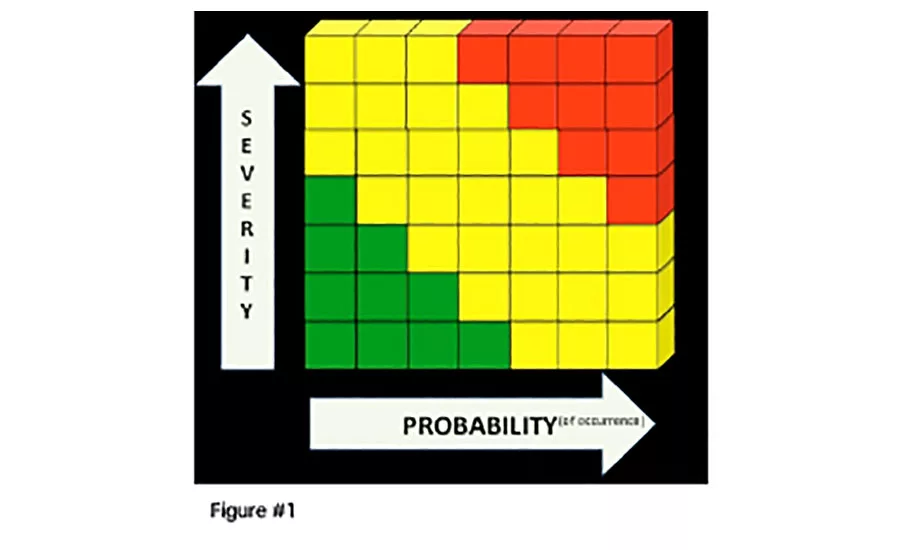
As you can imagine, this is another real eye-opener for most employees. Especially those who took for granted the traditional risk matrix as being valid. (See Figure #1). Although it seems to make perfect, intuitive sense that people would get hurt when they are doing the most dangerous things, that isn’t what actually happens to more than 95 percent of us.

An obvious explanation for this is when you are doing something you think is dangerous or extremely dangerous, chances are you’re paying attention or full attention (eyes and mind on task). How much does that change the risk? And what about the opposite: how much does risk change when your eyes are not on task and your mind is not on task? 

Beyond the obvious risks

So, what does this mean in terms of the old risk assessment matrix? Well, it means that if we want to prevent serious injuries and fatalities (the majority of them), we have to go beyond the obvious risks. We will need to look at another dimension of risk assessment, which is human error. How much does someone making a mistake, like not looking before they move, how much does that change the risk? And, most importantly, can we predict when and where someone will make a mistake that could cause serious harm?

Risk scenarios

Consider the following scenarios and the risk of a single-vehicle collision:

  1. A driver is going at excessive speed but is paying attention.
  2. A driver is going at normal speed but is not paying attention (driving on auto-pilot).

Which scenario has more risk? If you had to bet, which one would you put the money on? Or, if given a chance, would you prefer not to bet?

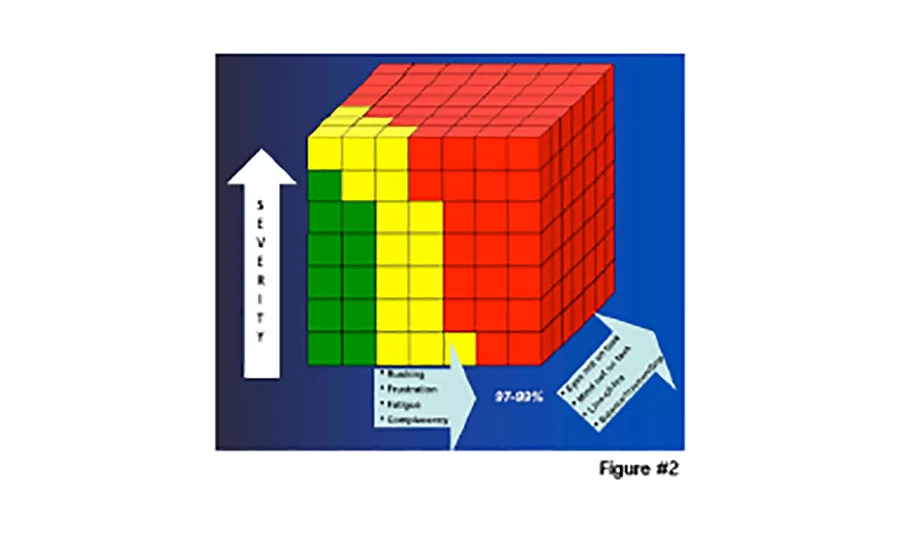
Now, consider the second scenario, but in addition to driving at normal speed—on “auto-pilot” — the driver is also really, really tired. Now how much would you bet? We know calculating the risk of inattention is difficult — not that anybody’s arguing that it’s unimportant — but it’s difficult. However, we do know this: the risk of inattention goes up if someone is rushing, or going faster than they normally go, or if they are frustrated, fatigued or a little too complacent. Note: in most cases it will be a combination of states: fatigue and complacency combining to cause someone to fall asleep at the wheel.

So, what does this mean in terms of the old risk assessment matrix?

So, the four states and their intensity are key components to calculating the probability of occurrence (x axis), and the critical errors such as eyes not on task and mind not on task are the 3rd dimension (z axis). Although these two critical errors are not necessarily equal either — and definitely affect the probability of severity (y axis) — more on that next issue. (See Figure #2)

For now, the main argument or paradigm shift is that an accurate risk assessment is not just about the obvious or the intuitive risks. Think about it: if getting hurt was not counter-intuitive, how many thousands of years ago do you think your ancestors would have quit getting hurt!

Moreover, if we want to prevent the majority of serious injuries and fatalities (SIFs) we need to look beyond the obvious basics, and start to include human error and the potential for human error in all your risk assessments; otherwise, they could be misleading and create a false sense of security in situations when it's not high voltage, high temperature, high speed, etc. That would be the epitome of irony: that your risk assessment increased risk.

Next issue: Skill vs. Luck/Reflexes and SIF’s

See more from Larry Wilson

KEYWORDS: human error human factors risk assessments risk factors serious injuries & fatalities (SIFs)

Share This Story

Looking for a reprint of this article?
From high-res PDFs to custom plaques, order your copy today!

Larry Wilson is a pioneer in the area of human factors in safety. He has been a behavior-based safety consultant for over 25 years and has worked on-site with hundreds of companies worldwide. He is also the author of SafeStart, used in more than 3,000 companies, 66 countries, with more than 3.5 million people trained.

Recommended Content

JOIN TODAY
to unlock your recommendations.

Already have an account? Sign In

  • forklift safety

    Exploring the latest technologies in forklift safety

    With more staff and more stock in warehousing now more...
    Facility Safety
    By: Josh Cramer
  • welding

    All about welder’s flash or arc eye

    A flash burn is a painful inflammation of the cornea,...
    Environmental Health and Safety
  • dangerous jobs

    The 10 most dangerous jobs in the U.S.

    On-the-job deaths have been rising — hitting the highest...
    Transportation Safety
    By: Benita Mehta
Manage My Account
  • eMagazine Subscriptions
  • ISHN Newsletter & Other Newsletter Alerts
  • Online Registration
  • Manage My Preferences
  • Subscription Customer Service

More Videos

Sponsored Content

Sponsored Content is a special paid section where industry companies provide high quality, objective, non-commercial content around topics of interest to the ISHN audience. All Sponsored Content is supplied by the advertising company and any opinions expressed in this article are those of the author and not necessarily reflect the views of ISHN or its parent company, BNP Media. Interested in participating in our Sponsored Content section? Contact your local rep!

close
  • man wearing the the Sundström SR200 Full Face Mask Respirator
    Sponsored byOHD

    5 Fit Testing Mistakes That Could Cost You

  • This image shows Magid AcuSpex polarized blue mirrored safety glasses.
    Sponsored byMagid Glove and Safety

    Construction PPE Guide: What Crews Need for Each Task

  • lone worker in confined space
    Sponsored byAlphasense Ltd.

    GET THE LEAD OUT of your Safety Oxygen Sensors!

Popular Stories

SpaceX 7 launch

OSHA Investigating Fatal Fall at SpaceX Starbase

Worker Impairment

How to Tell When a Co-Worker is Impaired? A Safety Pro’s Challenge

Automated loading dock equipment

After March 2026 Rivian Death, Safety Managers Reassess Loading Dock Systems Under OSHA's Warehouse Emphasis Program

top 10 most dangerous jobs

Poll

Seasonal Readiness

With the federal heat stress prevention rule on the horizon, which area of your safety program needs the most attention?
View Results Poll Archive

Products

Surviving an OSHA Audit A Management Guide, 2nd Edition

Surviving an OSHA Audit A Management Guide, 2nd Edition

See More Products

ISHN Podcasts

Related Articles

  • AIHA supports DOL's withdrawal of risk assessment rule (9/3)

    See More
  • EPA releases draft of chemical risk assessment

    See More
  • Using science to assess workplace hazards: NIOSH practices in occupational risk assessment

    See More

Related Products

See More Products
  • 1118911040.jpg

    Risk Assessment: A Practical Guide to Assessing Operational Risks

  • 3E

    Safety Professional's Reference and Study Guide, Third Edition

  • 9781138749573.jpg

    Occupational Health and Safety Management: A Practical Approach, Third Edition

See More Products

Related Directories

  • Pinnacle Systems Inc.

    USA Manufacturer of standard & custom safety products for industrial machine guarding applications. Products include safety light curtains, safety mat systems & ergonomic palm buttons. Capabilities include repair, assembly & engineering. Risk assessment is also offered. All products are manufactured, engineered & serviced in the United States.
×

Become a Leader in Safety Culture

Build your knowledge with ISHN, covering key safety, health and industrial hygiene news, products, and trends.

JOIN TODAY
  • RESOURCES
    • Advertise
    • Contact Us
    • Directories
    • Manufacturing Division
    • Store
    • Want More
  • SIGN UP TODAY
    • Create Account
    • eMagazine
    • Newsletters
    • Customer Service
    • Manage Preferences
  • SERVICES
    • Marketing Services
    • Reprints
    • Market Research
    • List Rental
    • Survey/Respondent Access
  • STAY CONNECTED
    • LinkedIn
    • Facebook
    • YouTube
    • X (Twitter)
  • PRIVACY
    • PRIVACY POLICY
    • TERMS & CONDITIONS
    • DO NOT SELL MY PERSONAL INFORMATION
    • PRIVACY REQUEST
    • ACCESSIBILITY

Copyright ©2026. All Rights Reserved BNP Media, Inc. and BNP Media II, LLC.

Design, CMS, Hosting & Web Development :: ePublishing