Leading Safety
Focus on employees’ needs for a more productive approach to workplace engagement
Some research has shown that formal performance management practices may not work well in garnering employee involvement and/or management leadership resulting in operational excellence and superior organizational results. A more productive approach focuses on the employee’s five basic needs delineated in Maslow’s hierarchy of needs theory, enabled by management’s practice of servant leadership resulting in employee engagement.
Various research studies have found that organizations with high levels of employee engagement garner an empathic work climate, greater productivity, operational efficiency, higher quality products and/or services, as well as employee satisfaction driving low turnover. This results in an efficacious work environment, enhancing communication which enhances customer satisfaction and loyalty leading to greater profitability.
Employee engagement
It is important to recognize that just about anyone starting a new job, commences with high levels of motivation and enthusiasm. They generally want to accomplish their work, gain experience and enjoy what they do. But, in reality this natural state of motivation and involvement is often reduced or even eliminated completely over time, by poor and misaligned organizational systems, cumbersome operational processes, ineffective and/or misaligned procedures, difficult relationship with supervisors and/or other employees as experienced or perceived by the individual.
An "engaged employee" is one who is fully involved in, and enthusiastic about his or her work in particular and the organization in general. As a result, they will act in ways that advance their organization's interests. Employee engagement is important to the competitiveness of any organization, particularly in the current business and economic environment.
Employee engagement is influenced by how the individual experiences or perceives the organizational culture as well as work climate cognitively, reacts emotionally and responds behaviorally.
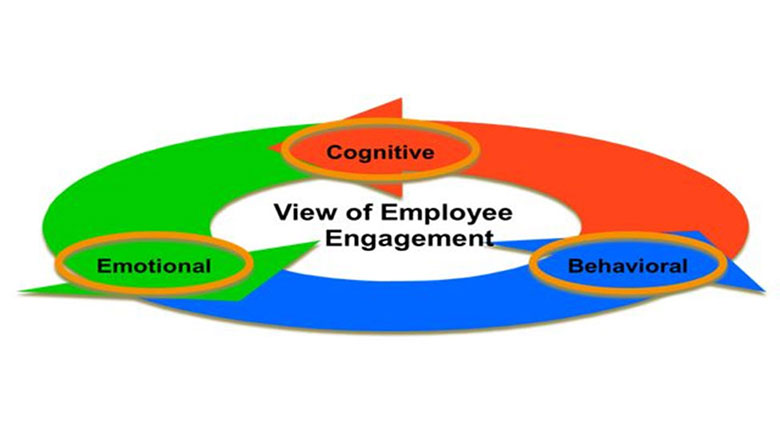
The cognitive perspective revolves around the employees' understanding, perception and beliefs regarding the organization and its culture in general, its leaders, and working climate or conditions in particular.
The emotional perspective relates to whether the employee has a positive or negative attitude concerning the organization and its leaders and managers. The cognitive element is influenced by the emotional perspective.
The behavioral perspective of engagement is reflected in the employee's willingness to apply his or her discretionary effort to the work, resulting in a value-added benefit to the organization.
Doctor David Serota conducted extensive research involving over four million employees around the world assessing factors which motivate them. He concluded that the way to create enthusiasm leading to an engaged workforce is to provide them with what they want and/or need. Sirota's Three-Factor Theory of Human Motivation in the Workplace is based on three fundamental principles:
- The organizational/operational goals are not in conflict with the workers' goals.
- Workers have basic needs that organizations should try to meet.
- Employee enthusiasm is a source of organizational competitive advantage.
Directing the focus of traditional performance management towards the management of employee engagement requires creating the antecedent conditions in the performance management system in order to foster and sustain psychological meaningful engagement. People achieve psychological meaningfulness when they feel worthwhile, are appreciated, respected, and when their efforts and contribution matter and are recognized.
Categories of engagement
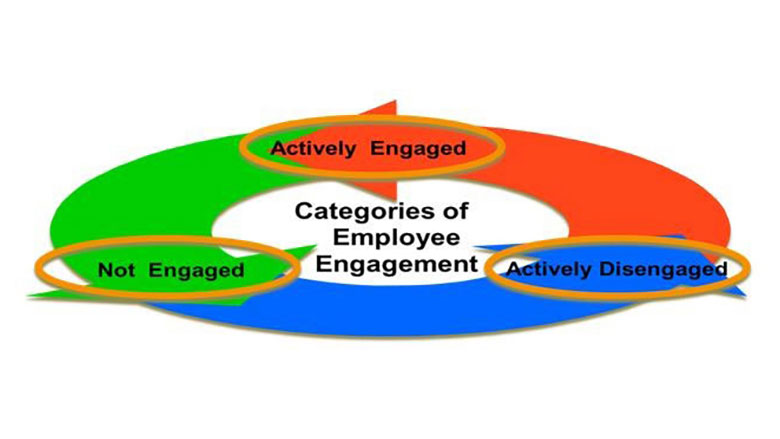
Employee in all organizations exhibit some form and/or level of engagement, which may more than likely fall into three distinct broad categories:
- Actively engaged employees are the ones who are fully involved in their work and are passionate about it. They have a good working relationship with management, and feel a strong connection to the organization and its leadership. Such workers are effective in their work practices, strengthen working relationships, drive innovation, and help move the organization forward.
- Not engaged employees are those workers who see their jobs as just a “job” and are basically "putting in their time" doing the bare minimum to get by. They have no opinion of their supervisor nor do they feel any affinity to their coworkers. They bring little or no energy to their work and are not vested in or passionate about the organization.
- Actively disengaged employees aren't just unhappy with their jobs but have an adversarial relationship with management and dislike the organization as a whole. They are busy acting out their unhappiness as well as frustrations. Such employees tend to cause disharmony in the work environment.
- To change the level of employee engagement, the organization must also have a good understanding of change management, as well as potential drivers of engagement. Since organization need actively engaged employees, they need to have a means of identifying those who are not, and then have a process with which to intervene and ensure that their workforce is actively engaged. If this is not addressed, it can also affect others in the workforce.
Many research studies have documented the importance and effectiveness of high-involvement work practices in many different industries. These studies compared traditional management methods with high-involvement work practices in automotive, electronic, apparel and steel manufacturing as well as in various service organizations. In virtually every case, workers in the high-involvement plants or operations showed higher levels of morale, positive attitudes, trust, and cooperation with significantly higher labor productivity. These also included organizational commitment and intrinsic enjoyment of the work. Invariably, those organizations with a high-involvement workforce showed superior operational performance and exemplary financial outcomes as well.
Enabling engagement
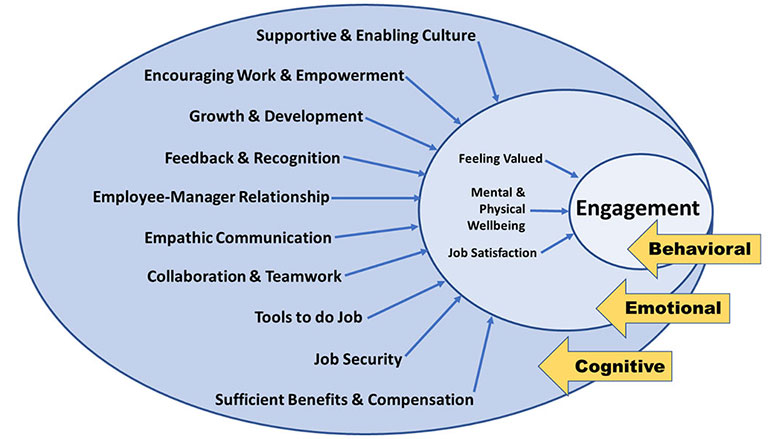
Research has also shown certain management practices enhance and encourage employee engagement. These four practices have to be bolstered by management by placing the “right” people, in the “right” positions, providing them with the “right” information and resources, so that they are enabled to do the “right” things, and follow this up with the “right” recognition in order to sustain their engagement over the long term.
Power
This represents management empowering employees to participate in decision-making regarding their work, soliciting input, fostering open discussion and communication. This requires a democratic style of leadership on management’s part. For this interaction to function optimally, time has to be allocated for participation and workers encouraged to provide suggestions and participate in problem solving. In construction, the toolbox talks function could provide a forum for this exchange to occur.
Knowhow
Prior to making a task assignment, the supervisor assesses the task-demand and evaluates the worker’s capabilities and knowledge to meet them. Should there be any deficiencies, the supervisor provides the education, training, and information so as the enable the worker prior to work commencement. And to ensure success the supervisor provides the appropriate resources, guidance and coaching to the worker.
Information
Timely and sufficient information is necessary for a worker to perform their task. This becomes the basis for decision-making, problem solving, and proper execution of the work. The management's challenge is to set up a process by which the worker gets the right information at the right time. To sustain involvement the worker must see a direct link between what they do on a daily basis and how that contributes to the organizational or project goals and objectives.
Recognition
Recognition of the worker’s efforts and accomplishment is critical to foster involvement and sustain the engagement of workers who are involved in improving themselves and the operations. Recognition comes in many forms, but it is critical that, whatever form it takes, it has to be provided soon after the accomplishment. Workers generally expect good work will be praised or rewarded. The type of praise given must be meaningful to the worker. Research in manufacturing operations has shown that a few thousand dollars of bonuses to each worker translated into millions of dollars in operational efficiencies with the added bonus of much higher quality, less waste, more dependable delivery, and fewer occupational incidents or losses.
Conclusion
Employee engagement is a powerful means for organizations to improve all of their business functions and their outcomes, be it in productivity, quality, safety, partner relations, customer loyalty, as well as profitability. How employees feel about the organization and their work is greatly influenced by the work climate and how they interact with their supervisor. See the second installment of this column next month detailing specific safety benefits of employee engagement.
Looking for a reprint of this article?
From high-res PDFs to custom plaques, order your copy today!