Tips for Managing Accidents on Construction Projects
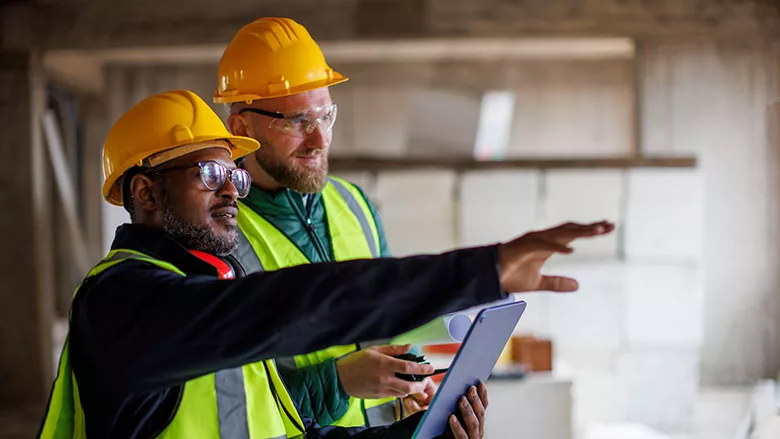
Photo credit: damircudic / E+ / Getty Images Plus
Although at the strategic level accident management for construction projects is no different from that for plant sites, there are significant differences at a tactical level. Shrewd safety professionals carefully consider these differences at the planning stage and throughout the life of a construction project.
Big picture
The construction industry in the US, Canada, and many other countries has garnered a dubious honor of the industry with highest rates of accidents. According to the Bureau of Labor Statistics (BLS), the construction industry accounted for nearly half of the fatalities due to falls, slips, and trips in 2022. In Canada, data show that in 2022, the construction industry ranked at the top of the list of occupational fatalities. Injury data for many years in the past show that opportunities exist for improving safety.
A host of factors contribute to high accident rates in construction projects including, for example, frequent worker turnover, variable demographics and language barriers, poor communications and training, environment, scheduling pressures, and poor safety culture. Prevalence of these and other factors vary from one project to another.
Project managers, contractors, and sub-contractors work tirelessly to ensure safety of workers. Still, accidents occur. Although accidents provide opportunities to improve, it is unpleasantly expensive route to learn — lower employee morale and trust, loss of revenue, tarnished public image and lower credit ratings are some of the unfortunate outcomes, with lasting impact of an accident. Of course, the goal is zero accidents. Although it may appear unreachable in some situations, it helps workers and managers become safety centric.
Management of accidents starts long before an accident occurs and continues through the duration of the project.
Management of accidents starts long before an accident occurs and continues through the duration of the project. The best or an ideal accident management system is such that it eliminates the need of having to deal with accidents altogether.
Systems approach and hierarchy of risk management are helpful tools in developing strategic and tactical details for managing accidents.
Systems approach and hierarchy of risk management
Hierarchy of risk management is a structured thought process that can be incorporated at all stages of a construction project — from the planning, design, implementation, and completion. Simply put, the hierarchy seeks to consider ways in which hazards can be eliminated or can be minimized with the use of engineering controls and if that option is not justifiable, then manage the risk with administrative controls and PPE.
From the systems approach perspective, it is convenient to regard the project as a system comprising a number of subsystems at each major stage of the project. For each subsystem, develop guidelines and procedures with salient focus on limiting liability and minimizing risk.
Pre-construction: Construction safety document
This pivotal document is intended for worker and neighbors’ protection and risk management by setting guidelines and procedures for compliance with federal, state, and local regulatory requirements and industry standards.
This document should incorporate essential work practices including, for example, management support and worker involvement, alerting systems for potential accidents or hazards, database systems for monitoring and reporting accidents, injuries, and illness, and accident investigation and corrective actions, and systems for internal and external communication of accident events.
This document should encourage culture of openness and trust.
This document is helpful and is used as a part of the contractor selection process.
Hazard identification and mitigation
Construction hazards that have accounted for many of safety incidents and/or fatalities include slips, trips, and falls, exposure to hazardous substances, electricity, severe weather.
Obviously if hazards are identified and mitigated at an early stage, accident occurrence can be drastically reduced. Many, not all, projects conduct Constructability Analysis (CA) to identify major construction hazards at the design stage. Unfortunately, some of the CA’s are performed hurriedly (and only once at the start of the project) under the pressure of tight schedule. The author believes that If CAs are performed with a finer level of granularity (similar to those in HAZOP/BOWTIE/ FMEA/ LOPA studies) and are done during EACH stage of the project coupled with Job Safety Analysis (JSA), they will collectively help reduce accident frequency and severity significantly.
Construction laws and contracts–minimization of owner liability
Owners and contractors must consider myriads of regulations, including for example OSHA, EPA, state and local laws, building laws/ code, and employment regulations. Many regulations, in the event of an accident, tend to place responsibility on the owner or general contractor even though they may not have directly created the accident — akin to strict liability doctrine. Owners or general contractors may feel like walking on eggshells, while dealing with provisions of liabilities and fines in the regulations.
Similar to numerous regulations, there are numerous contract arrangements. In contractual agreements, one key goal, besides safe completion of the project, is to minimize owner or general contractor’s liability. At the contact stage, safety professionals work along with company’s legal counsel, procurement, human resources, and engineering groups. Inclusion of safety considerations in contracts is of crucial importance.
Data management, data analysis and cyber security
From regulatory as well as project management perspective, data management and analysis are of vital importance. Today, it is near impossible to manage a project without data management and cyber security safeguards and this requires close coordination among safety, project management, IT, and cyber security personnel.
Community rapport
Effective rapport has long term dividend, especially in terms of communicating status of accident investigation to external stakeholders — neighbors, news, TV, and social media.
Collectively, training, audits, data management, safety manuals and healthy safety culture help lower the EMR (Experience Modification Rating) and hence Workers’ Compensation Insurance premium.
During-construction/accidents: Systems for inspections/audits
Construction projects typically involve numerous sub-contractors. From a productivity viewpoint, it is important to avoid excessive intrusion in their work. However, periodic audits help maintain high levels of safety. In audits, maintain an environment of openness and cooperation.
Infrastructure for accident investigation
Of course, accident investigation, data collection, worker interviews should start as soon as practicable after an accident has occurred. Trained in-house team or external consultants should be on call for quick deployment.
Internal and external communications
Obviously, belated and fragmentary communications to external agencies (social media, news reporters, radio/TV) could have devastating impact on your public image. This in turn could negatively impact business stability or even survivability.
Assign qualified speakers for managing external-agency interaction. Proper use and tone of words, and accurate representation of the status of investigation are important.
Rapport with external agencies
Although cordial interaction is important, you need to take your time to ensure that information you are planning to transmit is accurate and least likely to create confusion. Keep in mind external agencies are likely not familiar with technical jargon that may seem natural to you.
Post-accident systems: Corrective action
Investigation may reveal that multiple corrective actions are required to correct inadequacies that led to the accident. Assign priorities, time schedules and responsible persons to complete the corrective actions, test them for their reliability, train workers, and document details of the corrective action.
As discussed earlier, importance of documentation and data collection cannot be overstated.
Waste disposal systems
While from environmental sustainability, it is important to minimize waste, it cannot be eliminated and hence you need to have systems in place for timely and environmentally compliant waste disposal.
To sum up, accident management starts way BEFORE an accident occurs. Robust safety systems help reduce probability of future accidents and yields pecuniary dividends.
Reference
Darry C. Hill, Editor — Construction Safety Management and Engineering, American Society of Safety Engineers, Desplaines, Illinois, 2004
Looking for a reprint of this article?
From high-res PDFs to custom plaques, order your copy today!