ISHN logo
search
cart
facebook twitter linkedin youtube
  • Sign In
  • Create Account
  • Sign Out
  • My Account
ISHN logo
  • NEWS
    • Today's News
    • Global Safety News
    • Government Regulations
  • PRODUCTS
    • Product Innovations
    • Featured Products
  • TOPICS
    • Environmental Health and Safety
    • Facility Safety
    • Workplace Health
    • Occupational Safety
    • PPE
    • More Topics
  • CONSTRUCTION
  • TECHNOLOGY
  • COLUMNS
    • Best Practices
    • Dave Johnson: What’s going on
    • Editorial Comments
    • Leading Safety
  • MULTIMEDIA
    • ISHN Podcast
    • Videos
    • Cold Stress Education Quiz
    • Webinars
    • White Papers
  • MORE
    • Buyer's Guide
    • Newsletters
    • Convention Companion
    • Polls
    • Events
    • ISHN Store
    • Sponsor Insights
  • EMAGAZINE
    • eMagazine
    • Archived Issues
    • Contact
    • Advertise
  • JOIN TODAY!
Government Safety RegulationsOccupational SafetyOSHA Construction Industry Safety and Health

Digging Deeper: Why Trench Safety Needs to Be a Top Priority

By Chris McGlynn, MS, CSP
digging a trench
Photo: Roco Rescue
September 15, 2025

Trenching work remains one of construction's most lethal activities, yet its dangers are often underestimated. Each year, dozens of workers lose their lives in entirely preventable collapses. The statistics paint a sad picture: between 2003 and 2017, 373 workers died in trench-related incidents, averaging about 25 fatalities annually. More than 80% of these fatalities occurred in the construction industry. Even more alarming, 2022 saw a dramatic spike, with 39 deaths, more than double the previous year’s total. These aren’t abstract numbers; they represent parents, spouses, children, friends and colleagues who never returned home.  


The Nature of Trenches  

A trench, by OSHA’s definition, is a narrow excavation deeper than it is wide, with the bottom no broader than 15 feet. What makes trenches so dangerous is simple physics: soil is heavy, and unsupported 90-degree walls will collapse. A cubic yard of dirt weighs nearly 3,000 pounds, about as much as a midsize car. When a trench wall gives way, several cubic yards can bury a worker in seconds, leaving little chance for escape. It’s not a matter of if, but rather, a matter of when. 

Consider the case of two workers in Jarrell, Texas, in June 2022. They were in a trench 23 feet deep but only 34 inches wide. Despite three unused trench boxes sitting on-site, no protective systems were in place. When the walls collapsed, the men had no chance. This tragedy demonstrates a harsh reality: trenches don’t usually give warnings. They fail suddenly, and when they do, the consequences are often fatal.  
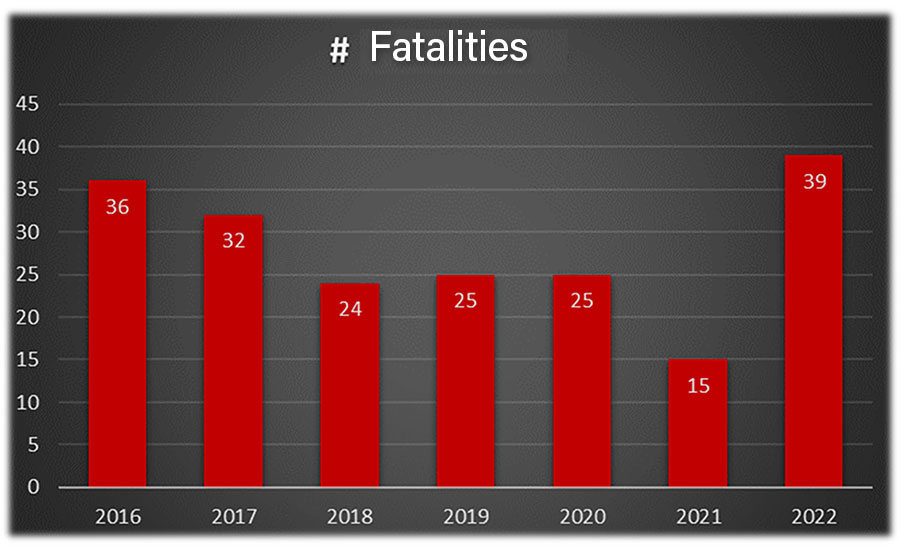
Number of Trenching Fatalities

Chart: Roco Rescue

Cave-ins are the leading cause of trench fatalities, but they’re far from the only hazard. Workers face electrocution from struck utility lines, suffocation in oxygen-deficient atmospheres, and crushing injuries from falling equipment. In one horrific incident, a worker drowned when a ruptured water main flooded a trench with 4,000 gallons per minute.  

Many of these deaths share common root causes: No protective systems and no competent person present. OSHA requires trenches deeper than 5 feet to have sloping, shoring, or shielding. Yet in 64% of fatal cave-ins, no such protection was used.  

In 86% of fatalities, no trained individual was present to assess hazards. OSHA’s "competent person" should be viewed as more than just a title. This individual must have the training to spot hazards (like fissures in trench walls) and the authority to halt work immediately. Their presence and active participation on the jobsite is essential in reducing hazards and preventing injuries and fatalities. 


OSHA’s Lifesaving Rules 

To combat these risks, OSHA mandates strict precautions under Subpart P (1926.650-652). Among the most critical are the following: 

  • Protective Systems: For trenches 5+ feet deep, walls must be sloped, shored, or shielded. The exact angle depends on soil type — stable clay (Type A) can be cut steeper than loose sand (Type C), which requires gentler slopes.  
  • Access and Escape: Workers in trenches 4+ feet deep must have a ladder or ramp within 25 feet.  
  • Utility Checks: Dialing 811 before digging helps locate underground lines, preventing deadly strikes.  
  • Spoil Piles: Dirt excavated from trenches must be kept at least 2 feet back from the edge. Piling it too close adds dangerous weight.  
  • Equipment Awareness: Heavy machinery operating near trenches can destabilize walls and shall be at least two feet from the edge of excavations.   
  • Rescue Planning: If a collapse occurs, untrained bystanders rushing in often become victims themselves. Proper rescue teams with shoring equipment are essential.  
  • Daily Inspections: A competent person must examine trenches before each shift and after any hazard-increasing event, like rain.  


Conclusion 

Trench fatalities are preventable, yet they persist because safety measures are skipped to save time or money. The solution isn’t just better training or stricter rules; it’s honestly a fundamental shift in mindset. Every trench death is a failure of planning, a failure of leadership, and above all, a failure to respect the lethal potential of an unstable hole in the ground.  

The next time you see workers in a trench, ask: Are protective measures in place? Is there a way out? Is someone watching for dangerous conditions? Ultimately the question should be “Can you dig it… safely?”

See more articles from our September 2025 issue!

KEYWORDS: trench safety

Share This Story

Looking for a reprint of this article?
From high-res PDFs to custom plaques, order your copy today!

Chris McGlynn is the Director of Safety and VPP Coordinator at Roco Rescue. He is a Certified Safety Professional (CSP), nationally registered paramedic, and experienced rescue technician specializing in confined space and rope rescue. Chris holds a Master’s degree in Occupational Safety and Health and is currently pursuing a Ph.D. at West Virginia University’s Statler College of Engineering & Mineral Resources.

Recommended Content

JOIN TODAY
to unlock your recommendations.

Already have an account? Sign In

  • forklift safety

    Exploring the latest technologies in forklift safety

    With more staff and more stock in warehousing now more...
    Facility Safety
    By: Josh Cramer
  • welding

    All about welder’s flash or arc eye

    A flash burn is a painful inflammation of the cornea,...
    Environmental Health and Safety
  • dangerous jobs

    The 10 most dangerous jobs in the U.S.

    On-the-job deaths have been rising — hitting the highest...
    Construction Industry Safety and Health
    By: Benita Mehta
Manage My Account
  • eMagazine Subscriptions
  • ISHN Newsletter & Other Newsletter Alerts
  • Online Registration
  • Manage My Preferences
  • Subscription Customer Service

More Videos

Sponsored Content

Sponsored Content is a special paid section where industry companies provide high quality, objective, non-commercial content around topics of interest to the ISHN audience. All Sponsored Content is supplied by the advertising company and any opinions expressed in this article are those of the author and not necessarily reflect the views of ISHN or its parent company, BNP Media. Interested in participating in our Sponsored Content section? Contact your local rep!

close
  • man wearing the the Sundström SR200 Full Face Mask Respirator
    Sponsored byOHD

    5 Fit Testing Mistakes That Could Cost You

  • This image shows Magid AcuSpex polarized blue mirrored safety glasses.
    Sponsored byMagid Glove and Safety

    Construction PPE Guide: What Crews Need for Each Task

  • lone worker in confined space
    Sponsored byAlphasense Ltd.

    GET THE LEAD OUT of your Safety Oxygen Sensors!

Popular Stories

SpaceX 7 launch

OSHA Investigating Fatal Fall at SpaceX Starbase

Automated loading dock equipment

After March 2026 Rivian Death, Safety Managers Reassess Loading Dock Systems Under OSHA's Warehouse Emphasis Program

psychology in the workplace

Most Workplaces Measure Psychological Safety, Ignoring Psychosocial Risks

top 10 most dangerous jobs

Poll

Seasonal Readiness

With the federal heat stress prevention rule on the horizon, which area of your safety program needs the most attention?
View Results Poll Archive

Products

Surviving an OSHA Audit A Management Guide, 2nd Edition

Surviving an OSHA Audit A Management Guide, 2nd Edition

See More Products

ISHN Podcasts

Related Articles

  • trenching fatalities

    OSHA makes reducing trenching deaths a top priority

    See More
  • The safety profession needs to be more shrill

    See More
  • OLFA knives

    With OLFA utility knives, safety is a top priority

    See More

Related Products

See More Products
  • Top Ten Pitfalls in OSHA Recordkeeping and How to Avoid Them

  • 0470387408.jpg

    Preparing for OSHA s Voluntary Protection Programs: A Guide to Success

  • 111885960X.jpg

    Professional Rope Access: A Guide To Working Safely at Height

See More Products

Related Directories

  • Broner Glove & Safety Co.

    For over 90 years, Broner Glove and Safety has been dedicated to 'Making a Difference' in safety programs. As proud members of AD-SafetyNetwork, we provide comprehensive safety solutions, including personalized service, top-tier PPE, and cutting-edge plant and site safety equipment, ensuring the well-being of your workforce and industry excellence.
  • EME Safety LLC

    EME Safety offers non-ionizing radiation training and survey services. We can provide EME safety training with CEUs through our IEEE credentialed courses. We can also provide survey services and in-person training. Training can be provided for a few hours to multiple days to meet your learning needs.
  • SAS Safety Corp.

    SAS Safety Corp. offers head-to-toe safety products and solutions for respiratory, hearing, eyes, hands, body, face, first-aid kits, absorbents, spill containment, and other crucial safety accessories. Our goal is to provide safety managers, wholesalers, and DIY’ers with simple solutions for determining safety needs and solutions.
×

Become a Leader in Safety Culture

Build your knowledge with ISHN, covering key safety, health and industrial hygiene news, products, and trends.

JOIN TODAY
  • RESOURCES
    • Advertise
    • Contact Us
    • Directories
    • Manufacturing Division
    • Store
    • Want More
  • SIGN UP TODAY
    • Create Account
    • eMagazine
    • Newsletters
    • Customer Service
    • Manage Preferences
  • SERVICES
    • Marketing Services
    • Reprints
    • Market Research
    • List Rental
    • Survey/Respondent Access
  • STAY CONNECTED
    • LinkedIn
    • Facebook
    • YouTube
    • X (Twitter)
  • PRIVACY
    • PRIVACY POLICY
    • TERMS & CONDITIONS
    • DO NOT SELL MY PERSONAL INFORMATION
    • PRIVACY REQUEST
    • ACCESSIBILITY

Copyright ©2026. All Rights Reserved BNP Media, Inc. and BNP Media II, LLC.

Design, CMS, Hosting & Web Development :: ePublishing