NSC News: The Strongest Link in the Safety Chain
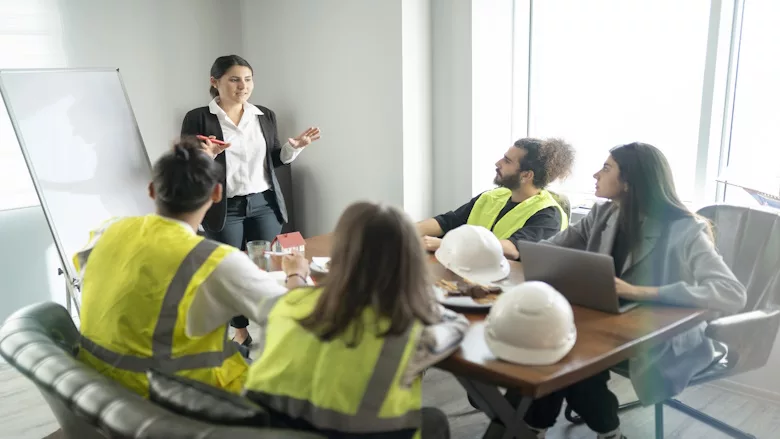
Credit: isayildiz / E+ / Getty Images Plus
Denver — “Humans have been seen as the weakest link in the safety chain; I’d like to challenge that,” said Corrie Pitzer at a Tuesday afternoon session at the National Safety Congress.
Pitzer said four factors have driven the perception of employees as safety’s weak link: 1) lack of competence or simply not being competent; 2) taking advantage of no one watching to take short cuts and risks; 3) lack of motivation to be safe due to the benefits of risk-taking (short cuts that save time) outweighing the disadvantages (following the rules slows you down); and 4) the inclination to deviate from the norm to meet deadlines, production quotas, etc.
Employees as the weak link is reinforced by incidents caused by carelessness, recklessness, complacency and risk habituation — “I’m used to this risk. Have done this job for years. I know what I’m doing.”
Pitzer, a trained industrial psychologist, advocates taking the opposite view – that employees have unique characteristics that enhance safety such as endurance, empathy, compassion, anticipation, analytical thinking, meticulous planning, the ability to plan for risk, critical thinking, the ability to recognize biases, and emotional intelligence. All can be harnessed to the benefit of safety if employees are effectively engaged.
Also unique to humans, according to Pitzer, is the ability to improvise (such as the famous landing of a disabled jet on the Hudson River); to overcome (fears and obstacles and barriers); and to sense (through use of hearing, touch, taste and smell).
“Humans have incredible capabilities,” said Pitzer.
That includes observation skills, especially if they are honed by hazard recognition training that enables employees to get out of the autopilot zone and “see better,” a term used by the Center of Visual Expertise.
Pitzer defines safe as the readiness to address risk. Humans are uniquely equipped for that preparation if properly trained, engaged and empowered, he said. That’s how you make humans the strongest link in the safety chain. He cited one study showing that employees closed out 74% of hazards found during observation rounds with their own problem-solving.
As the strongest link, employees are most likely to know where the next incident will occur, why it will happen, and what can be done to eliminate the possibility.
Looking for a reprint of this article?
From high-res PDFs to custom plaques, order your copy today!