Boundary Monitoring for Construction Sites Keeps Hazards Away and Fines Down
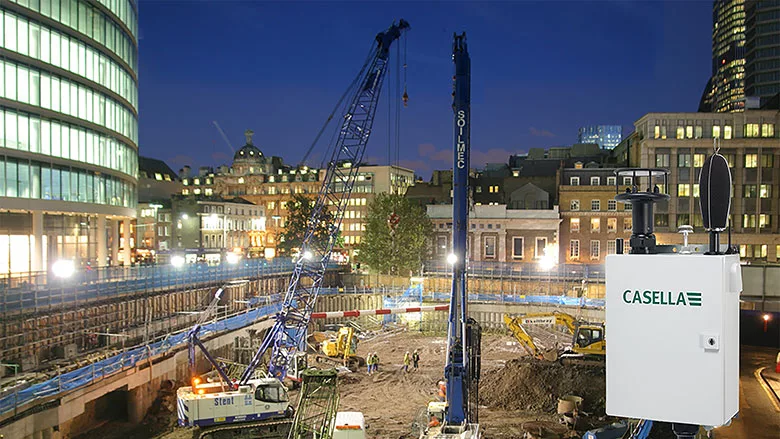
Are employers managing the impact of construction sites to the surrounding area? Fenceline, often referred to as boundary monitoring, is a vital tool which can identify environmental noise pollution, dangerous air pollutants and job-site hazards that may harm the public.
Dust stirred up from construction activities can compromise air quality, cause environmental noise pollution and excessive vibration that can be harmful to workers and local residents. Large areas of soil disturbance, or processes such as cutting and grinding, create a flurry of different dust particles that the wind can carry to nearby residences and other receptors.
Alongside the human cost to health, there is also a financial penalty for companies whose sites exceed the regulated limit, as well as reputational damage. As of 2023, under the Clean Air Act penalized, the maximum civil penalty for violations of the CAA is $121,275 per day, per violation.1
Dust is not the only anti-sociable consequence of a building site. In 2022, New York City received 27,428 construction related noise complaints2, and in that same year there were 103,551 Initial Construction Permits issued3.
The site management team of the company operating the construction site has a duty of care to protect workers and the public from the adverse health effects presented by dust, noise and vibration generated from construction activities. The Environmental Protection Agency (EPA) requires environmental management during the pre-bid, pre-construction and during construction stages of operations.4
It is often assumed that monitoring should start at the beginning of the project’s construction phase, but a period of baseline monitoring before the start of activities can be beneficial and is often required by law. Doing so will give you an understanding of dust and noise levels in the area prior to commencing work, providing a benchmark comparison that will enable you to assess and demonstrate the impact of your site once work begins.
The only way to quantify the level of emission from the site is through environmental information gathering from a well planned and executed monitoring system.
Boundary monitoring systems are typically deployed across construction and demolition projects, environmental remediation sites, mining and quarrying, waste transfer, heavy road traffic and other places where compliance-related monitoring is required. For construction sites, this type of monitoring can control emission by minimizing potential contamination, protecting the public from jobsite hazards and enabling compliance of standards and regulations.
Dust
Dust from cutting, grinding, drilling, excavations, concrete mixing, transport of material, as well as demolition debris, all of which can be harmful to health in varying degrees. For the environment, it reduces air quality, settles on plants and water and contributes to overall pollution. In a local community it is a nuisance, settling on surfaces and causing visibility issues.
Noise and Vibration
Noise is most dangerous to on-site workers as consistently loud noise can cause hearing damage and is more potent the closer an individual is to the source. Noise escaping the boundary of the worksite is a nuisance to neighboring communities that can disrupt quality of life, leading to complaints and damaging the relationship between construction companies and the community.
In 2018, a construction project now referred to as the “Leaning Tower of FiDi” presents the perfect case study for why boundary monitoring is important commercially. A reported structural defect in the foundation due to a poor soil improvement method has caused the building to lean slightly, resulting in violations that have meant construction has been halted since 2023. Work to correct this issue would cause more dust and noise than planned for in the original construction, creating a variety of compliance and permit headaches on top of excessive pollution concerns.
Boundary monitoring can detect excessive noise and vibration levels that would cause disturbances or structural damage. This monitoring is especially crucial in urban settings where an incident like the case of the Leaning Tower of FiDi has caused significant issues for the developer and contractor involved with the build.5 Any further heavy vibrations caused by construction equipment could further disrupt the integrity of the building, causing legal disputes, lawsuits, and withdrawal of investors, halting the project.
The Law
The legal requirements of a company to monitor workplace pollutants at the edge of worksites are often dependent on specific regulations that vary by state and local government. For example, California's South Coast Air Quality Management District (SCAQMD) has strict rules on fugitive dust control for construction sites.
However, there are several laws that govern monitoring requirements on a federal level that should also be considered. The EPA regulates particulate emission levels through the Clean Air Act (CAA), which can include dust, and the National Ambient Air Quality Standards (NAAQS) set limits for PM10 and PM2.5, which are commonly monitored at construction sites to ensure compliance.
The Occupational Health & Safety Administration (OSHA) also has several regulations that influence construction boundary monitoring, such as those related to air quality and noise exposure that indirectly impact how construction sites monitor pollutants.
The federal Noise Control Act of 1972 details national regulations that promote environmental noise management on site. While the enforcement is largely delegated to local authorities, the Act itself provides a framework for noise standards.
For larger construction projects, it’s often required for an Environmental Impact Assessment to take place. These include evaluating and planning for the monitoring of dust, noise, and vibration impacts to ensure compliance with environmental regulations.
Knowing your site
You must understand the area that surrounds your site and which locations to monitor. Large sites may need monitoring in more than one location, depending on the receptors around the site. For example, sites with nearby receptors such as schools, hospitals, or housing, will be more sensitive to disruption and require extra monitoring points. You may also have to measure vibration to avoid disruption or damage if less structurally sound buildings or people are present around the site.
It's crucial to monitor the prevailing wind conditions around your site. Ideally, place dust monitors both upwind and downwind to track dust levels entering and exiting the site. By pairing these monitors with a wind speed and direction sensor, you can gather precise data to address and mitigate potential complaints, providing clear evidence on whether excessive dust is a result of your site’s activities.
Mounting monitors
Mounting boundary monitors correctly is imperative for accurate results. Noise monitors, for example, should not be mounted against flat surfaces as the reflected sound will lead to overestimated results. Any microphone should be above hoardings with a clear line of sight to the nearest receptor. Inlets for any real-time dust measurements should also be 1.5 to four meters above the ground and be unobstructed. When measuring vibration, the sensor should be mounted to a concrete plinth firmly attached to the ground to ensure measurements remain untainted by the instability of the mount.
Educate your staff
Site operatives must be provided with clear guidance on controlling noise and dust, including understanding the limits and site performance requirements. Alongside basic training on how the monitoring equipment works, operatives should also be informed on proper maintenance procedures. This includes ensuring that units are not knocked or damaged and that sensors, like noise monitors, are regularly calibrated. In the event that equipment is accidentally damaged, it is essential that staff are familiar with the reporting procedures to ensure prompt maintenance or replacement of the equipment.
Being proactive
Traditional monitoring techniques such as dust deposit gauges limited companies’ ability to be proactive. However, modern boundary monitors provide real-time noise, dust and vibration levels with email or text alerts whenever prescribed levels have been exceeded. Having instant access to this data allows your site operators to act rapidly before any legal limits have been passed.
For example, management may decide to move operations to another part of the site to reduce noise or measures such as dust suppression may be implemented if dust levels are in excess, ensuring the site remains compliant. With multiple sensors around the site, managers can opt to continue working in another area of the site meaning operations can continue whilst levels settle.
Ensuring you manage the impact of your site
A comprehensive boundary monitoring program is a key part of any compliant, safe and environmentally focused project, ensuring your organization adheres to environmental limits and guidelines and that your finances and reputation are protected.
Making sure employees understand the correct procedures of boundary monitoring will ensure that operations can continue in the most efficient, safe manner to the benefit of all on site and off.
References
1. https://www.mccoyseminars.com/newsletter/article.cfm?artnum=1329
2. https://www.nyc.gov/assets/dep/downloads/pdf/air/noise/local-law-53-noise-report-data-2022.pdf
3. https://www.nyc.gov/site/buildings/dob/pr-annual-cons-safety-report-2022.page
4. https://www.epa.gov/sites/default/files/2015-10/documents/myerguide.pdf
5. https://therealdeal.com/new-york/2023/03/09/watch-trd-weighs-in-on-leaning-tower-of-fidi/
Looking for a reprint of this article?
From high-res PDFs to custom plaques, order your copy today!