Ergonomics Driven Tactile Sensing for Industrial Hand Safety
Inside the evolution of tactile sensing gloves that transform touch into data

Photo credit: PK Safety
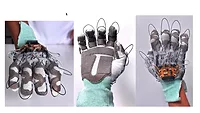
Imagine if human touch could be mapped like terrain, each grip revealing its peaks and contours, every contact leaving a trace to study and improve. That idea lies behind the evolution of tactile sensing gloves, wearable systems that convert touch into data for engineers, researchers and practitioners. Here, Dr Jae Son, CEO and Founder of tactile sensing specialist PPS, examines how the technology has advanced, its current uses and what might come next.
Since their arrival in the middle of the last decade, tactile sensing gloves have changed markedly. Originally, they were delicate laboratory instruments with few sensors but have since developed into robust ergonomic tools used in manufacturing, healthcare and sport. Their potential is still expanding as the technology matures, offering finer measurement with simpler operation.
From fingertips to full hand insight
Early sensing systems measured only fingertip pressure. They provided useful data for ergonomics and product design but revealed little about how the rest of the hand behaved. Extending sensing coverage across the entire hand, including the palm, allowed researchers to measure exertion during practical tasks such as cutting metal, lifting boxes or assembling components.
This provided evidence to replace guesswork. Objective data shows how the hand interacts with tools and materials. With that knowledge designers can locate where strain builds and modify the equipment or technique to protect long term health.
Prototypes, comfort and calibration
Initial models, fitted with approximately 50 sensing elements, proved the concept but highlighted limitations. Demand for richer data produced versions with more than 60 sensing elements, offering a clearer picture of how force is distributed across fingers and palm.
Comfort evolved with performance. Early materials and thick seams restricted movement, prompting the switch to woven, lightweight and flexible fabrics. Pull tabs and a broader size range made the gloves easier to remove and more comfortable to wear.
Accuracy improved too. Each glove is now calibrated to maintain consistency between units and reliability across environments. Collaboration between academic and industrial researchers has refined calibration techniques to account for ambient conditions and body temperature, ensuring dependable readings in both controlled studies and demanding workplaces.
Turning touch into data
Tactile gloves use capacitive sensing, a principle familiar from touch screens, adapted to detect pressure and force. Modern versions employ the most advanced Bluetooth technology for faster and steadier data transfer. Sampling rates between ten and 50 hz allow real time grip analysis and motion tracking, with live streaming into software that visualizes hand forces as they occur.
Safety and performance implications
For safety managers and ergonomists, the value is immediate. Quantitative data strengthens job task analysis, reveals force hot spots, guides workstation design and supports efforts to prevent musculoskeletal disorders.
In healthcare and rehabilitation, it assists assessment and progress tracking. In sport it helps coaches and athletes understand grip strategy and technique. The same approach could refine surgical tool design, massage therapy and other precision activities. In time, linking these gloves with connected factory systems could permit continuous monitoring of hand loads during critical operations.
The road ahead
Tactile gloves have become more durable, accurate and practical. Current development focuses on faster data capture, better removal systems and improved fit for a wider range of users.
The broader vision reaches further. In the coming years tactile sensing may become standard in smart factories, enabling real time oversight of worker safety, while applications in sport, rehabilitation and consumer wearables are set to grow.
Those wishing to explore the field can find recent academic papers and industry studies charting how tactile sensing is reshaping ergonomics and human performance.
Looking for a reprint of this article?
From high-res PDFs to custom plaques, order your copy today!