The Right Filter Strategy for Manufacturing Companies
How to select the most suitable extraction and filtration system

Invisible particles, visible consequences
Modern manufacturing industry is a dynamic field in which innovative joining, cutting, and surface treatment processes, as well as additive manufacturing, deliver top performance on a daily basis. But every coin has its downside: These processes generate particles of varying sizes, shapes, and chemical compositions. Often suspended invisibly in the air, these particles can have serious consequences.
Fine dust and fumes penetrate deep into the respiratory tract and can cause serious long-term health damage. Deposits in machinery and equipment impair their functionality, cause costly downtimes, and can even negatively impact product quality. Furthermore, unfiltered emissions pollute the environment.
To address the urgency of air pollution control, legislators worldwide have enacted strict guidelines. A central pillar of these are European Union (EU) directives, such as the Industrial Emissions Directive (IED), which are implemented into national law by member states. These regulations require the use of Best Available Techniques (BAT) to minimize pollutants in the workplace and the environment. Another important component is occupational health and safety guidelines, which ensure the protection of employees from hazardous substances. Compliance with these requirements requires consistent utilization of extraction and filtration technology.
Challenge: Particle diversity and properties
The need for effective extraction and filtration technology is therefore not only a matter of corporate responsibility, but also a legal requirement. However, selecting the right system is no trivial task. The diversity of production processes is reflected in the complexity of the particles released. To find the optimal solution, it is essential to examine the properties of these emissions in more detail.
The world of industrial emissions is anything but homogeneous. Depending on the process utilized, a wide variety of airborne pollutants are produced. It is important to distinguish between particulate substances such as dust, fumes, and aerosols, as well as gaseous substances and vapors. However, this distinction is not always clear, as under certain conditions, gaseous substances can also react with each other to form fine particles.
Size plays a crucial role in the evaluation of particulate matter. The spectrum ranges from coarse dust particles in the micrometer range to tiny nanoparticles produced by modern processes such as laser welding or nanomaterial processing. Especially nanoparticles pose a particular challenge because of their small size, allowing them to penetrate deep into the human body (lungs, brain).
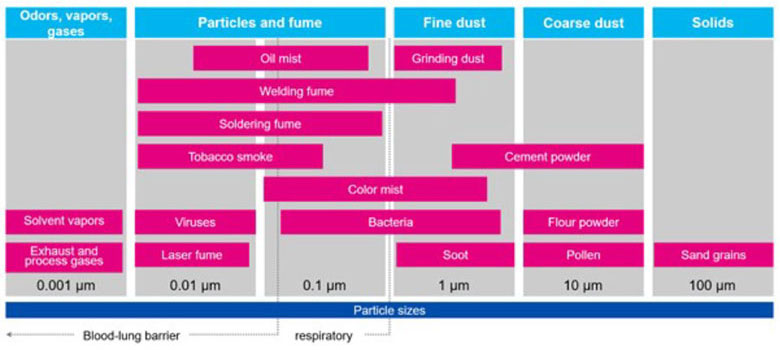
Particle sizes courtesy of ULT
It is important to distinguish between particulate substances such as dust, fumes, and aerosols, as well as gaseous substances and vapors.
But it's not just the size that matters. The physical and chemical properties of the particles also significantly influence the choice of the appropriate filter system. For example, if the particles are adhesive and tend to stick together, filters can quickly become clogged. Condensing vapors can moisten filter media and reduce their efficiency. Particularly, when handling flammable hazardous substances, special safety precautions and filter technologies are required to minimize fire and explosion risks.
Overview of basic separation processes
In order to find the right extraction and filtration solution, it is essential to have a basic understanding of the various separation processes available. Industrial air pollution control uses a range of different principles to remove particles and gases from the air. The most common processes include:
- Gravity separators (e.g. settling chambers): Use gravity to sediment heavy particles from the air stream.
- Centrifugal force separators (e.g. cyclones): Use centrifugal force to separate particles by changing the direction of the air flow.
- Wet separators (e.g. scrubbers): Bind particles and gases in a liquid.
- Electrical precipitators (electrostatic precipitators): Ionize particles and deposit them on charged surfaces.
- Filtering separators (fabric filters, cartridge filters): Use porous materials to mechanically retain particles.
- Adsorption filters (e.g. activated carbon/chemisorption): Bind gaseous pollutants and odors on the surface of an adsorbent.
In the following, the focus is primarily on filtering separators, as these are used in the widest range of industrial applications and play a key role in the separation of particulate emissions.
Filtering separators – classes and principles
Filtering separators, also known as fiber filters or filtration separators, are a central pillar of industrial air purification. Their operation is based on the principle of mechanical retention of particles as they flow through a porous filter medium. The efficiency of these separators depends largely on the nature of the filter medium and the size of the particles to be separated.
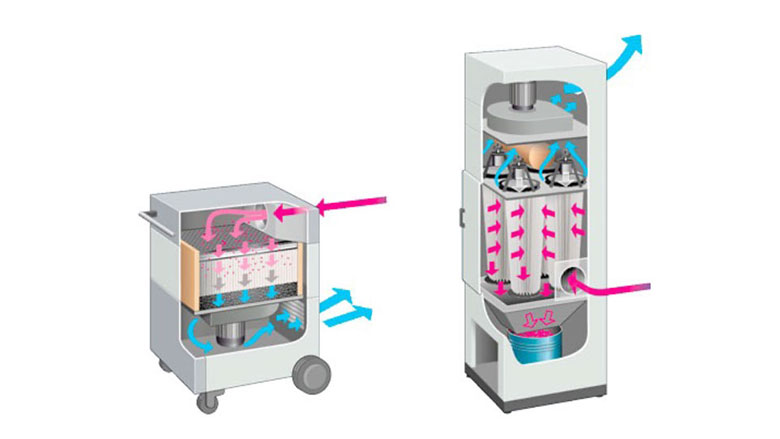
Filtration principles cartridge filter (left) and storage filter (right) courtesy of ULT
Particle size is therefore a decisive criterion for selecting the appropriate filter class. While coarse dust filters primarily separate particles larger than 10 µm, fine dust filters are designed for particles larger than 1 µm. High-efficiency particulate air filters (HEPA and ULPA filters) are used to separate the smallest suspended particles, including nanoparticles.
In addition to the separation efficiency, other performance parameters are important for the practical use of air filters. These include the initial pressure drop and its progression during filter loading, which directly influence the system's energy consumption. The filter's service life, i.e., the time until it needs to be replaced or cleaned, also plays an important role in the economic efficiency of the operation. When selecting the optimal air filter, a balance between filter performance and energy efficiency should therefore always be sought.
Of course, the ideal capture/collection of air pollutants also plays a crucial role, but this will not be discussed in detail here.
Setting the course for clean air – Detailed selection criteria for an optimal extraction and filtration system
- Investing in an optimally suited extraction and filtration system is a strategic step that goes far beyond mere compliance with legal regulations. It is a key factor in employee protection, production process efficiency, and product quality. Making the right choice requires a detailed analysis of various criteria, based on an understanding of the fundamentals explained above:
- Specific emissions analysis: It is essential to precisely analyze the origin and properties (type, size, reactivity, concentration) of the particles and gases released during the production process. It’s important to know whether the emissions are combined and any specific challenges (e.g., stickiness, flammability).
- Process-related framework conditions: The specific characteristics of the production process must be considered in the selection process. The operating mode (continuous vs. discontinuous), potential load fluctuations, and the spatial conditions all play a role. Specific circumstances (e.g., ATEX zones) may require special system technology.
- Derivation of required filter performance: The requirements arising from legal limits and internal protection needs must be translated into concrete requirements for the separation efficiency of the filter stages. When selecting the right air filtration technology, the sizes of the particles to be removed play a decisive role. These include coarse particles, fine dust, and suspended matter.
- Optimizing energy consumption: The desired filter performance must be weighed against the resulting pressure loss. Energy-efficient filter media must be used, and regular maintenance must be planned to reduce pressure loss in the long term.
- Economic efficiency in mind: In addition to the initial investment costs, ongoing operating costs resulting from energy consumption and maintenance (including filter change intervals) must be considered. Cleanable filter systems can offer long-term advantages in this regard.
- Integration of capture: The extraction system must be designed to capture emissions at closest proximity. Spatial constraints must be considered, and appropriate capture elements and air duct dimensions must be selected.
A thorough evaluation of these application-specific criteria, based on the foundation laid in the previous chapters, enables the selection of a customized extraction and filtration system that optimally meets the specific needs and makes a valuable contribution to clean, safe and efficient production.
Conclusion
The selection of the ideal extraction and filtration system is based on a precise analysis of process-related emissions and operational requirements. Key aspects include the required cleaning performance, energy consumption, and the long-term economic viability of the system. Efficient collection of air pollutants directly at the point of origin is just as important as compliance with legal framework conditions. By thoroughly evaluating these criteria, a customized solution for clean, safe, and efficient manufacturing can be implemented. Investing in the right plant technology therefore represents a strategic gain for any manufacturing industry.
Looking for a reprint of this article?
From high-res PDFs to custom plaques, order your copy today!