Aim to Make Pre-Job Briefs the Strongest Control in Your Electrical Workday
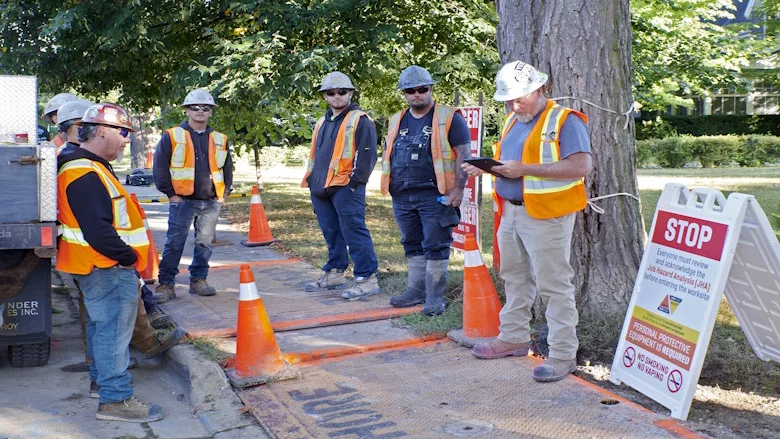
High-hazard work doesn’t get safer by accident. It gets safer because crews pause, think together, and agree on how to control energy and uncertainty before any work begins. That’s the job of the pre-job brief. Yet across construction, utilities, manufacturing, oil and gas, these conversations are too often built on “legacy knowledge”—what someone remembers from last time—rather than a consistent, evidence-based process. That approach is prone to error, leaves hazards unidentified, and can lead to injuries.
The remedy is a structured, research-driven method that leverages a scientifically proven process sourced from the Construction Safety Research Alliance (CSRA) to build high-quality pre-job briefs, minimizing exposure to significant injury and fatality (SIF)-level hazards and protecting the workforce throughout the day.
What a High-Quality Brief Looks Like
A pre-job safety meeting should create a clear, shared understanding of the work tasks, associated hazards, and necessary controls. When the facilitator is prepared, the meeting is efficient and sends a strong signal that safety, not speed, is the day’s priority.
Facilitator preparation
Before the huddle, the facilitator should be familiar with the task, environment, potential dangers, schedule, situation, and site history. Meetings should be held as close to the work as possible, in a safe and reasonably quiet place. The facilitator must ensure that every crew member is present and then identify the day’s major tasks, along with the materials, tools, and equipment required.
Put the hazard conversation at the center
Most briefs begin with task lists such as pull cable, isolate, test, install, and commission. Effective ones start with energy. In the pre-job brief, the most important activity is identifying, prioritizing, and controlling hazards, especially those that pose a potential threat to life.
At Centuri, crews use an energy wheel to identify common hazards across categories such as electrical, mechanical, gravity, thermal, pressure, motion, radiation, noise, chemical, and biological. Ask: Where could voltage be present even if we think it’s not? Is there induced voltage? Are there alternate sources (generators, UPS, PV/DER) that can backfeed? Will automatic devices such as reclosers and transfer switches change the state? Also, don't forget “ordinary” hazards, such as pinch points and trip hazards.
Document and verify
All life-threatening hazards must be discussed in detail, and the crew should capture tasks, hazards, and safe work practices in the record, with a final sign-off by the entire team. Reviewing relevant toolbox talks or safety bulletins during the brief strengthens alignment.
Assign roles
Role clarity is a leading indicator of safety performance. In the brief, assign:
- a task lead who owns the sequence and holds the pace,
- an energy verifier who performs and documents absence-of-voltage tests (or equivalent isolation checks) and tracks system state,
- a boundary attendant whose only job is to protect limits, manage public encroachment, and stop the job when conditions drift, and
- a spotter when mobile equipment or vehicle traffic is present.
Clear roles eliminate divided attention and create a common mental model, so that all workers know who is responsible for what.
HECA: Direct Control for High-Energy Hazards
Not all hazards are equal. Centuri crews apply High Energy Control Assessments (HECA) to focus attention on 14 high-energy hazards, including electrical contact, high temperatures, suspended loads, falls from elevation, and others, that are most likely to cause life-altering injuries and fatalities. The expectation is simple: when a high-energy hazard is present, a direct control is required. Tie each control to the hierarchy; eliminate or substitute first, then engineering controls, administrative controls, and finally PPE.
Document which high-energy hazards exist, and which direct controls are in place for each. In electrical, this means verifying isolation and grounding, confirming boundaries and barricades, ensuring test-before-touch protocols, and validating permits and switching orders before anyone is exposed.
Empowerment Is a Control: Stop-Work Obligation
Policy only matters when it’s usable under pressure. We operationalize stop-work authority as a frontline control with three simple triggers: stop when a relevant hazard wasn’t discussed in the brief; when existing controls are inadequate or failing; or when you’re unsure about the task or instructions. Leaders must explicitly tell crews not to be afraid to stop work, fix the situation, and only then proceed. At the end of the day, doing the job safely matters more than doing it quickly.
Change Management: Treat Change as a Hazard
Change is a common root cause of serious injuries. According to a CDC study, Poor hazard recognition contributes to as much as 40 percent of all injuries. Therefore, prepare with these four questions:
- What could change?
- How would that change impact our safety?
- What will we do if a change is encountered?
- What will we do if an unexpected change occurs?
The aim is to pre-load a safe response so the team knows exactly how to pause and adapt. An emergency response plan is part of the same discipline. The crew and facilitator must clearly define roles and establish an emergency plan during the brief. This plan should include: identifying the CPR lead, who will contact emergency services, the location of the defibrillator, designated egress paths, and muster points. Most importantly, ensure everyone understands others’ roles as well, to avoid confusion when seconds matter.
Participation Is the JHA
A good brief isn’t a lecture; it’s a conversation. Encouraging participation and engagement in safety plans empowers crews, increases comprehension, and boosts adherence to the plan. Leaders should use open-ended questions, seek clarification, recognize the value of crew ideas, balance participation so everyone contributes, and instill a sense of ownership in the plan. When people help build the plan, they follow the plan.
Document What Matters
At a minimum, capture the specific job tasks, the hazards identified, and the controls selected. Review any relevant toolbox talks or safety bulletins. Add a quick fit-for-duty check for each crew member: Are you mentally and physically ready today? Close the loop with a crew sign-off that affirms understanding and ownership.
Bottom Line
The pre-job brief isn’t just a meeting; it’s the most powerful safety system you own when applied consistently. By starting with identified hazards, clearly assigning roles, planning for potential changes, and prioritizing stop-work authority, crews achieve the two most important outcomes: ensuring personnel safety and executing the job exactly as planned.
Looking for a reprint of this article?
From high-res PDFs to custom plaques, order your copy today!