Toxic Asbestos Exposure Challenging Without a Paper Trail
Bridging the Evidence Gap Impacting 1099 Asbestos Workers in the United States
Oftentimes, asbestos-associated diseases are described as a haunting legacy of America's industrial past. Essentially, that perspective is deeply rooted in the heavy use of such a natural mineral across a wide range of sectors — most especially construction, manufacturing, shipbuilding, automotive, and defense. However, for countless workers, the impact of this narrative remains painfully relevant. Exposure to asbestos continues to be a critical issue, while the long-term repercussions, usually emerging only years later, serve as a stark reminder of the drastic threats it poses to countless lives. Even more troubling, not all staff are equally positioned to preserve a history of their exposure in the first place. While traditional employees can still turn to personnel files as well as union and workplace documentation for verification, many self-employed and independent contractors — commonly known as 1099 asbestos workers — find themselves outside these protective frameworks, deprived of clear evidence of their dangerous contact with asbestos throughout their careers.
As time moves forward and vital records become increasingly difficult to obtain, these individuals are often left with little more than invoices, tax documents, and faded memories to piece together their decades of occupational challenge. Worse, the concern transcends mere recordkeeping, as understanding the specifics of exposure is crucial to identifying potential health risks and eventually informing medical choices and empowering workers to determine their rights within existing legal frameworks. Sadly, when exposure histories remain undocumented, accessing these necessities becomes an uphill battle—an urgent administrative gap jeopardizing public health and fairness.
The Continuing Health Burden of Asbestos Exposure on 1099 Workers
To this day, asbestos exposure continues to be one of the most persistent occupational health issues in the country, largely because of how extensively such a natural mineral was used since the late 1800s. Its popularity even surged during World War II due to its practical advantages, including strong heat resistance, tremendous durability, and effective insulating and thermal properties, making it a fundamental composition across various industries nationwide. Unfortunately, this widespread use meant that this issue was not limited to specialized tasks. Rather, it infiltrated everyday work routines in buildings, repairs, and maintenance, which affected both major industrial enterprises and small independent contractors alike. Consistent with this, data revealed that just from 1940 to 1979, around 27 million Americans faced asbestos exposure in their jobs — a staggering figure that far exceeds the statistics today. Alarmingly, what a large portion of these workers failed to recognize at the time was that when asbestos-laden materials are disturbed, they can release microscopic fibers into the air that, once inhaled, may become lodged deep within lung tissues.
Because these components are notoriously difficult to eliminate, or even break down, they can remain and persist in the human bloodstream indefinitely, gradually triggering debilitating diseases, such as asbestosis, lung cancer, and mesothelioma, whose symptoms may only manifest 20 to 50 years following initial contact. Tragically, this long latency period often leaves victims unaware of their conditions, with many only becoming aware after reaching late stages marked by late prognosis as well as limited treatment options. As such, these delayed detections continue to exact a substantial human toll as fatalities from occupational asbestos-related diseases reportedly climbed by 20.2% between 1990 and 2019. A separate study also indicates that from 1999 to 2017 alone, this crisis has already caused the demise of roughly 236,981 to 277,654 Americans nationwide. And until now, the brunt is still considerable, taking into account the roughly 3,000 annual log of mesothelioma diagnoses, and 12,000 to 15,000 residents who succumb to linked illnesses each year.
Trades Workers Still at Risk
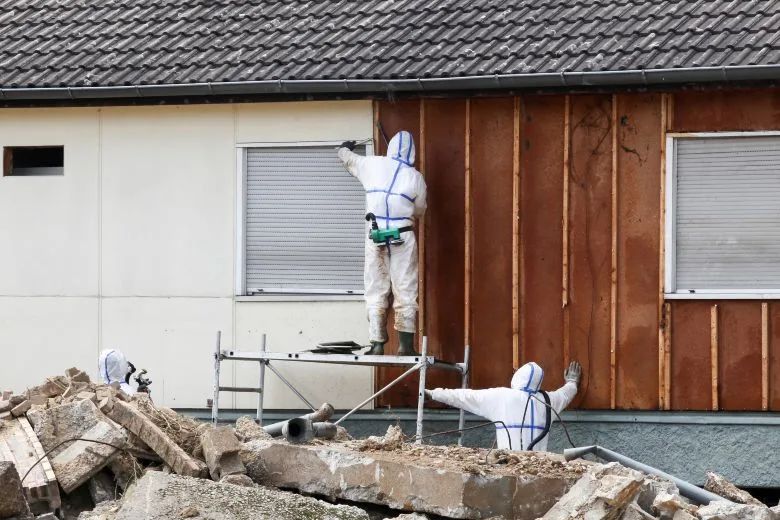
Although asbestos use has dramatically declined — especially after chrysotile was prohibited in 2024 — exposure has still not been eliminated as it continues primarily during renovation, demolition, maintenance, and repair work involving aging infrastructure where the toxic mineral’s fibers remain embedded. Disconcertingly, these high-risk activities are not only carried out by large contracting companies but also by self-employed tradespeople and 1099 contractors who shift from project to project without the benefit of centralized oversight, as well as robust documentation and protective structures typically found in traditional employment. In these precarious settings, the threat is determined more by the working conditions than by job titles, as workers responsible for handling risky tasks such as insulation, cutting through older materials, or repairing outdated equipment can inadvertently disturb and release dangerous fibers into the air.
1099 Asbestos Workers Urgently Need Robust Exposure and Health Monitoring
The history of occupational asbestos exposure in the country is often pieced together through conventional employment records, most notably personnel files, union archives, and various workplace documents. Though critics may argue that these sources lack comprehensiveness, they undeniably provide valuable insights for workers seeking to trace their exposure to asbestos even if it occurred decades ago. Regrettably, for 1099 workers, including the independent electricians, mechanics, plumbers, farmers, truckers, remodelers, and flooring contractors, the records are often sparse or nonexistent, thereby leaving their exposure histories fragmented across invoices, tax documents, business files, and personal recollections. Such a gap in documentation is particularly concerning given that asbestos-related diseases can develop long after the initial exposure has ended. By the time symptoms emerge, many job sites may have vanished, companies might have shuttered their doors, and essential information could become nearly impossible to access. For independent electricians, mechanics, plumbers, farmers, truck drivers, remodelers, flooring contractors, and other self-employed tradespeople, who typically work across numerous clients and locations, reconstructing their extensive work histories becomes an especially daunting task.
Addressing this issue does not require creating new categories of rights or guaranteeing compensation. Instead, it begins with ensuring that workers have access to better tools for understanding and documenting their occupational histories. Agencies such as the National Institute for Occupational Safety & Health, Centers for Disease Control & Prevention, and Environmental Protection Agency could expand educational initiatives and exposure-awareness resources tailored to self-employed workers whose exposure pathways may differ from those of traditional employees. Likewise, state licensing boards and trade associations could help disseminate occupation-specific guidance, historical exposure information, and practical resources that enable workers to better identify jobs or materials that may have posed asbestos risks.
Such measures are not intended to presume exposure or promise compensation. Rather, they recognize a simple reality: Workers cannot act on information they do not have, nor can they preserve histories they were never encouraged to track. The legacy of asbestos is not just measured in diseases but also in whether workers can comprehend exposures that might have happened many years ago. With time reducing the chances of retrieving records and reconstructing work histories, it is essential to ensure that self-employed and 1099 workers are included in the exposure records. This is not only a pressing public health concern but also an issue of equity. The dangers of asbestos do not discriminate based on a worker's tax status, so it is only appropriate that the nation’s efforts to understand this risk should reflect that principle.
Looking for a reprint of this article?
From high-res PDFs to custom plaques, order your copy today!