ISHN logo
search
cart
facebook twitter linkedin youtube
  • Sign In
  • Create Account
  • Sign Out
  • My Account
ISHN logo
  • NEWS
    • Today's News
    • Global Safety News
    • Government Regulations
  • PRODUCTS
    • Product Innovations
    • Featured Products
  • TOPICS
    • Environmental Health and Safety
    • Facility Safety
    • Workplace Health
    • Occupational Safety
    • PPE
    • More Topics
  • CONSTRUCTION
  • TECHNOLOGY
  • COLUMNS
    • Best Practices
    • Dave Johnson: What’s going on
    • Editorial Comments
    • Leading Safety
  • MULTIMEDIA
    • ISHN Podcast
    • Videos
    • Cold Stress Education Quiz
    • Webinars
    • White Papers
  • MORE
    • Buyer's Guide
    • Newsletters
    • Convention Companion
    • Polls
    • Events
    • ISHN Store
    • Sponsor Insights
  • EMAGAZINE
    • eMagazine
    • Archived Issues
    • Contact
    • Advertise
  • JOIN TODAY!
Today's Safety NewsTransportation Safety

NTSB releases initial findings in Sissonville pipeline rupture
January 18, 2013
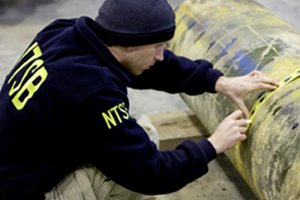
NTSB senior materials engineer Don Kramer identifies a section of pipe to be cut and removed for further examination at the NTSB's lab in Ashburn, Va.

Columbia Gas controller received more than a dozen alerts about a pressure drop in a natural gas pipeline, but it was a field technician from another gas company who notified the controller about a rupture that released natural gas and led to a fire that destroyed homes and shut down a major freeway.

That is one of the findings of a National Transportation Safety Board (NTSB) preliminary report into the Dec. 11, 2012, rupture of a natural gas transmission line in Sissonville, W.Va.

To date, the NTSB's investigation has found:

• At about 12:41 p.m., a buried 20-inch diameter natural gas transmission pipeline (Line SM-80), owned and operated by Columbia Gas Transmission Corporation ruptured near Route 21 and Derricks Creek, and about 112 feet west of Interstate 77 in Sissonville, W.Va. About 20 feet of pipe was separated and ejected from the underground pipeline and landed more than 40 feet from its original location. The pipeline maximum allowable operating pressure was 1,000 pounds per square inch gauge, and the operating pressure at the time of the rupture was about 929 psig.

• The rupture occurred in a pipe that was a part of a pipeline segment installed in 1967 with an original, nominal wall thickness of 0.281 inches. The 20-foot ejected section of the pipe was fractured in the base metal along the entire longitudinal direction along the bottom of the pipe. The outside surface of the pipe was heavily corroded near the midpoint and along the longitudinal fracture. The thinned area was approximately 6 feet in the longitudinal direction and 2 feet in the circumferential direction. The lowest wall thickness measured was 0.078 inches.

• After the escaping high-pressure natural gas ignited, fire damage extended nearly 1,100 feet along the pipeline and was about 820 feet wide. Three homes were destroyed by the fire, and several other homes were damaged. Interstate 77 was closed in both directions for about 18 hours until the roadway surfaces were repaired.

• The first notification to the Columbia Gas control center was received from a controller from another gas company, who had received a report of a rupture and fire from a field technician who was near the accident location. Prior to the call from the other company, the Columbia Gas controller received 16 pressure drop alerts.

A link to the full preliminary report can be found at: http://go.usa.gov/4grH

Additional reports, analysis and a finding of probable cause will come later in the investigation.

KEYWORDS: pipeline

Share This Story

Looking for a reprint of this article?
From high-res PDFs to custom plaques, order your copy today!

Recommended Content

JOIN TODAY
to unlock your recommendations.

Already have an account? Sign In

  • forklift safety

    Exploring the latest technologies in forklift safety

    With more staff and more stock in warehousing now more...
    Workplace Training Strategies
    By: Josh Cramer
  • welding

    All about welder’s flash or arc eye

    A flash burn is a painful inflammation of the cornea,...
    Environmental Health and Safety
  • dangerous jobs

    The 10 most dangerous jobs in the U.S.

    On-the-job deaths have been rising — hitting the highest...
    Transportation Safety
    By: Benita Mehta
Manage My Account
  • eMagazine Subscriptions
  • ISHN Newsletter & Other Newsletter Alerts
  • Online Registration
  • Manage My Preferences
  • Subscription Customer Service

More Videos

Sponsored Content

Sponsored Content is a special paid section where industry companies provide high quality, objective, non-commercial content around topics of interest to the ISHN audience. All Sponsored Content is supplied by the advertising company and any opinions expressed in this article are those of the author and not necessarily reflect the views of ISHN or its parent company, BNP Media. Interested in participating in our Sponsored Content section? Contact your local rep!

close
  • man wearing the the Sundström SR200 Full Face Mask Respirator
    Sponsored byOHD

    5 Fit Testing Mistakes That Could Cost You

  • This image shows Magid AcuSpex polarized blue mirrored safety glasses.
    Sponsored byMagid Glove and Safety

    Construction PPE Guide: What Crews Need for Each Task

  • lone worker in confined space
    Sponsored byAlphasense Ltd.

    GET THE LEAD OUT of your Safety Oxygen Sensors!

Popular Stories

SpaceX 7 launch

OSHA Investigating Fatal Fall at SpaceX Starbase

Worker Impairment

How to Tell When a Co-Worker is Impaired? A Safety Pro’s Challenge

Automated loading dock equipment

After March 2026 Rivian Death, Safety Managers Reassess Loading Dock Systems Under OSHA's Warehouse Emphasis Program

top 10 most dangerous jobs

Poll

Seasonal Readiness

With the federal heat stress prevention rule on the horizon, which area of your safety program needs the most attention?
View Results Poll Archive

Products

Surviving an OSHA Audit A Management Guide, 2nd Edition

Surviving an OSHA Audit A Management Guide, 2nd Edition

See More Products

ISHN Podcasts

Related Articles

  • CSB’s initial findings in ExxonMobile explosion to be made public

    See More
  • NTSB heads to pipeline rupture in W. Virginia

    See More
  • NTSB to meet on pipeline rupture and oil spill accident

    See More

Related Products

See More Products
  • Top Ten Pitfalls in OSHA Recordkeeping and How to Avoid Them

  • fearless world.jpg

    The Fearless World of Professional Safety in the 21st Century

See More Products

Events

View AllSubmit An Event
  • May 28, 2026

    The Mental Health Crisis in Construction

    ON DEMAND: Each year, about 1,000 construction workers die from on-the-job incidents – but more than 5,000 die from suicide and 11,000 from overdoses.
View AllSubmit An Event
×

Become a Leader in Safety Culture

Build your knowledge with ISHN, covering key safety, health and industrial hygiene news, products, and trends.

JOIN TODAY
  • RESOURCES
    • Advertise
    • Contact Us
    • Directories
    • Manufacturing Division
    • Store
    • Want More
  • SIGN UP TODAY
    • Create Account
    • eMagazine
    • Newsletters
    • Customer Service
    • Manage Preferences
  • SERVICES
    • Marketing Services
    • Reprints
    • Market Research
    • List Rental
    • Survey/Respondent Access
  • STAY CONNECTED
    • LinkedIn
    • Facebook
    • YouTube
    • X (Twitter)
  • PRIVACY
    • PRIVACY POLICY
    • TERMS & CONDITIONS
    • DO NOT SELL MY PERSONAL INFORMATION
    • PRIVACY REQUEST
    • ACCESSIBILITY

Copyright ©2026. All Rights Reserved BNP Media, Inc. and BNP Media II, LLC.

Design, CMS, Hosting & Web Development :: ePublishing