Most common hand and wrist injuries
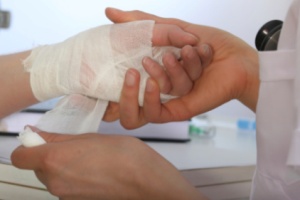 While hand and wrist injuries are very common, some athletes and workers never seek treatment. But, delaying the diagnosis and treatment may result in long-term problems or even a permanent disability. Here is a list of some of the most common injuries that those who use their hands regularly experience.
Sprains
Sprains are damage to ligaments. A ligament is a type of tissue that connects bone to bone. There are different grades of sprain from minor tear to complete rupture. Treatment and recovery time will depend on grade of sprain.
Thumb Sprains
Breaking a fall with the palm of your hand or taking a spill on the slopes with your hand strapped to a ski pole, could leave you with a painful thumb injury. The ulnar collateral ligament may be sprained. This ligament acts like a hinge and helps your thumb to function properly. If you sprain your thumb, you could lose some or all of your ability to grasp items between your thumb and index finger or to grasp well with the entire hand.
Wrist Sprains
When you fall forward, as when you trip running, your natural response is to put your hands out in front of you to catch yourself. Unfortunately, this natural response causes you to land on your palm, bending your wrist backwards, and possibly stretching or tearing the ligaments connecting the bones in your wrist. The resulting injury is a wrist sprain.
Injuries to the Bone
Bones can be fractured and dislocated. A fracture is a crack or break in a bone. It is commonly referred to as broken bone. A dislocation is when a bone is pushed out of place so that they no longer line up correctly at the joint. This can decrease the ability to move and cause pain.
Hand Fractures
Fractures of the metacarpals (the bones in your hand just before your knuckles) and your phalanges (the bones between the joints of your fingers) are also common injuries.
The most common fracture of the metacarpals is a boxer's fracture. A boxer's fracture usually occurs when you strike an object with your closed fist. With a boxer's fracture, the fifth metacarpal joint (the one at the base of your littlest finger) is depressed and the surrounding tissue is tender and swollen.
Wrist Fractures
Scaphoid fractures account for many wrist fractures. The scaphoid bone is one of eight small bones that make up the wrist.
Wrist fractures are common in sports, work, and motor vehicle accidents. The break usually occurs during a fall on the outstretched wrist. The angle at which the wrist hits the ground may determine the type of injury. The more the wrist is bent back (extension), the more likely the scaphoid bone will break. With less wrist extension it is more likely the lower arm bone (radius) will break.
Scaphoid fractures are not always immediately obvious. Many people with a fractured scaphoid think they have a sprained wrist instead of a broken bone because there is no obvious deformity and very little swelling.
Dislocations of the PIP Joint
One of the most common injuries to a hand is an injury to the joint above the knuckle, the proximal interphalangeal (PIP) joint. Injuries to the PIP joint occur when the finger is either hyperextended (forced backwards) or forced into flexion (downward into a bent position). Injuries to the PIP joint may include fractures, dislocations, and fracture dislocations.
Soft Tissue and Closed Tendon Injuries
Tendons are a type of connective tissue that attaches muscle to bone. A common injury of the tendon is called tendonitis, an irritation of the tissue.
DeQuervain's Syndrome
DeQuervain's syndrome is a common injury with people who use a lot of wrist motion, especially repetitive rotating and gripping.
The overuse of the hand may eventually cause irritation of the tendons found along the thumb side of the wrist. This irritation causes the lining around the tendon to swell, making it difficult for the tendons to move properly.
ECU Tendonitis
Extensor carpi ulnaris (ECU) tendonitis is another common closed tendon injury. ECU tendonitis is an inflammation of the tendon that runs along the back of the wrist and is caused by repetitive twisting and backward flexion of the wrist. It is most commonly seen in basketball players and those playing racquet sports.
Baseball Finger
Baseball finger (or mallet finger) is an injury that commonly occurs at the beginning of the baseball season. It occurs when a ball hits the tip of your finger, bending it down. Normally, the tip of your finger can bend toward the palm of your hand about 60-70 degrees. However, add the force of a ball that has been batted through the air, and it can push your finger beyond that limit, tearing the extensor tendon that controls muscle movement in the affected finger. If the force is great enough, it may even pull tiny pieces of bone away, as well.
Jersey Finger
Jersey finger is the opposite of mallet finger and occurs when the fingertip, usually the ring finger, is forcibly extended, such as if your finger gets caught in machinery. This causes the flexor tendon, which bends the fingertip, to be pulled away from the bone and will leave you unable to bend your finger without assistance.
Boutonnière Deformity
Boutonnière deformity is an injury to the tendons that straighten your fingers. It occurs when your finger receives a forceful blow when it is bent. Several tendons, running along the side and top of your finger, work together to straighten the finger. If the tendon on the top that attaches to the middle bone of the finger (the central slip of tendon) is injured by a forceful blow, it can sever the central slip from its attachment to the bone, in some cases, even popping the bone through the opening. The tear looks like a buttonhole ("boutonnière" in French). If you have a boutonnière deformity, the middle joint of your finger will bend downward and the fingertip end joint bends back. People with a boutonnière deformity cannot fully straighten their finger.
Preventing Hand and Wrist Injuries
The best ways to prevent hand, wrist, and upper extremity injuries include:
- Wrist guards:Wrist guards may help protect you from bone fractures and hand scrapes if you fall or slide.
- Gloves:Use gloves to protect your hands. The gloves will help protect your hands if the palm suffers a direct blow. In addition to protecting your nerves, gloves can protect your skin from direct wounds and cuts.
- Warm-up:Before playing sports or working an eight hour, physically-intense work shift, include a warm-up routine where you focus on stretching and improving your flexibility.
Above content provided by Beth Israel Deaconess Medical Center. For advice about your medical care, consult your doctor.
Posted March 2011
2013 Beth Israel Deaconess Medical Center
330 Brookline Avenue, Boston, MA 02215
617-667-7000 | TDD: 800-439-0183
Looking for a reprint of this article?
From high-res PDFs to custom plaques, order your copy today!