Fewer U.S. kids dying in car crashes
Child passenger deaths decreased 43 percent from 2002 - 2011
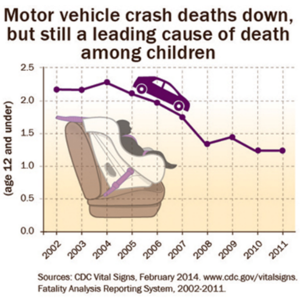 Motor vehicle crash deaths among children age 12 and younger decreased by 43 percent from 2002-2011, according to a new Vital Signs report from the Centers for Disease Control and Prevention (CDC).
Still, more than 9,000 children died in crashes during that period. CDC Director Tom Frieden, M.D., M.P.H., said many of those fatalities were preventable.
“No child should die in a motor vehicle crash because they were not properly buckled up and yet, sadly, it happens hundreds of times each year in the U.S.,” said Frieden.
Striking racial disparities in buckling up
Although research has shown that using age- and size-appropriate child restraints (car seats, booster seats, and seat belts) is the best way to save lives and reduce injuries in a crash, the report found that almost half of all black (45 percent) and Hispanic (46 percent) children who died in crashes were not buckled up, compared to 26 percent of white children (2009-2010).
CDC analyzed 2002–2011 data from the Fatality Analysis Reporting System, collected by the National Highway Traffic Safety Administration, to determine the number and rate of motor-vehicle occupant deaths, and the percentage of child deaths among children age 12 and younger who were not buckled up.
The Vital Signs report also found that:
- One in three children who died in crashes in 2011 was not buckled up.
- Only 2 out of every 100 children live in states that require car seat or booster seat use for children age 8 and under.
Child passenger restraint laws result in more children being buckled up. A recent study by Eichelberger et al, showed that among five states that increased the required car seat or booster seat age to 7 or 8 years, car seat and booster seat use tripled, and deaths and serious injuries decreased by 17 percent.
“Parents and caregivers play an important role in keeping children safe in the car,” said Daniel M. Sosin, M.D., M.P.H., F.A.C.P., acting director of CDC’s National Center for Injury Prevention and Control. “Children often imitate their parents; so it’s important that parents model safe behavior and buckle up on every trip. Parents also should always buckle children in age- and size-appropriate car seats, booster seats and, seat belts.”
To help keep children safe on the road, the CDC urges parents and caregivers to:
-
Use car seats, booster seats, and seat belts in the back seat—on every trip, no matter how short.
-
Rear-facing car seat from birth up to age 2
Buckle children in a rear-facing seat until age 2 or when they reach the upper weight or height limit of that seat. - Forward-facing car seat from age 2 up to at least age 5 When children outgrow their rear-facing seat, they should be buckled in a forward-facing car seat until at least age 5 or when they reach the upper weight or height limit of that seat.
- Booster seat from age 5 up until seat belt fits properlyOnce children outgrow their forward-facing seat, they should be buckled in a booster seat until seat belts fit properly. The recommended height for proper seat belt fit is 57 inches tall.
- Seat belt once it fits properly without a booster seatChildren no longer need to use a booster seat once seat belts fit them properly. Seat belts fit properly when the lap belt lays across the upper thighs (not the stomach) and the shoulder belt lays across the chest (not the neck).
-
Rear-facing car seat from birth up to age 2
- Install and use car seats according to the owner’s manual or get help installing them from a certified Child Passenger Safety Technician.
- Buckle children age 12 and under in the back seat.
Steps that states and communities can take:
-
Use proven actions that increase car seat, booster seat, and seat belt use and reduce child motor vehicle deaths. Options proven to be effective include:
- Child passenger restraint laws that require car seat or booster seat use through age 8.
- Car seat and booster seat give-away programs that include education for parents or caregivers.
- Increase the number of certified Child Passenger Safety Technicians.
- Partner with researchers to develop and evaluate programs to address racial/ethnic differences in getting children buckled up.
For information about the CDC’s Injury Center, which works to protect the safety of those on the roads, visit www.cdc.gov/motorvehiclesafety. Additional information can be found at www.safercar.gov.
Looking for a reprint of this article?
From high-res PDFs to custom plaques, order your copy today!