ISHN logo
search
cart
facebook twitter linkedin youtube
  • Sign In
  • Create Account
  • Sign Out
  • My Account
ISHN logo
  • NEWS
    • Today's News
    • Global Safety News
    • Government Regulations
  • PRODUCTS
    • Product Innovations
    • Featured Products
  • TOPICS
    • Environmental Health and Safety
    • Facility Safety
    • Workplace Health
    • Occupational Safety
    • PPE
    • More Topics
  • CONSTRUCTION
  • TECHNOLOGY
  • COLUMNS
    • Best Practices
    • Dave Johnson: What’s going on
    • Editorial Comments
    • Leading Safety
  • MULTIMEDIA
    • ISHN Podcast
    • Videos
    • Cold Stress Education Quiz
    • Webinars
    • White Papers
  • MORE
    • Buyer's Guide
    • Newsletters
    • Convention Companion
    • Polls
    • Events
    • ISHN Store
    • Sponsor Insights
  • EMAGAZINE
    • eMagazine
    • Archived Issues
    • Contact
    • Advertise
  • JOIN TODAY!
Today's Safety NewsFacility SafetyOil and Gas Industry Safety & Health

NTSB: Natural gas pipeline rupture, fire caused by corrosion

Pipeline not inspected since 1988
March 14, 2014

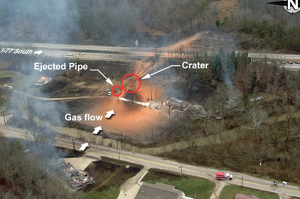
Natural gas pipeline ruptureThe 2012 rupture of a Columbia Gas Transmission Corporation natural gas pipeline in West Virginia was caused by external corrosion that could have been discovered by the pipeline operator, the National Transportation Safety Board (NTSB) said in a report released earlier this week.

On December 11, 2012, a 20-inch high-pressure natural gas pipeline running through Sissonville, W.V., ruptured with so much force that a 20-foot-long segment of pipe was thrown more than 40 feet from where it had been buried. The released natural gas ignited and burned so hot that it heavily damaged the asphalt road surface on an interstate highway, destroyed three homes, and melted the siding on houses hundreds of feet from the rupture site.

Pipeline controller didn’t heed alerts

It took the pipeline controller more than 10 minutes to recognize that a rupture had occurred despite the series of alerts he was receiving that indicated that the pressure in the pipeline had begun to decay. The shutdown was only initiated after a controller from another pipeline company reported a possible rupture to the CGTC control center.

Following the rupture, more than an hour passed before the pipeline operator’s field personnel were able to shut down the supply of natural gas to the broken pipe. More than 76 million cubic feet of natural gas was released and burned, which exacerbated the property damage caused by the accident. The NTSB said that had the pipeline been equipped with automatic shutoff valves, they would have shortened the duration of the gas-fed fire.

Severe corrosion

A 30-square-foot area of the ruptured pipeline was found to have suffered from severe external corrosion that reduced the thickness of the pipeline wall to only about 30 percent of what the pipe originally had when it was installed in 1967.

The ruptured pipe was the smallest diameter of a group of three CGTC pipelines, all of similar age, which traversed the immediate area. The two larger pipelines were in a “high consequence area,” which required more stringent inspections. Both of those pipes were periodically examined with an inline inspection tool. The accident pipeline, however, had not been inspected or tested since 1988. The NTSB said that if it had been inspected with an inline tool, the rupture would likely have been prevented.

Potential for tragedy

“Remarkably, no lives were lost in this accident but the potential for tragedy was clearly there,” said NTSB Chairman Deborah A.P. Hersman. “Inspection and testing improve the chances of locating defects early, and reduce the probability of a catastrophic failure which can have devastating results.”

As a result of this accident investigation, the NTSB issued three safety recommendations to the Columbia Gas Transmission Corporation and one to the Pipeline and Hazardous Materials Safety Administration.

The full 38-page accident report, including a one-page executive summary of investigation, is available at http://go.usa.gov/KDKx.

KEYWORDS: accident investigation chemicals safety in the oil and gas industry

Share This Story

Looking for a reprint of this article?
From high-res PDFs to custom plaques, order your copy today!

Recommended Content

JOIN TODAY
to unlock your recommendations.

Already have an account? Sign In

  • forklift safety

    Exploring the latest technologies in forklift safety

    With more staff and more stock in warehousing now more...
    Facility Safety
    By: Josh Cramer
  • welding

    All about welder’s flash or arc eye

    A flash burn is a painful inflammation of the cornea,...
    Environmental Health and Safety
  • dangerous jobs

    The 10 most dangerous jobs in the U.S.

    On-the-job deaths have been rising — hitting the highest...
    Government Safety Regulations
    By: Benita Mehta
Manage My Account
  • eMagazine Subscriptions
  • ISHN Newsletter & Other Newsletter Alerts
  • Online Registration
  • Manage My Preferences
  • Subscription Customer Service

More Videos

Sponsored Content

Sponsored Content is a special paid section where industry companies provide high quality, objective, non-commercial content around topics of interest to the ISHN audience. All Sponsored Content is supplied by the advertising company and any opinions expressed in this article are those of the author and not necessarily reflect the views of ISHN or its parent company, BNP Media. Interested in participating in our Sponsored Content section? Contact your local rep!

close
  • man wearing the the Sundström SR200 Full Face Mask Respirator
    Sponsored byOHD

    5 Fit Testing Mistakes That Could Cost You

  • This image shows Magid AcuSpex polarized blue mirrored safety glasses.
    Sponsored byMagid Glove and Safety

    Construction PPE Guide: What Crews Need for Each Task

  • lone worker in confined space
    Sponsored byAlphasense Ltd.

    GET THE LEAD OUT of your Safety Oxygen Sensors!

Popular Stories

SpaceX 7 launch

OSHA Investigating Fatal Fall at SpaceX Starbase

Worker Impairment

How to Tell When a Co-Worker is Impaired? A Safety Pro’s Challenge

Automated loading dock equipment

After March 2026 Rivian Death, Safety Managers Reassess Loading Dock Systems Under OSHA's Warehouse Emphasis Program

top 10 most dangerous jobs

Poll

Seasonal Readiness

With the federal heat stress prevention rule on the horizon, which area of your safety program needs the most attention?
View Results Poll Archive

Products

Surviving an OSHA Audit A Management Guide, 2nd Edition

Surviving an OSHA Audit A Management Guide, 2nd Edition

See More Products

ISHN Podcasts

Related Articles

  • Natural gas from Kentucky pipeline rupture ignited, killing one

    See More
  • CSB: Utah refinery blast caused by corrosion, lack of inspection

    See More
  • A Pacific Gas and Electric Co. natural gas pipeline near Fresno erupts

    See More

Related Directories

  • Knight Fire Specialsts LLC

    Knight Fire Specialists, LLC is a fire suppression company dedicated to serving the Oil and Gas Industry. Established in January of 2017 as a direct result of a personal experience by our founder and CEO, Stephen Knight. It has become our mission to protect personnel and investments to the greatest extent possible. Together, with a combined experience of 35 years in the Oil and Gas Industry, our leadership team has an unparalleled knowledge of what is required to take the safety of an operation to the next level. We are confident that with our knowledge and experience ranging from safety consulting to firefighting, combined with our vast industry contacts and broad network of resources we will continue to experience rapid growth providing services to the Oil and Gas Industry.
  • WatchGas Detection

    Founded in 2018 in Rotterdam, WatchGas manufactures the SST Range of portable gas detectors, including multi-gas and single-gas devices. Unlike others, we focus on compliance, ensuring reliable, cost-effective solutions without hidden fees. With global offices and distributors, WatchGas is your trusted partner for safe, compliant gas detection worldwide.
×

Become a Leader in Safety Culture

Build your knowledge with ISHN, covering key safety, health and industrial hygiene news, products, and trends.

JOIN TODAY
  • RESOURCES
    • Advertise
    • Contact Us
    • Directories
    • Manufacturing Division
    • Store
    • Want More
  • SIGN UP TODAY
    • Create Account
    • eMagazine
    • Newsletters
    • Customer Service
    • Manage Preferences
  • SERVICES
    • Marketing Services
    • Reprints
    • Market Research
    • List Rental
    • Survey/Respondent Access
  • STAY CONNECTED
    • LinkedIn
    • Facebook
    • YouTube
    • X (Twitter)
  • PRIVACY
    • PRIVACY POLICY
    • TERMS & CONDITIONS
    • DO NOT SELL MY PERSONAL INFORMATION
    • PRIVACY REQUEST
    • ACCESSIBILITY

Copyright ©2026. All Rights Reserved BNP Media, Inc. and BNP Media II, LLC.

Design, CMS, Hosting & Web Development :: ePublishing