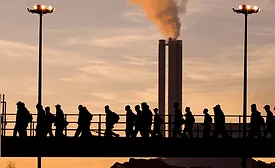
Once upon a time, dangers in the workplace focused solely on equipment issues or malfunctions. In today’s work environment you must be aware of other risks such as extreme weather conditions, internal threats and updates on the location of onsite construction.
Amy Chambers, MS, is a research engineer working in the NIOSH Spokane Mining Research Division. She joined NIOSH in July 2015.
Ms. Chambers seeks to ensure underground miners have a stable roof to work under. With a background in metallurgy, she is the lead engineer for corrosion research as part of a project to examine ground control (i.e., controlling the ground above an underground mine workspace) in metal mines.
The fear that a robot or computer could put workers in the unemployment line may be directly linked to some physical and mental health issues, says three Ball State University researchers and a Villanova University professor.
“County-level job automation risk and health: Evidence from the United States,” published in the journal Social Science and Medicine, found that exposure to automation risk may be negatively associated with health outcomes, plausibly through perceptions of poorer job security.
Frostbite results from exposure to severe cold. The nose, cheeks, ears, toes, and fingers are the parts most frequently frostbitten.
Symptoms: Frostbite is more likely to occur when a high wind is blowing that takes heat from the body rapidly. Usually frostbite is not associated with pain but rather with a feeling of intense coldness and numbness.
When the body is unable to cool itself through sweating, serious heat illnesses may occur. The most severe heat-induced illnesses are heat exhaustion and heat stroke. If actions are not taken to treat heat exhaustion, the illness could progress to heat stroke and possible death.
Severe combat wounds and chronic PTSD (posttraumatic stress disorder) may put service men and women at risk of having high blood pressure later, according to new research in the American Heart Association’s journal Hypertension.
PTSD, a mental health disorder that stems from a traumatic or life-threatening event, has been previously linked to risk of high blood pressure and other issues, including substance abuse, obesity, coronary artery disease, and suicide.
ACGIH® has released its 2018 editions of the TLVs® and BEIs® book and the Guide to Occupational Exposure Values.
The information in the user-friendly, pocket-sized TLVs® and BEIs® book is used worldwide as a guide for evaluation and control of workplace exposures to chemical substances and physical agents.
Will workers resist, due to privacy concerns, using wearables that capture a workers’ vitals?
Carina Santos, CEO, Logical Safety: Privacy concerns are at the tip of many peoples tongues at the moment.
 RSS
RSS