ISHN logo
search
cart
facebook twitter linkedin youtube
  • Sign In
  • Create Account
  • Sign Out
  • My Account
ISHN logo
  • NEWS
    • Today's News
    • Global Safety News
    • Government Regulations
  • PRODUCTS
    • Product Innovations
    • Featured Products
  • TOPICS
    • Environmental Health and Safety
    • Facility Safety
    • Workplace Health
    • Occupational Safety
    • PPE
    • More Topics
  • CONSTRUCTION
  • TECHNOLOGY
  • COLUMNS
    • Best Practices
    • Dave Johnson: What’s going on
    • Editorial Comments
    • Leading Safety
  • MULTIMEDIA
    • ISHN Podcast
    • Videos
    • Cold Stress Education Quiz
    • Webinars
    • White Papers
  • MORE
    • Buyer's Guide
    • Newsletters
    • Convention Companion
    • Polls
    • Events
    • ISHN Store
    • Sponsor Insights
  • EMAGAZINE
    • eMagazine
    • Archived Issues
    • Contact
    • Advertise
  • JOIN TODAY!
PPE

New glove testing standards

10 things you need to know
By Alex Carrillo-Hayley
ANSI/ ISEA and EN 388 glove testing processes
June 1, 2016

If you work in the health and safety industry, chances are that you’ve been hearing all of the buzz about the recent updates to the ANSI/ISEA and EN 388 glove testing processes and classifications. If you’re curious about what these changes will entail, you’ve come to the right place; we’ve compiled a list of the ten major things that you need to know about the new testing standards, and how they will affect you and your customers.

What you need to know

1. The first crucial thing you need to know is that these changes are designed to improve the accuracy of the testing by making it easier for glove manufacturers to replicate their testing results. For this reason, although you might be feeling a bit overwhelmed by the thought of having to alter your glove testing process, in the long run, these changes will result in an increase in employee safety in the workplace. The standards committee believes that these changes will make it easier for end users to choose appropriate work gloves for their industries, and consequently, help to lower the number of hand-related injuries in the workplace.

2. If you’re located in North America, the new ANSI/ISEA 105-2016 standard will be your main concern; the updates were officially approved in February 2016, and are therefore now in effect.

3. One of the main changes to the old ANSI/ISEA standard is the increase in the number of cut levels from five to nine. The ANSI/ISEA committee realized that since the old cut level 4 category covered such a large range (from 1500 to 3499 grams), dividing this large spectrum into smaller sections would result in more differentiation between products. The thought was that this change would benefit end users the most, since it would improve the overall accuracy of glove selection, and therefore, bring about a higher level of safety on the jobsite. For this reason, this change will also prevent end users from assuming that all gloves within the old cut level 4 category provide the same amount of cut protection.

4. In order to keep confusion to a minimum during this transitional stage, the new cut levels will now have an A in front of them, instead of just a number. (For example, a glove that offers 200 to 499 grams of cut protection will be rated ANSI level A1 for cut resistance).

5. Here are the cut test requirements for the new ANSI levels:

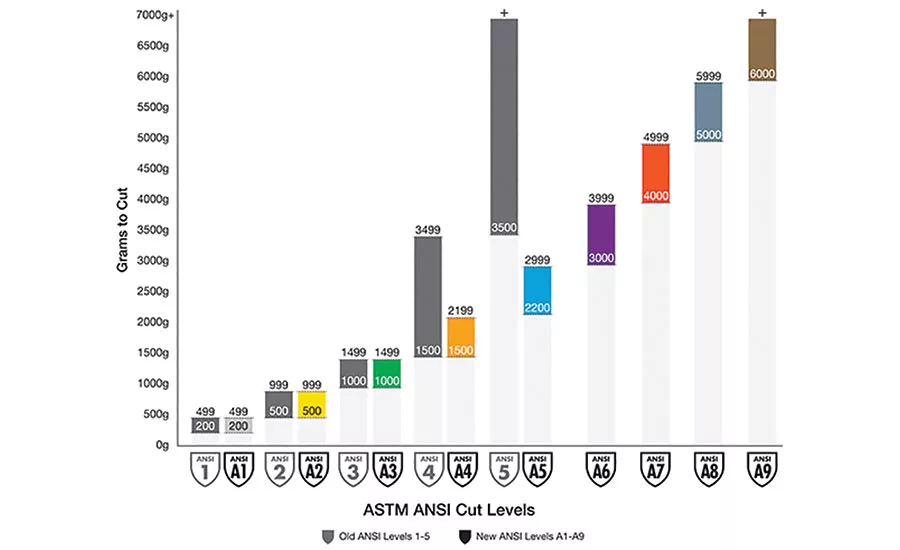
A1: 200-499 grams to cut

A2: 500-999 grams to cut

A3: 1000-1499 grams to cut

A4: 1500-2199 grams to cut

A5: 2200-2999 grams to cut

A6: 3000-3999 grams to cut

A7: 4000-4999 grams to cut

A8: 5000-5999 grams to cut

A9: 6000+ grams to cut

Wondering how the new cut levels compare to the old ones? See figure 1 for a comparison chart for reference.

6. Another significant change to the old ANSI/ISEA standard will be the addition of a new needle stick puncture test; by improving the way in which the levels of puncture resistance are classified, this will allow for a higher level of protection against puncture threats in the workplace. Also, since the ISO 13997 (TDM) machines generally produce much more consistent results than CPPT machines, the TDM machine is now the recommended testing machine for all future EN 388 and ANSI/ISEA testing. By encouraging everyone to use the same testing machine, the hope is that it will help standardize the way in which cut levels are assigned, meaning that test results from different glove manufacturing companies will be easier to interpret and compare.

7. The new EN 388 standard is the one that will directly affect European customers. While the changes to this standard are still currently pending review, they are expected to be approved during the summer of 2016. Note: Unless this standard becomes adopted by other countries in the future, these changes should only affect those living in the EU.

8. The EN 388 standard needs to be revised due to inconsistences with test results – especially with the cut and abrasion tests. For this reason, the main changes to the EN 388 standard will include the adoption of the ISO 13997 (TDM) cut test as the preferred testing method, the use of a different kind of abrasive paper to increase the accuracy of testing results, and the calculation of test results in Newtons instead of grams. The new EN 388 standard will also include testing for impact protection. For a greater level of consistency across the board, the last six EN 388 levels will also match the new ANSI/ISEA 105 levels, but the EN 388 levels will be designated using the letters A to F.

9. Here are the requirements for the new EN 388 levels:

A: 2 Newtons = 203 grams to cut

B: 5 Newtons = 509 grams to cut

C: 10 Newtons = 1019 grams to cut

D: 15 Newtons = 1529 grams to cut

E: 22 Newtons = 2243 grams to cut

F: 30 Newtons = 3059 grams to cut

10. Wondering when you’ll have to make these changes to your testing process? If you’re in North America, don’t stress: there isn’t currently a specific deadline for retesting your gloves under the new ANSI/ISEA 105-2016 standard. However, the sooner they’re retested, the better, since your gloves won’t be certified under the new standards until the testing is conducted. Since the new EN 388 standard is still pending approval, a deadline for retesting doesn’t currently exist. However, it is expected that there will be a mandatory testing deadline for European manufacturers in the future, so make sure you keep an eye out for it!

We hope you’re feeling more informed about what the major changes to the standards are and why they’re being made. Once they’re fully implemented, these new standards will make a world of difference: they’ll allow for a higher level of consistency among glove manufacturers, as well as greatly increase the accuracy of the testing processes overall. It is our hope that in the long run, these changes will result in a significant decrease in the number of hand-related injuries in the workplace as well.

KEYWORDS: American National Standards Institute (ANSI) cut protection work gloves

Share This Story

Looking for a reprint of this article?
From high-res PDFs to custom plaques, order your copy today!

Alex Carrillo-Hayley works in the Marketing department at Superior Glove Works Ltd: the four-time Canada’s Best Managed company and global leader in work glove manufacturing. She can be reached at alex.carrillo-hayley@superiorglove.com. Superior Glove offers a large selection of work gloves featuring Black Widow™ Micropore Nitrile. For more information about Superior Glove’s hand protection products, call (888) 428-1210, or visit www.superiorglove.com.

Recommended Content

JOIN TODAY
to unlock your recommendations.

Already have an account? Sign In

  • forklift safety

    Exploring the latest technologies in forklift safety

    With more staff and more stock in warehousing now more...
    Facility Safety
    By: Josh Cramer
  • welding

    All about welder’s flash or arc eye

    A flash burn is a painful inflammation of the cornea,...
    Environmental Health and Safety
  • dangerous jobs

    The 10 most dangerous jobs in the U.S.

    On-the-job deaths have been rising — hitting the highest...
    Construction Industry Safety and Health
    By: Benita Mehta
Manage My Account
  • eMagazine Subscriptions
  • ISHN Newsletter & Other Newsletter Alerts
  • Online Registration
  • Manage My Preferences
  • Subscription Customer Service

More Videos

Sponsored Content

Sponsored Content is a special paid section where industry companies provide high quality, objective, non-commercial content around topics of interest to the ISHN audience. All Sponsored Content is supplied by the advertising company and any opinions expressed in this article are those of the author and not necessarily reflect the views of ISHN or its parent company, BNP Media. Interested in participating in our Sponsored Content section? Contact your local rep!

close
  • man wearing the the Sundström SR200 Full Face Mask Respirator
    Sponsored byOHD

    5 Fit Testing Mistakes That Could Cost You

  • This image shows Magid AcuSpex polarized blue mirrored safety glasses.
    Sponsored byMagid Glove and Safety

    Construction PPE Guide: What Crews Need for Each Task

  • lone worker in confined space
    Sponsored byAlphasense Ltd.

    GET THE LEAD OUT of your Safety Oxygen Sensors!

Popular Stories

SpaceX 7 launch

OSHA Investigating Fatal Fall at SpaceX Starbase

Worker Impairment

How to Tell When a Co-Worker is Impaired? A Safety Pro’s Challenge

psychology in the workplace

Most Workplaces Measure Psychological Safety, Ignoring Psychosocial Risks

top 10 most dangerous jobs

Poll

Seasonal Readiness

With the federal heat stress prevention rule on the horizon, which area of your safety program needs the most attention?
View Results Poll Archive

Products

Surviving an OSHA Audit A Management Guide, 2nd Edition

Surviving an OSHA Audit A Management Guide, 2nd Edition

See More Products

ISHN Podcasts

Related Articles

  • ANSI/ ISEA and EN 388 glove testing processes

    New glove testing standards

    See More
  • NTSB to Coast Guard: Raise post-accident alcohol, drug testing standards

    See More
  • work glove palm coatings

    Your guide to glove palm coatings

    See More

Events

View AllSubmit An Event
  • December 10, 2014

    Proof Of Performance Testing For Industrial Ventilation Systems webinar

    This webinar will teach methods for testing IVSs as they pertain to the original design parameters. Topics include: indentifying published standards, selecting measuring equipment, identifying test locations, identifying proper techniques for airflow measurement, correcting field measurements for local conditions, interpreting field data compared to design data, and introduction to system balance techniques.
View AllSubmit An Event

Related Directories

  • New Pig

    The world leader in absorbent products, New Pig provides innovative products to help maintain cleaner, safer, more productive work environments.
  • Superior Glove

    Superior Glove is a leading innovator in the design and manufacture of safety gloves and sleeves. Since 1910, we have been protecting workers across the globe with specialized hand and arm protection for every major industry.
×

Become a Leader in Safety Culture

Build your knowledge with ISHN, covering key safety, health and industrial hygiene news, products, and trends.

JOIN TODAY
  • RESOURCES
    • Advertise
    • Contact Us
    • Directories
    • Manufacturing Division
    • Store
    • Want More
  • SIGN UP TODAY
    • Create Account
    • eMagazine
    • Newsletters
    • Customer Service
    • Manage Preferences
  • SERVICES
    • Marketing Services
    • Reprints
    • Market Research
    • List Rental
    • Survey/Respondent Access
  • STAY CONNECTED
    • LinkedIn
    • Facebook
    • YouTube
    • X (Twitter)
  • PRIVACY
    • PRIVACY POLICY
    • TERMS & CONDITIONS
    • DO NOT SELL MY PERSONAL INFORMATION
    • PRIVACY REQUEST
    • ACCESSIBILITY

Copyright ©2026. All Rights Reserved BNP Media, Inc. and BNP Media II, LLC.

Design, CMS, Hosting & Web Development :: ePublishing