Shelter from lethal projectiles
Here’s an engineering strategy for dropped object protection
Dropped object protection (DOP) exists to protect pedestrians and workers during construction and demolition. But the scope of implementation differs greatly from project to project or industry to industry. There’s an opportunity to advance safety and cost effectiveness by challenging old assumptions and developing collaborative and innovative solutions.
A recently implemented DOP canopy on a Canadian offshore gravity-based oil platform (GBS) is an example of how collaboration with a contractor on a consultative basis yielded advanced safety at reduced cost for the contractor. The design now benefits several other industries, including petrochemical facilities, processing facilities, power plants and commericial construction sites.
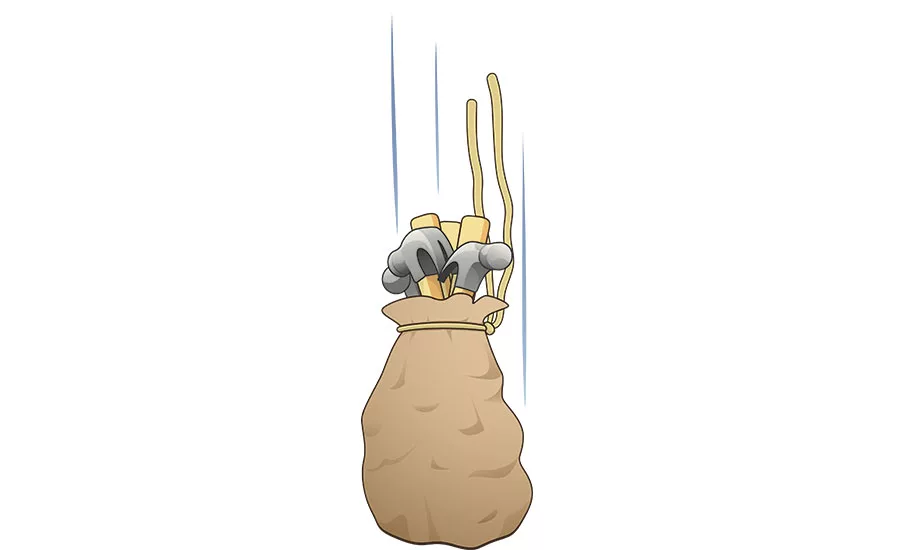
In this instance, the contractor identified that it wanted to protect workers and equipment from a five-pound hammer falling from a height of more than 200 feet.
Along with workers at the bottom of the GBS, ballast piping that controls water flow also required maximum DOP protection. Failure of this equipment could sink the vessel. Plus, all DOP systems had to be swiftly removed after work was completed. Once removed, the center shaft would be flooded to approximately 270 feet so that the structure would sink and hold firmly to the ocean floor.
A third way
Traditional DOP canopies use some variation of wood and/or steel combination. This contractor’s traditional DOP design consisted of two layers of wood plank and a layer of steel plate. While wood has high impact strength, it has little punching shear strength, meaning it offers little protection from “missiles” such as falling rebar. The steel layer provided shear strength but with significant burden of labor and material handling.
To review merits of various DOP options, let’s first review the system as a whole. Potential energy is mass x height x acceleration (E potential = mgh). Kinetic energy is (mass x velocity2) divided by 2 (E kinetic = (mv2)/2). Thus, an object with a mass of 2.3 kg (e.g., a five-pound hammer) dropped from a height of more than 200 feet has potential energy of 1580 Joules and an impact velocity of 37 m/s.
Crucial here is how this energy is absorbed. Consider two eggs dropped one meter: one on a stone and another on deep pile carpet. The egg falling on stone breaks, but the egg falling on deep pile carpet is unharmed. Both mass and fall height and thus potential energy are identical. The difference is the rate of deceleration. Decelerating the egg significantly altered the results.
DOP strategies are subject to this same principle. But in this case we’re not trying to preserve the egg or dropped object, but protect those below. Still, the principle stands because action = reaction. So gently decelerating the object will significantly reduce the impulse force the canopy must absorb. Immediately, you see the value of debris nets with their massive capacity to deflect and thus decelerate falling objects.
Returning to the GBS case, the traditional design had the cons of high costs of labor and material handling. Each section of wood-steel DOP canopy would have weighed about 500 pounds, and moving them in place would require horizontal and vertical travel distances of more than 200 feet each, assisted by cranes and other machinery.
Nets follow logically as a standard alternative. But nets have requirements or burdens of their own. These include vertical clearance to permit deflection, sometimes complicated support assemblies and, in this case, wind load.
A new design
To create the new canopy, a bottom layer of plywood was covered with two layers of Kevlar fabric oriented at 90 degrees to each other. A top layer of plywood secured the “sandwich” using six screws (one on each corner and one in the middle of each side of the long section), permitting easy disassembly. Aluminum joists about 11 inches apart supported the sandwich layers. The stiffness and compactness of traditional DOP canopies were combined with the object trapping and deceleration of nets via the fabric.
To test the new DOP, objects were dropped from about 100 feet, the height available at the test facility. The DOP easily stopped five-pound hammers and a six-foot section of rebar. The rebar did punch through the plywood, but it only pulled the Kevlar fabric through the bottom plywood less than an inch for a deceleration distance of about two inches.
Note that while the installed DOP uses two layers of Kevlar, engineers calculated that a single layer of Kevlar, no heavier than blue jeans, would be sufficient to trap the specified object.
Lighter, cheaper, safer
While protecting workers and the GBS ballast system, the plywood-Kevlar canopy also reduced weight by 78 percent compared to the wood plank-steel canopy. Two men can easily move the DOP, and it can be lowered by rope instead of a crane. In addition, Kevlar costs one-third the price of steel. But the best bonus was increased safety.
The wood plank-steel DOP would have to have been disassembled and the steel cut in sections for removal, requiring huge amounts of labor. Considering that 50 percent of accidents occur in material handling, a plywood-Kevlar-wood DOP panel that simplifies material handling creates safer overall jobsite.
Middle ground
Finding the best canopy solution for the GBS only occurred because of extensive two-way communication between the developer and the contractor. In this case, the two companies had a long and successful working relationship, which generated a high degree of trust. That’s not always the case, and in new relationships, a contractor might be tempted to simply specify a pre-designed and pre-engineered DOP solution. But an off-the-shelf solution might not be the right solution.
For example, an off-the-shelf solution might be primarily designed to meet the requirements set by International Building Codes (IBC) for public areas and by OSHA for the workplace. Say a particular canopy in a particular situation is required to handle a static load of 4.8 kPa (100 psf). But the impact load from a falling object, if concentrated in a very small area (such as with a piece of rebar) has a much greater force.
Of course, a sturdier canopy could be designed, but that could also increase the cost of the solution. Balancing the relationships between protection, cost and compliance can be a tricky line to walk. The key is to analyze a site’s unique hazards to provide the optimum solution.
Looking for a reprint of this article?
From high-res PDFs to custom plaques, order your copy today!