ANSI/ISEA Z358.1 -2014 Emergency eyewash and shower equipment
Why this standard is important
This standard establishes minimum performance and use requirements for eyewash and shower equipment for the emergency treatment of the eyes or body of a person who has been exposed to hazardous materials. It covers the following types of equipment: emergency showers, eyewashes, eye/face washes, and combination units.
Emergency Showers
Performance: A means shall be provided to ensure that a controlled flow of flushing fluid is provided at a velocity low enough to be non-injurious to the user.
- Emergency showers shall be capable of delivering flushing fluid at a minimum of 75.7 liters per minute (20 gpm) for a minimum of 15 minutes. If shut-off valves are installed in the supply line for maintenance purposes, provisions shall be made to prevent unauthorized shut off.
- Emergency showers shall provide a flushing fluid column that is at least 208.3 cm (82 in.) and not more than 243.8 cm (96 in.) in height from the surface on which the user stands.
- The spray pattern shall have a minimum diameter of 50.8 cm (20 in.) at 152.4 cm (60 in.) above the surface on which the user stands, and the center of the spray pattern shall be located at least 40.6 cm (16 in.) from any obstruction. The flushing fluid shall be substantially dispersed throughout the pattern.
- Emergency showers shall be designed, manufactured and installed in such a manner that, once activated, they can be used without requiring the use of the operator’s hands.
- Emergency showers shall be constructed of materials that will not corrode in the presence of the flushing fluid. Stored flushing fluid shall be protected against airborne contaminants.
Installation:
It is the installer’s responsibility to ensure that emergency showers shall:
- Be assembled and installed in accordance with the manufacturer's instructions, including flushing fluid delivery requirements.
- Be in accessible locations that require no more than 10 seconds to reach. The emergency shower shall be located on the same level as the hazard and the path of travel shall be free of obstructions that may inhibit its immediate use. (See Appendix B5)
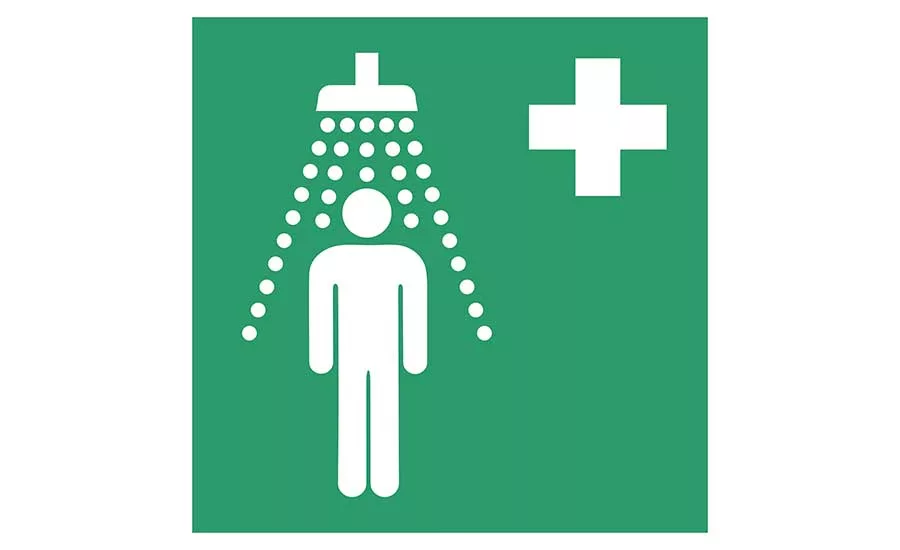
- Be located in an area identified with a highly visible sign positioned so the sign shall be visible within the area served by the emergency shower. The area around the emergency shower shall be well-lit.
- •Be positioned so that the shower pattern is dispersed such that the top of the flushing fluid column is at least 208.3 cm (82 in.) and not more than 243.8 cm (96 in.) from the surface on which the user stands. The center of the spray shall be at least 40.6 cm (16 in.) from any obstruction.
- Be connected to a supply of flushing fluid per the manufacturer’s installation instructions to produce the required spray pattern for a minimum period of 15 minutes. Where the possibility of freezing conditions exists, the emergency shower shall be protected from freezing or freeze-protected equipment shall be installed. If shut-off valves are installed in the shower line for maintenance purposes, provisions shall be made to prevent unauthorized shut off.
- Deliver tepid flushing fluid. In circumstances where chemical reaction is accelerated by flushing fluid temperature, a facilities safety/health advisor should be consulted for the optimum temperature for each application.
- When the plumbed emergency shower is installed, its performance shall be verified in accordance with the following procedures: (1) With the unit correctly connected to the flushing fluid source and the valve(s) closed, visually check the piping connections for leaks. (2) Open the valve to the full open position. The valve shall remain open without requiring further use of the operator's hands. (3) With the valve in the fully opened position, measure the diameter of the spray pattern. It shall be a minimum of 50.8 cm (20 in.) at 152.4 cm (60 in.) above the standing surface. The flushing fluid shall be substantially dispersed throughout the pattern.(4) Using the flowmeter or other means, determine that the rate of flow is at least 75.7 liters per minute (20 gpm). (5) Using a temperature gauge or other means, determine that the flushing fluid is tepid.
- When the self-contained emergency shower is installed, its installation shall be verified in accordance with manufacturer’s instructions.
Maintenance and Training:
Manufacturers shall provide operation, inspection and maintenance instructions with emergency shower equipment. Instructions shall be readily accessible to maintenance and training personnel.
- Plumbed emergency showers shall be activated weekly for a period long enough to verify operation and ensure that flushing fluid is available.
- Self-contained emergency showers shall be visually checked weekly to determine if flushing fluid needs to be changed or supplemented. Such inspection shall be conducted in accordance with manufacturer’s instructions.
- Employees who may be exposed to hazardous materials shall be instructed in the location and proper use of emergency showers.
- All emergency showers shall be inspected annually to assure conformance with this standard.
Eyewash Equipment
Performance:
A means shall be provided to ensure that a controlled flow of flushing fluid is provided to both eyes simultaneously at a velocity low enough to be non-injurious to the user.
- The eyewash shall be designed and positioned in such a way as to pose no hazard to the user.
- Nozzles and flushing fluid units shall be protected from airborne contaminants. Whatever means is used to afford such protection, its removal shall not require a separate motion by the operator when activating the unit.
- Eyewashes shall be designed, manufactured and installed in such a manner that, once activated, they can be used without requiring the use of the operator’s hands.
- Eyewashes shall be constructed of materials that will not corrode in the presence of the flushing fluid.
- Eyewashes shall be capable of delivering flushing fluid to the eyes not less than 1.5 liters per minute (0.4 gpm) for 15 minutes. If shut-off valves are installed in the supply line for maintenance purposes, provisions shall be made to prevent unauthorized shut off.
- Eyewashes shall be designed to provide enough room to allow the eyelids to be held open with the hands while the eyes are in the flushing fluid stream.
- Eyewashes shall provide flushing fluid to both eyes simultaneously. A test gauge for making determination of a suitable eyewash pattern shall be a minimum 10.16 cm (4 in.) in length with two sets of parallel lines equidistant from the center. The interior set of lines shall be 3.18 cm (1.25 in.) apart and the exterior lines shall be 8.26 cm (3.25 in.) apart. Place the gauge in the stream of the eyewash. The flushing fluid shall cover the areas between the interior and exterior lines of the gauge at some point less than 20.3 cm (8 in.) above the eyewash nozzle(s).
Maintenance and Training:
Manufacturers shall provide operation, inspection and maintenance instructions with eyewashes. Instructions shall be readily accessible to maintenance and inspection personnel.
- Plumbed eyewashes shall be activated weekly for a period long enough to verify operation and ensure that flushing fluid is available.
- Self-contained eyewashes shall be visually checked weekly to determine if flushing fluid needs to be changed or supplemented. Such inspection shall be conducted in accordance with manufacturer’s instructions.
- Employees who may be exposed to hazardous materials shall be instructed in the location and proper use of emergency eyewashes.
- All eyewashes shall be inspected annually to assure conformancewith this standard.
Sponsor: www.hawsco.com, 1-888-640-4297

Looking for a reprint of this article?
From high-res PDFs to custom plaques, order your copy today!


