A NIOSH Science Blog post
The engineers behind NIOSH’s respirator approval process
| This week is National Engineers Week which is dedicated to ensuring a diverse and well-educated future engineering workforce by increasing understanding of and interest in engineering and technology careers. The National Institute for Occupational Safety and Health (NIOSH) employs over 200 engineers and engineering technicians who identify, evaluate, develop, and implement engineering control technology to prevent occupational disease and injury. NIOSH engineers cover various disciplines including: biomedical, civil, chemical, computer, electrical, industrial, mechanical, mining, and safety engineering. Engineers are an important part of public health efforts. Many of the solutions developed by NIOSH engineers are adopted by industry, saving the lives and improving the health of American workers. To honor our engineers, the blog will highlight examples of their work throughout the week. |
One of the primary functions of the National Institute for Occupational Safety and Health's (NIOSH) National Personal Protective Technology Laboratory (NPPTL) is to approve respirators for use in occupational settings by evaluating them for conformance to the requirements found within Title 42, Code of Federal Regulations, Part 84 (42 CFR 84).
Respirators are used in many industries such as healthcare, agriculture, mining, and emergency response. Because each respirator must pass the NIOSH respirator approval process before being introduced to the workplace, users can depend on their respirators to keep them safe.
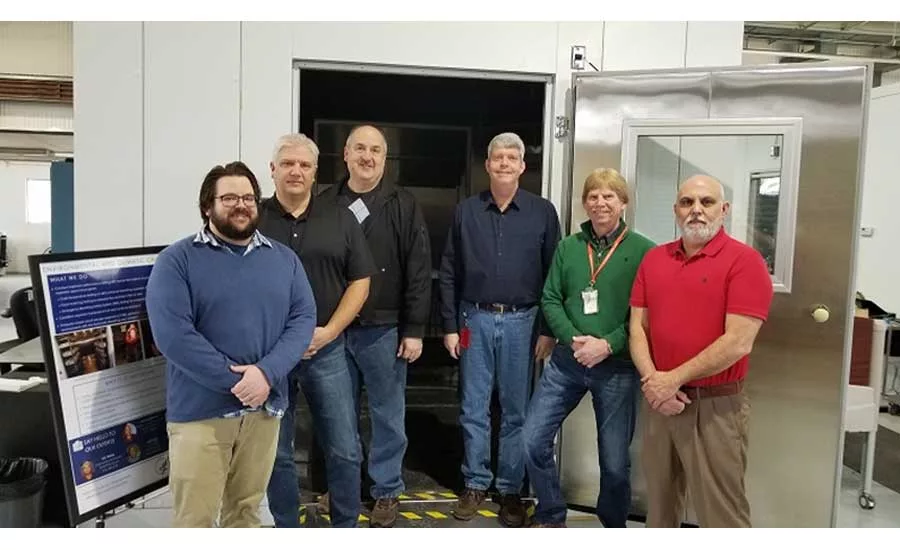
(Pictured above: Aaron Reeder, Jeff Palcic, Jon Szalajda, John Powers, Gary Walbert, Bill Monaghan.)
You know that your respirator should be NIOSH-approved. But what does that mean? Have you ever wondered what is involved in evaluating these respirators or who does those evaluations and tests?
When a manufacturer wants to produce and sell a respirator to be used in the workplace, the respirator must first be submitted to NIOSH and pass a series of design suitability, quality assurance, and laboratory performance procedures in order to receive NIOSH approval. Engineers are involved in every step of the process. To use Closed-Circuit Escape Respirators (CCERs) as an example, NPPTL engineers work as part of a team with physical scientists, quality assurance specialists, and technicians to review the applications, evaluate the quality program, and conduct approval tests through the evaluation of oxygen delivery capacity and stressors, such as inhaled oxygen, inhaled carbon dioxide, breathing resistance, and wet bulb temperature. These tests are conducted on an Automated Breathing Metabolic Simulator (ABMS), which is a machine that replicates the act of breathing (respiratory frequency, breath volume, flow, temperature, and humidity), oxygen consumption, and carbon dioxide production.
The ABMS is useful for both research and NIOSH approval testing of CCERs that are used for mining, naval, and industrial confined spaces. It allows the team to run a repeatable test without the use of human subjects. NPPTL engineers and their colleagues who operate the ABMS also collect and test respirators from mines and the Navy for after market surveillance and reporting through the Long-Term Field Evaluation (LTFE) project. The LTFE project studies the long-term storage and deployment effects on CCER performance through testing conducted on the ABMS. Reports on findings from this project are prepared and disseminated to stakeholders to provide input on the long-term reliability and effectiveness of CCERs.
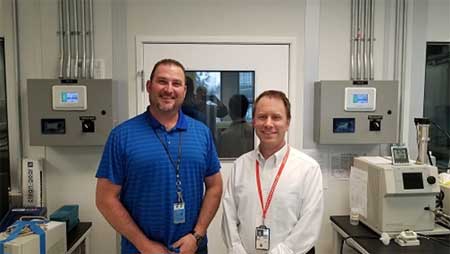 (At right: Charlie Wolfe and James Harris)
The dedicated engineers in NPPTL who have backgrounds in chemical, electrical, industrial, mechanical, and safety engineering, have a wide array of responsibilities in the respirator approval process, including calibrating equipment, reviewing the technical specifications of the equipment, running the tests, analyzing the data, writing test reports, and creating and updating standard test procedures and laboratory standard operating procedures. Engineers in the Laboratory also collaborate with their colleagues to develop new standards, develop test procedures to take advantage of new state-of-the-art test equipment, troubleshoot test equipment issues, and formulate replacement plans for aging test equipment. Should a product fail when used in the workplace, the team is also involved with investigating those product failures.
So next time you don your respirator at work, remember the engineers who have worked to help ensure your respirator is protecting you.
Click here to visit the NIOSH Science Blog web page and use the Comments section to share examples of workplace safety and health problems that engineers in your organization have helped solve.
Looking for a reprint of this article?
From high-res PDFs to custom plaques, order your copy today!