Labels must stick: Who knows what lurks in unidentified containers?
A chemistry professor wanted his students to learn the importance of ensuring the identity of each the chemicals that they would be using in the laboratory before adding them to any experiment. He placed petri dishes of seven white substances in front of them: salt, granulated sugar, flour, baking soda, corn starch, confectioner’s sugar and coffee creamer.
Using only their visual appearance in each dish, the students were asked to determine what each substance was. None of the students was able to correctly identify all seven compounds. The professor used this demonstration to remind each student that many chemicals look the same, and using the wrong one can have serious consequences. One way to avoid this is to check the container’s label every time a product is used.
In the workplace, using the wrong chemical in a process can also have dire consequences. In addition to physical hazards that can occur when the wrong chemicals are mixed, some chemicals that are used every day in industry can have serious health effects if they are not stored, handled and used correctly.
To help prevent injuries and deaths from working with hazardous chemicals, OSHA requires employers to establish a hazard communication program [29 CFR 1910.1200.] This program must identify all of the hazardous chemicals and compounds used in the workplace so that they can be communicated with employees. The hazard communication standard also requires employers to maintain safety data sheets, train employees and to ensure that all containers are properly labeled.
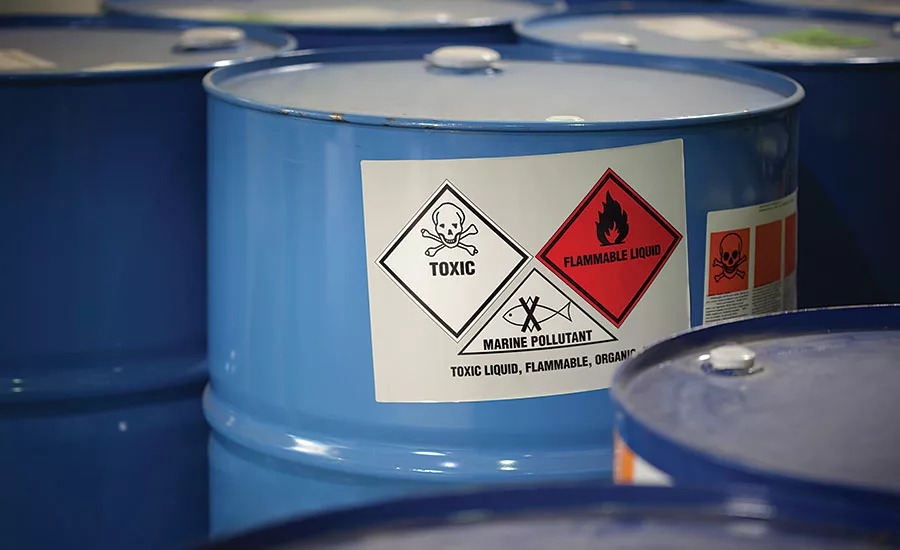
Training and proper container labeling helps to ensure that employees understand a product’s associated hazards as well as any special precautions that need to be taken to handle and use it safely. The information on a container’s label serves as a visual reminder each time the product is in use.
OSHA requires all containers of hazardous chemicals used in the workplace to be labeled with the name of the product; the manufacturer’s name, address and telephone number; pictogram(s); signal words, precautionary statements and first aid information; and hazard statements. Labels must be in English and must be legible.
Employees who have received hazard communication training sometimes ask why all containers don’t have pictograms, signal words, precautionary and hazard statements on them if OSHA requires it. One reason is that OSHA only governs workplace hazards. Products that are used in homes do not fall under OSHA’s jurisdiction. OSHA was also clear about several other types of container labeling that are exempted from the hazard communication standard because they are governed by other regulatory bodies which have their own methods of communicating necessary product and hazard information [29 CFR 190.1200(b)].
EPA
The Environmental Protection Agency (EPA) governs hazardous wastes under the Resource Conservation Recovery Act (RCRA). These regulations require facilities that generate wastes to determine whether each of their waste streams are hazardous. Small and large quantity generators of hazardous waste must ensure that containers of hazardous waste are correctly marked so that employees and anyone else that eventually handles the container is aware of its contents and hazards.
This marking must include the words “hazardous waste”, all applicable EPA waste codes, and verbiage identifying the hazards of the contents. Hazardous wastes stored in central accumulation areas must also have an accumulation start date on the container. Before the container leaves the facility, it must also comply with DOT marking and labeling requirements.
DOT
The Pipeline and Hazardous Materials Safety Administration (PHMSA) sets and enforces DOT standards for the safe transportation of hazardous materials by land, rail, air, sea and pipeline. To identify hazardous materials shipments, vehicle placards, hazardous materials manifests, and container marks and labels are all utilized.
The DOT requires all personnel involved with the shipment of hazardous materials to be properly trained. This training includes correctly marking and labeling hazmat containers for shipment. Marking and labeling includes the use of correct hazard pictograms as well as verbiage including the proper shipping name and UN identification numbers; the name, address and phone number of the shipper; hazard label(s).
FIFRA
Pesticides are governed under the Federal Insecticide, Fungicide and Rodenticide Act (FIFRA). These regulations require pesticide manufacturers to clearly and legibly mark pesticide containers with the name of the product; it’s registration code; the name, address and phone number of the manufacturer or distributor; storage, use and disposal information; ingredients; hazard and precautionary statements.
TSCA
Asbestos, lead-based paint, PCBs and formaldehyde are all governed under the Toxic Substances Control Act (TSCA). This act regulates these and other chemicals and mixtures that present “unreasonable risks,” requiring hazard warning labels, and in some cases banning the products from being manufactured, produced or distributed in commerce.
Signs, placards, batch tickets and warning labels may all be used to identify TSCA hazards. They must be legible, in English and not conflict with any other required labels. Identification must include the manufacturer’s name, the identity of the substance, health hazards and precautionary statements [40 CFR 721.72].
FDA
Part of the Department of Agriculture, the Food and Drug Administration (FDA) governs foods, food additives, color additives, drugs, cosmetics, medical and veterinary devices and products under the Federal Food, Drug and Cosmetic Act.
This act requires most foods to have nutritional labeling, ingredient listings and information about allergens. The name and address of the manufacturer, packer or distributor must also be included. [21 CFR 101].
CPSC
The Consumer Product Safety Commission (CPSC) enforces the correct use of precautionary labeling on containers of hazardous products being sold to households. This labeling must help consumers safety store and use hazardous products, and provide them with first aid information to use if an incident happens.
The Federal Hazardous Substance Act (FHSA) outlines the requirements for precautionary labeling on consumer products, and bans certain types of highly hazardous products from consumer sale and use. Products that are toxic, corrosive, flammable, combustible, irritating, sensitizing or that generate pressure through heat or decomposition; and that could cause substantial personal injury or illness must be correctly labeled.
No matter where products are used, stored or shipped; container labels help communicate information. This information helps people to make informed decisions about the use of the product as well as any precautions that they may need to take to ensure their own personal safety. It can also avoid costly and dangerous mishaps caused by inadvertently using the wrong product.
Looking for a reprint of this article?
From high-res PDFs to custom plaques, order your copy today!



.webp?t=1721257160 "download (1).jpg")