2019 top standards- OSHA Most Frequently Violated Standards
OSHA powered industrial truck standard
Powered Industrial Trucks (1910.178)
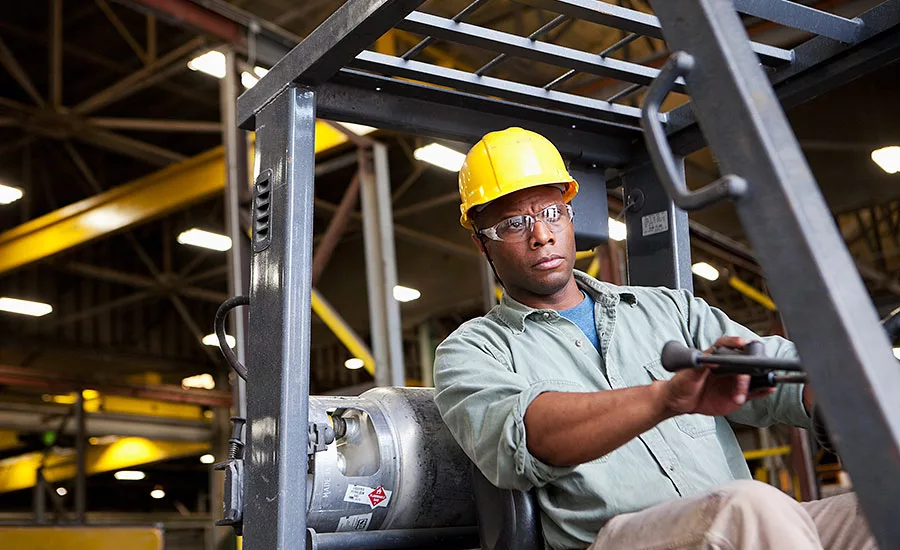
OSHA’s powered industrial trucks standard was the seventh-most-frequently cited agency standard in FY 2018.
Enforcement citations FY 2018: 1,949
Number of inspections: 1,397
Proposed penalties: $5,776,866
Most frequently cited industries
- Manufacturing
- Wholesale trade
- Construction
- Transportation and warehousing
- Retail trade
- Waste management and remediation services
- Services
Enforcement case studies
- Acting on an employee complaint, OSHA issued proposed penalties of $258,672 in connection with a citation issued to Rural King Supply, Inc. of Xenia, Ohio for allowing workers to operate defective forklifts.
OSHA issued two willful violations of $129,336 each for the alleged forklift operation deficiencies. According to OSHA, Rural King Supply, Inc. did not repair a forklift that had been repeatedly inspected and reported to have defective brakes. OSHA also claims Rural King Supply, Inc. did not at least remove the forklift from service until effective repairs could restore the truck to a safe operating condition.
Employers should be reminded that any issue that is noted on a pre-shift forklift inspection should be taken seriously, and if the finding is something that could affect the safe operation of the forklift, repairs should be made immediately or the forklift must be taken out of service until repairs can be made. Remember, “safe” means different things to different people, so if in doubt, consider what “safe” would mean to and OSHA compliance officer when determining if the deficiency could affect the safe operation of the forklift. - In 2016, OSHA fined the U.S. Postal Service (USPS) $88,000 in proposed penalties for unsafe forklift operations at its Urbandale, Iowa, distribution center.
The citations arose from an investigation following a complaint that alleged forklift operators were handling unstable loads and driving forward with no clear path of visibility.
OSHA said USPS failed to take actions including appropriate training, instruction, visual observation and other means when a forklift operator was involved in an accident or near miss. OSHA said operators were moving loads of an excessive size that routinely created off-center loads. It said operators were not ensuring loads were safely arranged and also were not reducing speed to a safe level while negotiating turns to prevent the load from shifting, rocking and then tipping off the forks, exposing other employees to struck-by hazards.
Background
OSHA statistics indicate that there are roughly 85 forklift fatalities and 34,900 serious injuries each year, with 42 percent of the forklift fatalities from the operators being crushed by a tipping vehicle.
Hazard protection
Hazards commonly associated with powered industrial trucks vary depending on the vehicle type and the workplace where the truck is used. Each type of truck presents different operating hazards. For example, a sit-down, counterbalanced high lift rider truck is more likely than a motorized hand truck to be involved in a falling load accident, because the sit-down rider truck can lift a load much higher than a hand truck. Workplace conditions also present different hazards. For example, retail establishments often face greater challenges than other worksites in maintaining pedestrian safety.
Key powered industrial trucks
standard takeaways:
- Safety requirements relate to fire protection, design, maintenance, and use of fork trucks, tractors, platform lift trucks, motorized hand trucks, and other specialized industrial trucks powered by electric motors or internal combustion engines. The standard does not apply to compressed air or nonflammable compressed gas-operated industrial trucks, or to farm vehicles, or to vehicles intended primarily for earth moving or over-the-road hauling.
- All new powered industrial trucks acquired and used by an employer shall meet the design and construction requirements for powered industrial trucks established in the American National Standard for Powered Industrial Trucks, Part II, ANSI B56.1-1969.
- Modifications and additions, which affect capacity and safe operation, shall not be performed by the customer or user without the manufacturer’s prior written approval. Capacity, operation, and maintenance instruction plates, tags, or decals shall be changed accordingly.
- Power-operated industrial trucks shall not be used in atmospheres containing hazardous concentration of acetylene, butadiene, ethylene oxide, hydrogen (or gases or vapors equivalent in hazard to hydrogen, such as manufactured gas), propylene oxide, acetaldehyde, cyclopropane, diethyl ether, ethylene, isoprene, or unsymmetrical dimethyl hydrazine (UDMH).
- Power-operated industrial trucks shall not be used in atmospheres containing hazardous concentrations of metal dust, including aluminum, magnesium, and their commercial alloys, other metals of similarly hazardous characteristics, or in atmospheres containing carbon black, coal or coke dust except approved power-operated industrial trucks designated as EX may be used in such atmospheres.
- The employer shall ensure that each powered industrial truck operator is competent to operate a powered industrial truck safely, as demonstrated by the successful completion of the training and evaluation specified.
- Training shall consist of a combination of formal instruction (e.g., lecture, discussion, interactive computer learning, video tape, written material), practical training (demonstrations performed by the trainer and practical exercises performed by the trainee), and evaluation of the operator's performance in the workplace.
- Refresher training in relevant topics shall be provided to the operator when:
- The operator has been observed to operate the vehicle in an unsafe manner;
- The operator has been involved in an accident or near-miss incident;
- The operator has received an evaluation that reveals that the operator is not operating the truck safely;
- The operator is assigned to drive a different type of truck; or
- A condition in the workplace changes in a manner that could affect safe operation of the truck.
- An evaluation of each powered industrial truck operator's performance shall be conducted at least once every three years.
- Trucks shall not be driven up to anyone standing in front of a bench or other fixed object.
- No person shall be allowed to stand or pass under the elevated portion of any truck, whether loaded or empty.
- Unauthorized personnel shall not be permitted to ride on powered industrial trucks. A safe place to ride shall be provided where riding of trucks is authorized.
- The employer shall prohibit arms or legs from being placed between the uprights of the mast or outside the running lines of the truck.
- When a powered industrial truck is left unattended, load engaging means shall be fully lowered, controls shall be neutralized, power shall be shut off, and brakes set. Wheels shall be blocked if the truck is parked on an incline.
- A powered industrial truck is unattended when the operator is 25 feet or more away from the vehicle which remains in his view, or whenever the operator leaves the vehicle and it is not in his view.
- The driver shall be required to slow down and sound the horn at cross aisles and other locations where vision is obstructed. If the load being carried obstructs forward view, the driver shall be required to travel with the load trailing.
- Under all travel conditions the truck shall be operated at a speed that will permit it to be brought to a stop in a safe manner.
- Stunt driving and horseplay shall not be permitted.
- Running over loose objects on the roadway surface shall be avoided.
- While negotiating turns, speed shall be reduced to a safe level by means of turning the hand steering wheel in a smooth, sweeping motion. Except when maneuvering at a very low speed, the hand steering wheel shall be turned at a moderate, even rate.
- An overhead guard shall be used as protection against falling objects. It should be noted that an overhead guard is intended to offer protection from the impact of small packages, boxes, bagged material, etc., representative of the job application, but not to withstand the impact of a falling capacity load.
Looking for a reprint of this article?
From high-res PDFs to custom plaques, order your copy today!